Wednesday, 28 August 2019

Germany’s Greens Are Looking East

CHEMNITZ, Germany—One year ago, violent anti-immigrant protests turned this German city near the Czech border into a worldwide symbol of racial intolerance.

But on a recent summer evening, under the massive Karl Marx monument that served as a meeting point for far-right marchers back in 2018, hundreds of residents turned out to cheer on a politician with a very different message.

Robert Habeck, the 49-year-old leader of the German Greens and, according to some polls, the most popular politician in the country, ahead of Chancellor Angela Merkel, is taking his party’s progressive message on climate change and social cohesion to the heart of the former Communist East ahead of three state elections here that could shake up German politics and resonate beyond the country’s borders.
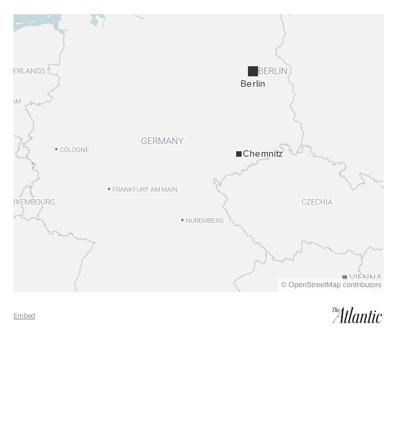
Chemnitz, in the state of Saxony, is hostile territory for the Greens. When the state votes on Sunday (the neighboring region of Brandenburg will hold an election on the same day, followed by Thuringia at the end of October), the big winner is expected to be the far-right Alternative for Germany (AfD).

But the emergence of the Greens as an influential player in eastern Germany is an overlooked subplot. In past elections, the party was happy if it scraped over the 5 percent threshold needed to make it into the regional parliament. Now, following a dizzying rise in national polls that has put the Greens nearly level with Merkel’s conservatives, the party is aiming higher. Its new leadership duo, Habeck and Annalena Baerbock, have been hitting the campaign trail with abandon, holding town halls and open-air events in eastern cities that are drawing record crowds.

Read more: [The far right isn’t the only rising force in Germany]

The evening before Habeck spoke here, he held a campaign event in a renovated former gas-storage facility in Zwickau, a city that served as the base of an underground neo-Nazi cell that murdered scores of people with immigrant backgrounds in the early 2000s. Organizers of the Zwickau event had planned for 250 people to show up. Instead, nearly twice that amount came. “You do realize you’re at a Greens event I hope,” Habeck joked as the crowd packed in.

Polls put support for the Greens at roughly 11 percent in Saxony and Thuringia, and at 14 percent in Brandenburg, hardly dominant numbers but roughly double the party’s results five years ago. The AfD, despite its strength, has little hope of governing in any of these three eastern states, because other parties have ruled out forming a coalition with it. The Greens, by contrast, could end up being part of the government in all three regions.

“These are extremely important elections for Germany. Thirty years after reunification, we are debating whether the country will be divided once again,” Habeck told me before his campaign appearance in Zwickau. “If the people here in eastern Germany show they trust us … it will show that our ideas have a much broader appeal.”

Indeed, if the Greens, who have traditionally drawn support from well-to-do, left-leaning urban voters, can lure people in less affluent, rural states, it will prove that concerns about climate change, fueled by record summer temperatures across Europe, are spreading to new corners of the electorate, with potentially far-reaching implications for the political landscape in Germany and beyond.

The rise of the Greens—and of the AfD—is also a story about the decline of Germany’s Volksparteien, the centrist parties that have dominated politics since World War II and that now rule together in Merkel’s listless “grand coalition” in Berlin. Disastrous results for the center-left Social Democrats (SPD) next month could trigger a collapse of her coalition, some analysts believe, forcing early national elections that would end Merkel’s 14-year reign and likely vault the Greens back into the federal government, where they ruled once before, as the junior partner of the SPD from 1998 to 2005.

Read more: [The slow death of Europe’s traditional center]

Habeck, a writer turned politician who has wrapped his party’s climate-first agenda in a feel-good narrative of economic renewal, could then become Germany’s next chancellor.

“Habeck is a friendly new face. People like what he says,” Frank Decker, a political scientist at the University of Bonn, told me. “And Merkel won’t be running again. That is a game changer.”

In their early years, the Greens saw themselves as more of a grassroots movement than a party. When they made it into the federal Parliament for the first time, in 1983, three years after their founding, freshly minted Green lawmakers showed up in the Bundestag dressed in jeans, sneakers, and colorful hand-knit sweaters—an image that captured Germany’s shifting political landscape and that remains embedded in the country’s collective memory to this day.

Back then, the Greens were intent on removing U.S. cruise missiles from West German soil, putting an end to nuclear power, and stopping deforestation and acid rain. When the Berlin Wall collapsed, they badly misjudged the national mood. (Their slogan in the 1990 election was “Everyone is talking about Germany. We’re talking about the weather.”) For the establishment parties, and much of the electorate, particularly in eastern Germany, they were scary, tree-hugging peaceniks.

Within two decades, however, they had entered the mainstream and were sharing power in Bonn (and later Berlin) with Chancellor Gerhard Schröder’s Social Democrats. Joschka Fischer, their longtime leader, became foreign minister and, in a sign of the party’s evolving realism, persuaded his colleagues to back the deployment of German troops to the Balkans, the country’s first foreign military mission since World War II.

When Fischer retreated from politics after Schröder’s loss to Merkel in 2005, long-simmering tensions between the party’s pragmatist Realo and more radical Fundi wings broke out into the open. A low point was the federal election campaign of 2013. Thanks to their opposition to nuclear power, the Greens seemed poised to benefit from the Fukushima disaster in Japan two years earlier. Instead they floundered, ridiculed for their plan to force school cafeterias to introduce a “Veggie Day” and haunted by their history of loose sexual morals in the 1970s, after excerpts from a book came to light in which the veteran Green politician Daniel Cohn-Bendit spoke of his sexual interactions with children.

Those troubles seem distant now. Habeck and the 38-year-old Baerbock, elected co-leaders in early 2018, have turned a party once known for its infighting into a model of decorum. Senior members of the party say the two get along well and complement each other: Habeck focuses on the big picture, while Baerbock takes care of the details, holding the party together.

The Greens won just over 20 percent of the vote in elections for the European Parliament in May, trailing only Merkel’s conservatives and winning more votes than any other party in Germany’s biggest cities, from Berlin and Cologne to Frankfurt, Hamburg, Munich, and Stuttgart. In the east, there have also been encouraging signs. Since the start of this year, party officials told me, membership has surged 27 percent in Saxony, 26 percent in Brandenburg, and 22 percent in Thuringia.

Read more: [Fighting the far-right and neo-Nazi resurgence]

One in four voters in these states may end up voting for the AfD. But for the three in four who don’t, there is rising interest in the Greens, particularly among women and young voters who are disappointed with Merkel’s conservatives and their flirtations with the far-right, Katja Meier, a co-leader of the Greens in Saxony, told me. Kai Friedrich, a local Greens activist, says anxiety about climate change is a growing issue in eastern Germany because forests are dying and water levels in the Elbe River are sinking.
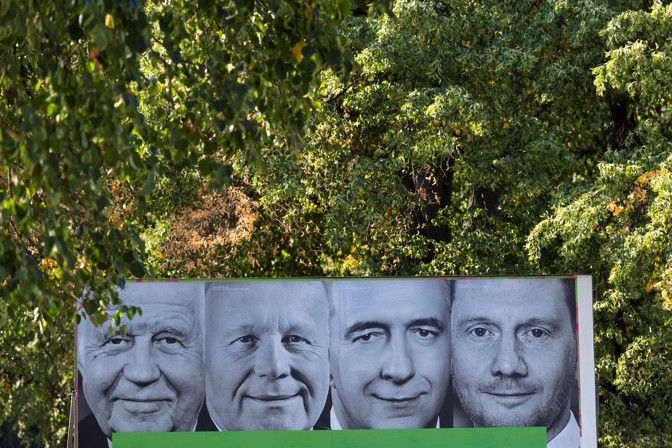
A Green Party election poster in Dresden, Saxony (Matthias Rietschel / Reuters)

Still, the argument the Greens are making on the campaign trail in eastern Germany is not an easy one. They want to accelerate the closure of Germany’s polluting brown-coal-power plants, four of which sit in the Lausitz region, near the border between Saxony and Brandenburg; and introduce a fuel tax to dissuade people from driving cars. They talk about the benefits of immigration in what is perhaps the most xenophobic corner of Germany.

“The traditional message—‘Vote for us and everything will get better’—doesn’t work any longer,” Habeck told me. “Our society and the global landscape are changing so rapidly that people feel these promises are empty. We are telling people that we won’t ignore them or try to return to a past that no longer exists, but rather shape the immense changes that we are facing.”

Volker Ratzmann, a leading Green from the southern state of Baden-Württemberg, told me that it is incumbent on a rich country like Germany to show others what is possible in fighting climate change.

At his campaign events, Habeck frames the elections as a choice between optimism and resignation: Voters can choose a bright future of cleaner new technologies coupled with some short-term pain, or double down on old, increasingly obsolete solutions that lead nowhere.

To fight populism, Habeck said, politicians need to tell a compelling story that arouses emotion and inspires, something Merkel is often criticized for failing to do. He spoke glowingly with me of the enthusiasm and energy he experienced during a week-long trip to Washington, D.C., shortly after Barack Obama’s inauguration.

The son of pharmacists, Habeck grew up in Schleswig-Holstein, on the Danish border. For years, he wrote books with his wife, with whom he has four sons. Only in his late 30s did he become a full-time politician, taking over the leadership of the Greens in his home state and later becoming agriculture minister there. Since taking over the co-leadership of the Greens at the national level, he has become the darling of a German media eager for charismatic new faces. Habeck, with his three-day stubble, open shirts, and bookish intellect, exudes a casual cool that appeals to many Germans after the staid Merkel era and at a time when other countries are turning to brash strongmen.

Still, some critics see more style than substance in Habeck, who uses terms such as radical realism to describe the party’s approach, and who raised eyebrows in June when he described himself as a “secular Christian.” “A lot of people like what he says and how he says it, but they don’t recall afterward what he was talking about,” the German weekly Der Spiegel wrote recently.

And yet the Greens are in the driver’s seat on climate change (Merkel’s government is scrambling to come up with its own plan for the environment after realizing belatedly how important it has become for many voters). But to build on their recent momentum, they will need to do more than impress in the looming regional elections.

Ralf Fücks, an influential early member of the Greens who now runs a progressive think tank in Berlin, says the party needs to get more concrete on a range of topics beyond its signature issue.

“Is there a coherent Green foreign policy? I would say that this is missing,” Fücks told me. “On Russia, on China, on transatlantic relations and the future of NATO, there are lots of question marks but no strategy.”

But here in Chemnitz, where protesters flashed Nazi salutes and chanted “Foreigners out!” one year ago after the death of a German man that they blamed on immigrants, Habeck has other issues on his mind.

“You will be deciding on September 1 what the government in Saxony looks like,” he told the crowd. “But you will also be determining whether Saxony sends out a signal to the world that it wants an open, democratic, optimistic society.”

Tuesday, 27 August 2019

Lobistas do Partido Republicano ajudam o Brasil a recrutar empresas dos EUA para explorar a Amazônia

Lobistas do Partido Republicano ajudam o Brasil a recrutar empresas dos EUA para explorar a Amazônia

Nos últimos meses, incêndios estão sendo usados para limpar vastas áreas da Amazônia em um ritmo sem precedentes. Um quinto da Amazônia já foi destruído nos últimos 50 anos. Uma maior industrialização da floresta tropical corre o risco de destruir outro quinto, uma perda que seria catastrófica para o ecossistema global.

O desastre é amplamente atribuído a interesses que procuram abrir a maior floresta tropical do mundo para dar espaço à pecuária, à mineração e ao agronegócio focado nas exportações. Documentos revelam que esses interesses estão sendo incentivados nos EUA por lobistas republicanos favoráveis ao governo Trump, que iniciaram conversas com o governo brasileiro para promover o investimento empresarial na Amazônia.

A crise na Amazônia ocorre com o Brasil agora sendo governado por uma administração abertamente hostil às preocupações ambientais e às comunidades indígenas. O presidente Jair Bolsonaro, ex-capitão do Exército que já foi visto como figura marginal na política brasileira, autodeclarado Capitão Motosserra por sua iniciativa de promover a exploração madeireira e o agronegócio na Amazônia.

Logo após assumir o cargo em janeiro, Bolsonaro cortou o financiamento para a principal agência ambiental do Brasil em 24%. E, nesta semana, depois de um relatório do centro de pesquisa espacial brasileira revelar que os incêndios na Amazônia subiram 83% este ano, Bolsonaro culpou as ONGs internacionais em vez de suas próprias políticas antiambientais.

Enquanto isso, um integrante do governo brasileiro contratou lobistas de Washington para continuar vendendo terras e destruindo a floresta.

Em junho, Wilson Lima, governador do Amazonas, onde está situado aproximadamente um terço da Amazônia, incluindo o epicentro da atual crise de incêndios florestais, começou a trabalhar com o InterAmerica Group, uma empresa de lobby com sede em Washington DC, fundada por Jerry Pierce Jr. Kellen Felix, brasileira vice-presidente do InterAmerica Group, também está listada em registro de divulgação para trabalhar com o estado do Amazonas. Eleito no ano passado, Wilson Lima é filiado ao PSC, partido conservador afiliado à Assembleia de Deus, igreja pentecostal em rápido crescimento no Brasil.

Os registros iniciais, divulgados sob a Lei de Registro de Agentes Estrangeiros através do Departamento de Justiça, que regulamenta o lobby estrangeiro, mostram que Pierce foi chamado para representar o governo de Lima em reuniões com agências federais e o Congresso.

O InterAmerica Group também já apresentou um pacote informativo montado para empresas americanas em nome do governador brasileiro, promovendo a região amazônica por seu potencial de desenvolvimento. O pacote lista mineração, agronegócio e “indústria química de gás” como “oportunidades” para empresas americanas. Entre os “desafios” para essas empresas em potencial está “garantir a conservação da floresta”.

Pacote, divulgado pelo InterAmerica Group, anunciando a Amazônia para interesses comerciais. Documento: divulgação da Lei de Registro de Agentes Estrangeiros.

Em resposta a uma pergunta do Intercept, Pierce disse que um contrato final não foi assinado. “Infelizmente, o estado da Amazônia decidiu adiar a contratação de nossa empresa por tempo indeterminado. Talvez a negociação seja retomada em 2020”, escreveu Pierce. Ele não respondeu a uma pergunta sobre por que sua empresa já estava produzindo comunicações em nome do governo de Lima.

Pierce escreveu extensivamente sobre como Trump e Bolsonaro são uma benção para o aumento dos negócios americanos no Brasil. “Sob o presidente Trump”, Pierce escreveu em um post de 2017 no site de sua empresa, o Brasil deve se tornar “um líder mundial em setores como agronegócio, mineração, bancos e aviação.” Em posts mais recentes, Pierce comemora a ascensão do presidente de direita Jair Bolsonaro, declarando que “Donald Trump abriu o caminho para uma vitória de Bolsonaro”.

Pierce também atuou anteriormente como funcionário do Departamento de Habitação e Desenvolvimento Urbano durante a administração de George Bush pai e como importante arrecadador de fundos do presidente George W. Bush. No governo George W. Bush, ele alcançou o status de “Pioneiro”, um elogio dado aos apoiadores que levantaram pelo menos 100 mil dólares para as campanhas de Bush. Em 2009, Pierce se declarou culpado de fazer contribuições ilegais para campanhas, usando o nome de outra pessoa. Ele foi condenado a três anos de liberdade condicional.

Imagens de mídias sociais mostram Pierce, Felix e outros funcionários do InterAmerica Group aparecendo, na descrição de Pierce, com membros da administração do presidente Donald Trump e em eventos de movimentos conservadores, incluindo a convenção CPAC e com o Turning Point USA.

Lima não é a única autoridade brasileira a estabelecer laços com políticos amigos de Trump.

O Intercept informou anteriormente que o antecessor de Lima, o governador Amazonino Mendes, assinou um controverso contrato de US$ 1,6 milhão com a Giuliani Safety & Security, uma empresa de consultoria afiliada a Rudy Giuliani, agora advogado de Trump. O estado do Amazonas sofre historicamente com a pobreza, o contrabando de drogas e a criminalidade – problemas que Mendes prometeu resolver através do contrato com a empresa de Giuliani.

As discussões com o InterAmerica Group estão entre os muitos laços americanos com a expansão dos negócios na Amazônia. Em abril, a Câmara de Comércio Brasil-Americana, um grupo comercial que representa os principais interesses bancários e de commodities, realizou um evento para tratar como os investidores americanos podem tirar proveito do agronegócio brasileiro no atual clima político.

Tradução: Cássia Zanon

The post Lobistas do Partido Republicano ajudam o Brasil a recrutar empresas dos EUA para explorar a Amazônia appeared first on The Intercept.

Sunday, 25 August 2019

Future-se quer aumentar investimento privado nas universidades. Mas o interesse das empresas em pesquisa é baixo.

Future-se quer aumentar investimento privado nas universidades. Mas o interesse das empresas em pesquisa é baixo.
img_6356df_1-1566318050

Foto: Marcelo Camargo/Agência Brasil

O programa Future-se prevê que as universidades e institutos federais realizem obrigatoriamente a contratação de uma organização social para gerir atividades como ensino, pesquisa e inovação. A premissa do programa é a de que, ao transferir a gestão acadêmica para essas organizações sociais, o setor privado passaria a investir nessas instituições. Essa expectativa não tem nenhum respaldo em fatos.

O dinheiro público representa mais da metade do investimento em P&D no Brasil. Não é uma realidade só brasileira: no mundo todo a pesquisa básica é financiada em grande parte pelo estado. Além disso, é temerário tomar a atual fotografia do orçamento público como parâmetro para mudar a estrutura do financiamento do sistema federal de educação superior para sempre. O custo total das universidades, institutos e hospitais federais representa algo em torno de 0,8% do PIB. Será que país deve “economizar” nessa área?

Nos últimos anos, houve um significativo aumento das concessões de incentivos fiscais para estimular o setor privado a investir em pesquisa e desenvolvimento. Sem sucesso. Um estudo do Instituto de Pesquisa Econômica Aplicada apontou que, mesmo com a fabulosa desoneração concedida, não houve investimento proporcional das empresas em P&D e inovação – em alguns casos, ele até diminuiu.

Considerando o histórico do investimento privado em P&D e educação no Brasil, é difícil crer em uma mudança repentina no comportamento do setor privado. Diante de um índice de endividamento empresarial alto, é pouco provável que a parcela do empresariado com condições de investir irá priorizar a pesquisa e a inovação que não oferecem resultados no curto prazo. Além disso, a entrada de investimentos privados pode ocorrer sem a previsão de intermediários como as organizações sociais.

Há dois dados relativos ao financiamento da pesquisa que precisam ser diferenciados. O primeiro é o investimento total (público e privado) que cada país faz em pesquisa, inovação e desenvolvimento, independente de onde essas atividades são realizadas. O segundo é o financiamento da pesquisa e da ciência feita em universidades. Nos países desenvolvidos, a fonte majoritária do investimento total é o setor privado, já a do financiamento da pesquisa nas universidades é o setor público. No Brasil, em ambos os casos o setor público é o principal financiador. Houve uma tendência de crescimento a partir de 2006, que começa a decrescer em 2015. O governo – sempre ele – foi o maior investidor nesse período.

Outra característica que nos diferencia dos países desenvolvidos é a de que a força de trabalho envolvida nas atividades de pesquisa no Brasil estão majoritariamente nas universidades. As empresas brasileiras, muito em função do perfil de nossa economia, não são um reduto profissional de pesquisadores em tempo integral.

Distribuição percentual dos dispêndios nacionais em pesquisa e desenvolvimento (P&D), segundo setor de financiamento, de países selecionados, 2000-2016

Privatização do ensino público

Aumentar o capital privado nas públicas é algo positivo, sem dúvida, mas o Future-se almeja uma substituição: o incremento do aporte do setor privado tende a reduzir o de recursos públicos diante das restrições orçamentárias que se desenham com o crescimento dos gastos obrigatórios e com a Emenda Constitucional 95. A garantia de que haverá orçamento para as instituições públicas compatíveis com suas demandas de manutenção e expansão não deveria ser um ponto negociável.

Mesmo as universidades e institutos que conseguem arrecadar recursos diretos estão submetidas a armadilhas orçamentárias. O caso da UFRGS é exemplar. Em 2018, a universidade arrecadou R$ 36,4 milhões de recursos próprios, sendo que R$ 23 milhões foram gastos no exercício do ano em despesas de custeio e capital. O restante teve dois destinos diferentes. Cerca de metade do valor foi incorporado ao caixa da universidade como superávit do exercício de 2018. A outra metade foi destinada, de forma inusitada, ao pagamento de aposentados e pensionistas, por determinação do Ministério do Planejamento, conforme Portaria 9.420 de 14 de setembro de 2018. Ou seja, parte daquilo que foi arrecadado através de convênios e contratos de pesquisa, extensão e outras taxas – o tipo de arrecadação que o Future-se quer fomentar – serviu para pagar despesas obrigatórias da União.

No mundo todo, a pesquisa básica é financiada em grande parte pelo estado.

É claro que esses recursos deveriam ter sido destinados para a aquisição de equipamentos, reformas de laboratórios, fomento à inovação etc. Mesmo que se incremente o aporte de dinheiro privado nas universidades e institutos federais, parte significativa dele pode acabar desviada para o pagamento de despesas obrigatórias. Além disso, a despesa com arrecadação própria das instituições federais é gasto primário, isto é, considerada na regra do teto de gastos – o que é um absurdo. A deturpação do destino dos recursos próprios é um alerta para que não caiamos na ilusão de que dinheiro vindo de parcerias vai resolver o problema. Não vai.

É urgente a ampliação do investimento privado em P&D no Brasil. Mas, em um país em que o ensino superior já é majoritariamente privado (75% das matrículas), não se pode renunciar à garantia do orçamento público para o funcionamento das IFES.

O ministro da Educação, Abraham Weintraub, e o secretário de Educação Superior do MEC, Arnaldo Lima, apresentam o programa "Future-se".

O ministro da Educação, Abraham Weintraub, e o secretário de Educação Superior do MEC, Arnaldo Lima, apresentando o programa “Future-se”.

Foto: Marcelo Camargo/Agência Brasil

Luta desigual

“Com o Future-se, queremos separar o joio do trigo”, afirma constantemente Abraham Weintraub, o ministro da Educação. São muitas as interpretações possíveis dessa fala, mas depreendo que o chefe do MEC esteja insinuando que as IFES “que realmente querem e trabalham, saberão buscar seus recursos”.

Essa não será uma luta justa. À medida que se institui uma busca individualizada por recursos privados (também escassos), qual será o grau de equidade na disputa entre as federais? Como uma unidade de uma universidade nova ou um campus de instituto federal de cidade pequena irá disputar com as universidades consolidadas, sediadas em grandes centros econômicos? Se a pesquisa, a inovação e a ciência básica das IFES menores, localizadas em regiões pobres depender de recursos privados, elas não irão existir. É o que os dados indicam.

Nos últimos anos, a expansão das universidades públicas e a criação e interiorização dos institutos federais teve  como um dos seus objetivos principais fomentar arranjos econômicos locais em regiões menos favorecidas. Ao passar a responsabilidade de buscar recursos para as IFES, o Future-se tende a colocar uma pá de cal no projeto de tornar o ensino superior e técnico um indutor do desenvolvimento dessas regiões.

O custo total das universidades, institutos e hospitais federais representa algo em torno de 0,8% do PIB.

Outro ponto curioso é que a ampliação de convênios e parcerias com o setor privado e o aperfeiçoamento dos mecanismos de arrecadação própria já estão previstos no novo Marco Legal para a Ciência, Tecnologia e Inovação. O novo governo parece querer inventar a roda instituindo um programa de forma unilateral, sem consultar gestores e comunidade acadêmica e desprezando o arcabouço legal que já existe.

Caso se considere que o ambiente regulatório ainda seja muito burocrático, cabe simplificá-lo, sem para isso destituir as IFES da gestão de seus recursos. O Future-se nem sequer prevê alternativa para as despesas que incidirão sobre os gastos obrigatórios oriundos das reformas da previdência e administrativa.

As alternativas ao programa de Weintraub passam por implementar a nova legislação vigente – ou mesmo aperfeiçoá-la –, elaborar programas de fomento e metas com fundos públicos e privados que toquem nos temas do combate à evasão, à otimização dos recursos humanos, à produção científica e tecnológica, à exigência de uma relação mais orgânica das universidades com a sociedade civil, entre outras pautas. Esses programas, porém, devem ser objeto de debate e participação das comunidades acadêmicas e, principalmente, ser geridos por seus servidores públicos. Nenhum projeto que deixe isso de lado irá ser incorporado por eles de maneira produtiva.

The post Future-se quer aumentar investimento privado nas universidades. Mas o interesse das empresas em pesquisa é baixo. appeared first on The Intercept.

Why 2020 Campaign Workers Are Suddenly Unionizing

A key part of the playbook for most successful Democratic presidential campaigns is courting the union vote. For candidates, that means touring union halls, trumpeting your solidarity with the labor movement, and making sure that the overpriced swag peddled by your campaign has an insignia certifying that it was made by American union workers.

But what goes unmentioned on the campaign trail is that most of the staffers ferrying their bosses to union events and writing speeches reaffirming the candidates’ support for labor aren’t members of a union themselves. Or rather, that used to be the case. Since the spring, campaign staffers for multiple 2020 hopefuls have made a push to unionize—the first time in history any presidential campaigns have ever done so.

Political work can be grueling. The pay is low or, in some cases, nonexistent. Caffeine-addled late nights and weekends are the norm. Unlike traditional union jobs—think of autoworkers on the assembly line or state-government bureaucrats—many campaign jobs are ill-defined, and by definition temporary. A staffer can spend years helping usher a candidate to victory only to be out of a job soon after the final votes are tallied. “We talked about the 2012 campaign being this unicorn, billion-dollar corporation that will fail in 18 months,” says Teal Baker, who was the deputy chief operating officer for former President Barack Obama’s 2012 reelection campaign.

The notion that unionization doesn’t jibe with the boom-and-bust nature of presidential-campaign work began to change earlier this year, at least on the Democratic side. (It’s an entirely different situation in the GOP: Though President Donald Trump has shaken up the GOP’s associations with union voters, his party has traditionally expressed hostility to labor.) The most prominent campaigns to organize so far are those of the two lefty heavyweights in the race: Senators Bernie Sanders of Vermont and Elizabeth Warren of Massachusetts. But they’re not the only ones. So have staffers for former Housing Secretary Julián Castro and Senator Cory Booker of New Jersey. (Eric Swalwell’s team also unionized before the congressman grounded his long-shot 2020 bid in July.) When workers make a move to collectively bargain, it’s not uncommon for employers to try to thwart their efforts: Unionizing can mean heftier compensation for their employees and added bureaucracy within the workplace. But in this case, all of the campaigns have voluntarily recognized their staffers’ push to unionize.

Unionizing doesn’t turn an onerous campaign job into any sort of cushy gig. The hours are still long and tiring. No one is making a killing. (Well, except maybe the campaign’s consultants.) And so far, the effort hasn’t been without growing pains.

Of the campaigns that have organized, only Sanders’s team has ratified a union contract codifying the wages and benefits to which workers are entitled. (The rest are still in the negotiation process.) The initial terms guaranteed a $36,000 base salary for field organizers, a common entry-level job on campaigns; doubled the amount of paid time off, from two to four weeks; and capped the salaries of the campaign’s top brass. Even so, earlier this year a labor spat rocked Sanders’s campaign, when field organizers demanded that they be paid $15 an hour instead of a set salary. (For the many staffers working around the clock, hourly pay would likely add up to more than $36,000.) Instead, the campaign and its staffers hammered out an agreement for a pay raise in late July—but an anonymous staffer still claimed to have been illegally fired for union activities.

That allegation is “patently absurd,” said a Sanders staffer who is part of the union and who spoke on the condition of anonymity to talk candidly about the campaign’s collective bargaining. “I don’t think you really hear union folks typically saying, ‘Management’s fucking awesome,’ but our management’s been really great with this. They voluntarily acknowledged the union. They did it right away—there was no hesitation.”

Staffers’ push to unionize is a reflection of the changing landscape for workers in this country. But their bosses’ consent may also reflect a reality for the campaigns themselves: They need all the help they can get—from union allies and from their own staff—to win the crowded Democratic primary.

These workers are turning to collective bargaining for a simple reason. “There’s been a growing sense in Democratic politics over the past decade-plus that a lot of Democratic campaigns talk the talk but don’t walk the walk,” says the strategist Dave Hamrick, who was the campaign manager for Martin O’Malley’s 2016 presidential run. “They espouse a certain set of policies, but their campaigns don’t actually deliver on them.”

Practically every 2020 Democrat wants to boost the federal minimum wage to $15 an hour. Not all of them apply that same standard to their own subordinates. Salaries for field organizers, for example, are all over the place, based on The Atlantic’s analysis of Federal Election Commission filings. Biden, one of the more donor-rich candidates, is shelling out about $38,700 a year, after taxes and benefits. If that’s the Mount Everest of field-organizer salaries, what organizers for Tulsi Gabbard’s 2020 campaign are earning is at the bottom of the Mariana Trench: $14,664 a year, after taxes and benefits. And many staffers have to foot the bill for work-related expenses. For example, field organizers crisscross interstates to canvass in town after town, but they can be on their own for the hefty gas tabs (and car-maintenance bills) that come with that travel.

For underemployed staffers, the weight of a demanding gig and the stress of covering their bills can take a toll. “There’s this burnout mentality among those running these campaigns,” says Erik Loomis, a labor historian at the University of Rhode Island and the author of A History of America in Ten Strikes. “You take this 22-, 23-year-old talent and work them into the ground.”

That mentality is all too familiar to Sarah Willenbrink-Sahin, who in 2016 worked as a field organizer canvassing to elect Democrats in Ohio. “The hours were so extreme that I was driving back and forth, and I was like, I hope my marriage makes it,” she told me. “Regularly, in 2016, I was working until 1 or 2 in the morning, with the expectation that I would have to be back in the office by 9 the next day ... When you’re working seven days a week, it can be hard to, frankly, have a life—or even spend a little time with your partner.”

The taxing nature of campaign work can be self-perpetuating: Managers reared on low pay and late-night drudgery expect their underlings to endure the same. And skimpy paychecks are baked into the business model of how campaigns are run: “Campaigns do everything that they can to spend every possible dollar on the actual communicating with voters as opposed to infrastructure costs” such as payroll and staff benefits, Hamrick told me.

But the newest crop of campaign workers, overwhelmingly Millennials, are rejecting the expectation that political work necessarily means little pay and the hazard of burnout. Millennials “are asserting themselves more around saying that they want more balance in their lives,” says Janice Fine, a professor at the Rutgers University School of Management and Labor Relations. “A generation of people working on political campaigns are striving for more balance in their lives.”

[Read: America’s teachers are furious]

These staffers are part of a broader reawakening in the labor movement. American workers have unions to thank for weekends and the 40-hour workweek, but in recent decades, unions have been in a moribund state: The share of American workers who are unionized has been in a half-century-long slump, and strike activity this decade has reached historic lows—trends that may be exacerbated by last year’s Janus Supreme Court case, which dealt a gut punch to public-sector unions.

But that doesn’t mean the labor movement has been relegated to its deathbed. In 2018, some 485,000 workers went on strike in the biggest year for worker protest in a generation, headlined by a tsunami of teacher strikes in states, like Oklahoma and Arizona, that haven’t historically been hot spots of union activity. The Fight for $15, a nationwide movement to boost the minimum wage, is picking up steam. Seemingly every week comes the news of another media outlet that has organized. (At least 30 have done so in the past two years, including BuzzFeed, Vox, the Los Angeles Times, and Slate.)

When Willenbrink-Sahin landed a job as a regional field director for the Ohio Democratic Party ahead of the 2018 midterms, staving off burnout was one of her top priorities. So she took a cue from the messages she’d heard from Democrats on the campaign trail: With a band of her colleagues, she led a drive to organize the staff, making the Ohio Democrats the first state party in the nation to unionize. They sought representation from the Campaign Workers Guild, an upstart union founded in late 2017. The guild has so far organized 30 campaigns—from city-council races to congressional campaigns to, now, Castro’s 2020 operation. Other 2020 teams have sought to unionize with more established outfits: Sanders’s with the United Food and Commercial Workers Local 400, based in the Washington, D.C., area; Warren’s with the International Brotherhood of Electrical Workers Local 2320, in New Hampshire; and Booker’s with Teamsters Local 238, in Iowa. (Both the Booker and Warren campaigns declined to comment beyond statements they already released applauding their staffers’ unionization push.)

Sawyer Hackett, Castro’s press secretary, told me that the team was keen on organizing virtually from the start, even when the staff numbered in the single digits. “We saw campaigns do this in 2018 and, you know, campaigns are big enterprises,” Hackett said. “Just like with big corporations supporting their workers, campaigns should do the same.”

Candidates aren’t voluntarily recognizing their staffers’ unionization efforts simply out of some warm and fuzzy altruism. The campaigns could have another goal in mind as well: attracting staffers. With 21 Democrats mounting credible 2020 runs—the largest flock of presidential wannabes in history—the competition for staffers is cutthroat, especially in the early-voting states of Iowa and New Hampshire, where campaigns need an army of field organizers. “The competition for staff is absolutely insane,” Hamrick told me. “It’s more intense than I’ve ever seen it. There’s just not enough staff experience to go around.” In the crush for workers, he added, unionized campaigns that can offer better pay and benefits (and the symbolic victory of being unionized) could have an edge.

Potential staffers wouldn’t necessarily flock to the campaign with the highest pay. (“Yeah, I would be working for Donald Trump if they weren’t paying me more here,” the Sanders staffer joked to me.) But unionization could help a campaign broaden its pool of applicants. “It allows us to form a staff that isn’t just a staff made of privileged rich kids,” the staffer said. “I wouldn’t say that it motivates people to work for Bernie Sanders, but what it does is allow our campaign to actually employ the working-class people that we want to have a voice in this campaign.”

Candidates get something else out of unionization, too: bragging rights. Winning the union vote has become something of an arms race in 2020, and candidates can use their own campaign’s unionization as a potential salvo.

“This is the most pro-union field of candidates in decades, perhaps in my lifetime,” says Steve Rosenthal, a former political director of the AFL-CIO.

Take former Vice President Joe Biden. In rolling out his campaign at a Teamsters hall in Pittsburgh in April, he sent a clear message: “I make no apologies,” he said. “I am a union man. Period.” The same month, Warren walked the picket line with striking workers at the supermarket chain Stop & Shop. South Bend, Indiana, Mayor Pete Buttigieg is beloved by Silicon Valley types and Wall Street big shots, but even he has endorsed a plan that would take a defibrillator to unions.

[Read: Biden is betting on unions. They might bet on someone else.]

The love that 2020 Democrats have tried to give unions is, in part, emblematic of the party’s general tack to the left: Policy positions that were once fringe—from single-payer health care to the decriminalization of border crossings—are now up for mainstream debate. And it may also be about a growing awareness, buoyed by a bevy of economic research, that the decline of unions isn’t unrelated to the state of the economy today: inequality verging on Gilded Age levels, and inflated corporate power.

“There’s been a recognition that unions had power,” Janice Fine said. “They had power because they had members.” From the campaigns’ perspective, “if you want to get back to where there is greater economic mobility and if you want to do something about inequality, then you have to not just support unions rhetorically. You have to make it possible for them to grow again and for them to organize.”

Despite their diminished stature, unions can still drive votes for Democrats in a way that few other groups can. While the average Pittsburgh steelworker or New York City subway conductor may not be clued in on the minutiae of which campaigns are organized (or the fact that unionization is happening at all), for the union leaders who have to make big decisions on which candidates to endorse, and consequently where to direct their members’ votes, campaign unionization could make a difference. “My campaign staff is unionized,” Warren made a point to say in her address to an AFL-CIO summit in Iowa on Wednesday, where a flock of candidates came to woo the unions. “I helped other places unionize, including the grad students in Boston, the casino workers and airport workers in multiple cities. I’ve walked picket lines and I’ve called CEOs to try to get them to settle disputes and recognize unions.”

Presidential campaigns aren’t going to revitalize the labor movement by unionizing a couple hundred overworked staffers. And it’s still not clear whether campaign unionization is merely a fleeting stage in the Democratic Party’s metamorphosis or something more permanent that will constitute a wholesale remake of campaign work. But one thing is already clear: The expectation that Democrats can talk about workers one way and then treat their own workers in another way is no longer going unquestioned.

Friday, 23 August 2019

Arab Women Are Tired of Talking About Just ‘Women’s Issues’

The striking image of a tall woman dressed in white, lightly veiled, wearing large gold earrings, and raising a finger as she led several hundred men and women in chants of protest against Sudanese President Omar al-Bashir went viral in April.

Described as a Nubian queen, 22-year old Alaa Salah quickly became an icon of the movement to bring down Bashir—and of the widespread participation of women in the protests that eventually resulted in his ouster. Her efforts, and those of many other women, were covered extensively by the media as an extraordinary moment, almost an exception.

Yet before Sudan, women were at the forefront of protests in Benghazi, Libya, in 2011; and in Yemen that same year, with one, Tawakkol Karman, going on to win a Nobel Peace Prize. And women were key to the activism that helped sustain the protests and civilian resistance against Syrian President Bashar al-Assad, with hundreds if not thousands of them landing in government jails.

[Read: Protesters in Sudan and Algeria have learned from the Arab Spring]

Though many of those protests were crushed, they were not new or fleeting moments of Arab women exerting their power. Women in the Middle East have historically been active in many fields from newspaper publishing in the early 20th century to banking and politics today, but their role has often been overlooked.

Now, however, a growing chorus of Arab women is offering an alternative to the typically male, often autocratic voice that dominates within their own societies (and in Western portrayals of the region). Through a variety of media, from journalism to television to literature, they are undermining the long-held narrative of Arab women as docile and submissive.

This is what emerges clearly from the recently published anthology Our Women on the Ground: Essays by Arab Women Reporting From the Arab World, a book edited by the Lebanese journalist and writer Zahra Hankir that brings together 19 essays by women journalists, all of them Arab or Arab American.

The essays are at turns searing, poignant, and funny, but what shines through in all of them is the sheer strength of the women writing. Whether it’s Hannah Allam covering Iraq for McClatchy newspapers in the days after the 2003 invasion, hunkering down in a shrine being bombed by American military jets; Nour Malas reporting for The Wall Street Journal on the descent of Syria, her homeland; or Hwaida Saad, a Lebanese reporter for The New York Times in Beirut who maintained open channels to contacts inside Syria with empathy and social-media ingenuity, their work has greatly enriched Western audiences’ understanding of what is unfolding in the region—hence, they are “our” women on the ground, all of us reading their articles.

In the essays, Hankir says, “none of them were striving to dispel stereotypes about who they are. Instead, they were focused on the task at hand, their jobs, and oftentimes survival. There is no one Arab woman; there is no one way to be an Arab woman; and there is no one Arab female experience. By telling their stories, these women, without intending to do so, and without a Western audience in mind, have punctured prevalent narratives rooted in flawed post-colonial discourse.”

[Read: In a changing Middle East, are women making progress?]

Some of the authors report for local media, such as Shamael Elnoor, who traveled into the war-ridden province of Darfur in 2015 to interview the feared chief of the Janjaweed militia; or Asmaa al-Ghoul, who stood up to militants from Hamas in Gaza with her pen and her gaze while writing for the Palestinian paper Al-Ayyam. Some have to deal with families who disapprove of their dangerous careers; others can count on fathers to remonstrate militants who dare question the women’s choices.

Through the essays, the reader meets yet more women from Libya to Yemen whose resilience and power are humbling, and who can “be devilishly funny” through the worst circumstances, as Allam writes in her essay. These women are journalists, activists, or teachers, yet they are never reduced to the sole status of women or asked to speak specifically about gender.

The notion that Arab women have much more to say than just commenting on their lives as women and on gender issues should be an obvious one, and it’s what drove the veteran Lebanese journalist Nada Abdelsamad to conceive her weekly talk show, Dunyana—Arabic for Our World—airing on BBC Arabic TV. (The program has been on air since 2014, when the British broadcaster began a push to give more airtime to women to achieve gender parity across all its output.)

Abdelsamad took the idea further in her show. The program not only features an all-women panel with the occasional male guest; it eschews the discussions of motherhood and child-rearing heard on many women’s talk shows, choosing instead to focus hour-long episodes on a specific political or social issue. On Dunyana, female experts discuss everything from youth unemployment to modern Arab literature to counterterrorism strategies. To date, Abdelsamad has had 720 women on the program, from every single Arab country, and has herself been surprised by the seemingly never-ending supply of women experts to sustain the show. She refuses to include politicians on her shows, and while some of the women are prominent in their own country, there are no celebrities.

In a region where debate has been constantly stifled by oppressive rulers, “it wasn’t easy at the beginning to convince the guests to interrupt each other to make it a free-flowing discussion,” Abdelsamad told me. She said she noticed that the women were particularly averse to interrupting or contradicting male guests. To promote more debate, she began to brief her panel more thoroughly on the format as well as the content.

Some of her favorite episodes include a heated discussion on atheism with a Saudi guest, the television anchor Buthaina Nasr, who chose to appear without her veil, and a show on the future of oil, renewable energy, and water in the region that featured Sara Akbar, a Kuwaiti petroleum engineer, and Shorouk al-Abaiji, an Iraqi water and agriculture expert.

Dunyana launched a new format a couple of months ago with a rotating panel made up of three women of different nationalities who debate one or two topics among themselves and with a guest. Abdelsamad, who anchored the program from its inception, is no longer on screen but remains as the editor. In a recent episode that made waves on social media, the Palestinian actress and art curator Manal Khader confronted a priest about personal liberty and freedom of expression after accusations of blasphemy against a popular Lebanese indie-rock band led to the cancellation of one of their concerts in Lebanon this month.

Abdelsamad’s show would be groundbreaking even in the United States or other Western countries, where all-male panels are still a regular occurrence, and where there continues to be a dearth of women experts cited in newspaper articles and academic papers. Male writers and reviewers also dominate book coverage in the United States, according to the nonprofit organization VIDA, even though women writers and readers are the majority. Arab women, therefore, face twin obstacles: the West’s own gender biases, and the reductive narrative of the Arab woman.

This is why it was such a victory when the International Booker Prize jury chose an Arab novel—one written by a woman—to receive the award for the first time in the prize’s history. The Omani novelist Jokha al-Harthi’s breathtaking, layered, multigenerational novel Celestial Bodies, which was beautifully translated into English, follows the lives of three sisters from a small village at a time of rapid social and economic change in Oman. The tale is replete with history, poetry, and philosophy, but also slavery, broken marriages, passion, and not-so-secret lovers.

[Read: The real roots of sexism in the Middle East (it's not Islam, race, or 'hate')]

The chair of judges for the prize, the historian Bettany Hughes, said that the book gave the jury “access to ideas and thoughts and experiences you aren’t normally given in English. It avoids every stereotype you might expect in its analysis of gender and race and social distinction and slavery.”

That’s also why Hankir wanted to compile Our Women on the Ground. Though numerous memoirs have been written by Western foreign correspondents about the region, she writes in the anthology, “a volume like this one, which amplifies local Arab female voices in the literary space, hadn’t yet been created and was long overdue.”

Hankir told me that while questions from the audience at book events thus far in the United States have been thoughtful, she was surprised by how often journalists asked her about how her anthology would help puncture the narrative of the docile Arab woman, a reflection of how enduring that lens remains. It is still one chosen by some Western reporters in their own stories (as well as the one seen in portrayals from Hollywood and elsewhere), helping to perpetuate the stereotype.

And so, while the chorus of strong Arab women’s voices is growing, the question is: Does the West want to hear it?

If Trump Were an Airline Pilot

Through the 2016 campaign, I posted a series called “Trump Time Capsule” in this space. The idea was to record, in real time, what was known about Donald Trump’s fitness for office—and to do so not when people were looking back on our era but while the Republican Party was deciding whether to line up behind him and voters were preparing to make their choice.

The series reached 152 installments by election day. I argued that even then there was no doubt of Trump’s mental, emotional, civic, and ethical unfitness for national leadership. If you’re hazy on the details, the series is (once again) here.

That background has equipped me to view Trump’s performance in office as consistently shocking but rarely surprising. He lied on the campaign trail, and he lies in office. He insulted women, minorities, “the other” as a candidate, and he does it as a president. He led “lock her up!” cheers at the Republican National Convention and he smiles at “send them back!” cheers now. He did not know how the “nuclear triad” worked then, and he does not know how tariffs work now. He flared at perceived personal slights when they came from Senator John McCain, and he does so when they come from the Prime Minister of Denmark. He is who he was.

The Atlantic editorial staff, in a project I played no part in, reached a similar conclusion. Its editorial urging a vote against Trump was obviously written before the election but stands up well three years later:

He is a demagogue, a xenophobe, a sexist, a know-nothing, and a liar. He is spectacularly unfit for office, and voters—the statesmen and thinkers of the ballot box—should act in defense of American democracy and elect his opponent


The one thing I avoided in that Time Capsule series was “medicalizing” Trump’s personality and behavior. That is, moving from description of his behavior to speculation about its cause. Was Trump’s abysmal ignorance—“Most people don’t know President Lincoln was a Republican!”—a sign of dementia, or of some other cognitive decline? Or was it just more evidence that he had never read a book? Was his braggadocio and self-centeredness a textbook case of narcissistic personality disorder? (Whose symptoms include “an exaggerated sense of self-importance” and “a sense of entitlement and require[s] constant, excessive admiration.”) Or just that he is an entitled jerk? On these and other points I didn’t, and don’t, know.

Like many people in the journalistic world, I received a steady stream of mail from mental-health professionals arguing for the “medicalized” approach. Several times I mentioned the parallel between Trump’s behavior and the check-list symptoms of narcissism. But I steered away from “this man is sick”—naming the cause rather than listing the signs—for two reasons.

The minor reason was the medical-world taboo against public speculation about people a doctor had not examined personally. There is a Catch-22 circularity to this stricture (which dates to the Goldwater-LBJ race in 1964). Doctors who have not treated a patient can’t say anything about the patient’s condition, because that would be “irresponsible”—but neither can doctors who have, because they’d be violating confidences.

Also, a flat ban on at-a-distance diagnosis doesn’t really meet the common-sense test. Medical professionals have spent decades observing symptoms, syndromes, and more-or-less probable explanations for behavior. We take it for granted that an ex-quarterback like Tony Romo can look at an offensive lineup just before the snap and say, “This is going to be a screen pass.” But it’s considered a wild overstep for a doctor or therapist to reach conclusions based on hundreds of hours of exposure to Trump on TV.

My dad was a small-town internist and diagnostician. Back in the 1990s he saw someone I knew, on a TV interview show, and he called me to say: “I think your friend has [a neurological disease]. He should have it checked out, if he hasn’t already.” It was because my dad had seen a certain pattern—of expression, and movement, and facial detail—so many times in the past, that he saw familiar signs, and knew from experience what the cause usually was. (He was right in this case.) Similarly, he could walk down the street, or through an airline terminal, and tell by people’s gait or breathing patterns who needed to have knee or hip surgery, who had just had that surgery, who was starting to have heart problems, et cetera. (I avoided asking him what he was observing about me.)

Recognizing patterns is the heart of most professional skills, and mental health professionals usually know less about an individual patient than all of us now know about Donald Trump. And on that basis, Dr. Bandy Lee of Yale and other doctors and therapists associated with the “Duty to Warn” movement have been sounding the alarm about Trump’s mental state since the campaign.

But the diagnosis-at-a-distance issue wasn’t the real reason I avoided “medicalization.” The main reason I didn’t go down this road was my assessment that it wouldn’t make a difference. People who opposed Donald Trump already opposed him, and didn’t need some medical hypothesis to dislike his behavior. And people who supported him had already shown that they would continue to swallow anything, from “Grab ‘em by … ”  to “I like people who weren’t captured.” The Vichy Republicans of the campaign dutifully lined up behind the man they had denounced during the primaries, and the Republicans of the Senate have followed in that tradition.


But now we’ve had something we didn’t see so clearly during the campaign. These are episodes of what would be called outright lunacy, if they occurred in any other setting: An actually consequential rift with a small but important NATO ally, arising from the idea that the U.S. would “buy Greenland.” Trump’s self-description as “the Chosen One,” and his embrace of a supporter’s description of him as the “second coming of God” and the “King of Israel.” His logorrhea, drift, and fantastical claims in public rallies, and his flashes of belligerence at the slightest challenge in question sessions on the White House lawn. His utter lack of affect or empathy when personally meeting the most recent shooting victims, in Dayton and El Paso. His reduction of any event, whatsoever, into what people are saying about him.

Obviously I have no standing to say what medical pattern we are seeing, and where exactly it might lead. But just from life I know this:

  • If an airline learned that a pilot was talking publicly about being “the Chosen One” or “the King of Israel” (or Scotland or whatever), the airline would be looking carefully into whether this person should be in the cockpit.
  • If a hospital had a senior surgeon behaving as Trump now does, other doctors and nurses would be talking with administrators and lawyers before giving that surgeon the scalpel again.
  • If a public company knew that a CEO was making costly strategic decisions on personal impulse or from personal vanity or slight, and was doing so more and more frequently, the board would be starting to act. (See: Uber, management history of.)
  • If a university, museum, or other public institution had a leader who routinely insulted large parts of its constituency—racial or religious minorities, immigrants or international allies, women—the board would be starting to act.
  • If the U.S. Navy knew that one of its commanders was routinely lying about important operational details, plus lashing out under criticism, plus talking in “Chosen One” terms, the Navy would not want that person in charge of, say, a nuclear-missile submarine. (See: The Queeg saga in The Caine Mutiny, which would make ideal late-summer reading or viewing for members of the White House staff.)

Yet now such a  person is in charge not of one nuclear-missile submarine but all of them—and the bombers and ICBMs, and diplomatic military agreements, and the countless other ramifications of executive power.

If Donald Trump were in virtually any other position of responsibility, action would already be under way to remove him from that role. The board at a public company would have replaced him outright or arranged a discreet shift out of power. (Of course, he would never have gotten this far in a large public corporation.) The chain-of-command in the Navy or at an airline or in the hospital would at least call a time-out, and check his fitness, before putting him back on the bridge, or in the cockpit, or in the operating room. (Of course, he would never have gotten this far as a military officer, or a pilot, or a doctor.)

There are two exceptions. One is a purely family-run business, like the firm in which Trump spent his entire previous career. And the other is the U.S. presidency, where he will remain, despite more and more-manifest Queeg-like  unfitness, as long as the GOP Senate stands with him.

(Why the Senate? Because the two constitutional means for removing a president, impeachment and the 25th Amendment, both ultimately require two thirds support from the Senate. Under the 25th Amendment, a majority of the Cabinet can remove a president—but if the president disagrees, he can retain the office unless two thirds of both the House and Senate vote against him, an even tougher standard than with impeachment. Once again it all comes back to Senate Majority Leader Mitch McConnell.)

Donald Trump is who we knew him to be. But now he’s worse. The GOP Senate continues to show us what it is.

Wednesday, 21 August 2019

Why the Democratic National Committee Must Change the Rules and Hold a Climate Debate

Why the Democratic National Committee Must Change the Rules and Hold a Climate Debate
A girl holds a sign that reads 'pull the emergency brake' as she attends a ceremony in the area which once was the Okjokull glacier, in Iceland, Sunday, Aug. 18, 2019. With poetry, moments of silence and political speeches about the urgent need to fight climate change, Icelandic officials, activists and others bade goodbye to the first Icelandic glacier to disappear. (AP Photo/Felipe Dana)

A girl holds a sign that reads “pull the emergency brake” at a ceremony to commemorate the Okjökull glacier in Iceland, on Aug. 18, 2019.

Photo: Felipe Dana/AP

Dear Members of the DNC:

Your meeting in San Francisco this weekend takes place against a backdrop that is literally on fire. You are gathering one month after the hottest month ever recorded in human history. You are meeting on the same week that smoke from a record number of wildfires in the Amazon rainforest turned day into night in the Brazilian megapolis of São Paulo. And you are meeting just days after Iceland’s prime minister led her country in its first funeral service for a major glacier lost to climate change.

This is the terrifying context in which you will vote on a series of resolutions to determine whether the presidential primaries will include a dedicated debate about the climate emergency. Not the already scheduled climate “forum” or climate “town hall,” which will surely be fascinating for those who seek them out — but a formal televised debate among the top candidates vying to lead your party and the country.

I am writing to add my voice to the hundreds of thousands of others who have called on you to use your power to turn that debate into a reality.

Many of you are already on board, including the chairs of several state parties, but you are up against some powerful opponents. Let’s take on their two main counterarguments in turn.

First, you will hear that the rules on debates are already set. And, as DNC Chair Tom Perez has declared, the party “will not be holding entire debates on a single issue area.” But here’s the thing: Having a habitable Earth is not a “single issue”; it is the single precondition for every other issue’s existence. Humbling as it may be, our shared climate is the frame inside which all of our lives, causes, and struggles unfold.

More immediately, climate breakdown is already pouring fuel on every evil that humans are capable of conjuring, from deadly wars to femicide to unmasked white supremacy and colonialism. Indeed, President Donald Trump is currently throwing a tantrum because he is being denied what he perceives as the United States’s manifest destiny to purchase the Indigenous-governed territory of Greenland, which has become increasingly valuable because of the wealth made accessible by melting ice. In short, there is nothing singular about planetary breakdown — it encompasses, quite literally, everything.

Other members of the DNC will argue that the climate debate must be shut down because if you give in to this wave of pressure, spearheaded by the Sunrise Movement, it will open up the floodgates for every progressive constituency demanding a dedicated debate of their own.

DNC HEADQUARTERS IN NEW YORK CITY, NEW YORK, UNITED STATES - 2019/08/13: Members of the Sunrise Movement hubs from all across New York state gathered for a raucous rally on August 13, 2019 outside of the DNC headquarters on 420 Lexington Avenue in New York City to pressure the NY members of the DNC to vote for a climate debate when the DNC gathers in San Francisco on August 22-24. (Photo by Erik McGregor/Pacific Press/LightRocket via Getty Images)

Members of the Sunrise Movement hubs from across New York gathered for a rally on Aug. 13, 2019, outside the DNC headquarters in New York City to pressure the state members to vote for a climate debate.

Photo: Erik McGregor/Pacific Press/LightRocket via Getty Images

In truth, that will probably happen. And in retrospect, it probably would have served the country better to have a series of issue-based debates, rather than the incoherent free-for-alls we’ve been treated to so far. But the political and bureaucratic hassles you will face should you greenlight a climate debate need to be weighed against something far more important: the fact that, by breaking your own rules, you have a critical chance to model what it means to treat climate breakdown like a true emergency, which is precisely what the next administration needs to do if our species is going to have a fighting chance. And when you think about it (and I hope you do), that is a pretty fearsome responsibility.

Here is why setting an emergency tone at this crossroads is so important. Imagine that the party does absolutely everything right between now and November 2020. It elects a beloved candidate to lead the party with a bold and positive platform; that candidate goes on to defeat Trump in the general election; other galvanizing candidates succeed in taking the Senate and keeping the House for your party. Even in that long-shot, best-case scenario, a new administration would come to power with the climate clock so close to midnight that it will need to have earned an overwhelming democratic mandate to leap into transformative action on day one.

The timeline we face is nonnegotiable. According to the fateful report issued by the International Panel on Climate Change last October, if humanity is to stand a fighting chance of keeping warming below catastrophic levels, global emissions need to be slashed in half in the decade that follows a new U.S. administration taking office. Not 10 years to agree on a plan or 10 years to get started on the plan. It will have 10 years to get the job done.

According to the IPCC report, there is no historical precedent for change of that speed and scale, though it is technically possible. Some pathways are much more democratic than others. Some are much fairer than others — to workers, migrants, and the front-line communities that have already been forced to bear the toxic burden of our collective addiction to fossil fuels. There are big choices to be made about what path to take, and they must to be explained and debated before millions of Americans.

But let’s be clear about one thing: There is no pathway that stands a chance of cutting emissions in time that does not begin with treating the climate crisis like a true emergency. That has little to do with the words we use — all kinds of governments, from local to national, are declaring “climate emergencies” and then continuing on pretty much as before. Several of the candidates running for president have talked about the “climate emergency” — but it barely earns more than a passing mention in their stump speeches.

What matters is that we act like we’re in an emergency. Because it is only during true emergencies that we discover what we are capable of. During emergencies, we stop all procrastination and delay. We no longer do things just because that’s the way they have always been done — instead, we suspend business as usual and do whatever it takes to get the job done.

Which brings us to your deliberations this week: A very good place to show the country what this actually looks like is to vote to have a climate debate, precedents and procedures be damned.

There will be objections and they will be legitimate. The climate crisis is not the only emergency we face, and many Americans are in the grips of multiple existential emergencies at once. The Trump administration’s brutality against migrants is a full-blown emergency. Mass incarceration and police violence against African Americans is a five-alarm fire. Attacks on women’s rights and bodies are an emergency. Economic inequality is an emergency. Trump himself is a rolling emergency. All of that is true and more.

It does not help the case for this debate that much of the mainstream climate movement has done a poor job of making clear links between the ways that the wealthiest and most powerful interests in our economy are assaulting the earth, assaulting democracy, and assaulting the most vulnerable among us all at the same time and to serve the same profitable goals.

The reasons behind these failures to connect are many. There’s the blinding whiteness of too much of the climate movement. There’s the fact that dependence on philanthropic dollars has fostered an atmosphere of scarcity and competition between movements that should, by all rights, be working in common cause. There’s the long historical tail of the Red Scare, which has made a great many “progressives” unwilling to align themselves with a coherent left-wing worldview that would make these connections legible. All of these forces have succeeded in divided interlocking struggles into safe, “single-issue” silos, built to contain and restrain us.

Thanks to the climate justice movement and the momentum for a Green New Deal, awareness is growing about the ways that our crises overlap and intersect, which is why the calls for a climate debate have been endorse by diverse groups including the NAACP, United We Dream, Fight for $15, and more. But we have a long way to go before we can honestly say that we have built a truly intersectional climate movement.

Emergency personnel work to extinguish a wildfire near Cardigos village, central Portugal on Sunday, July 21, 2019. Portugal, a victim of its poor forest management, has long been the southern European country where most wildfires occur. Climate change has become another challenge for the country, bringing hotter, drier and longer summers. (AP Photo/Sergio Azenha)

Emergency personnel work to extinguish a wildfire near Cardigos village in Portugal, on July 21, 2019. Portugal has long had recurring forest fires; climate change has now brought hotter, drier, and longer summers.

Photo: Sergio Azenha/AP

None of this, however, absolves you of the historic responsibility you carry as you meet to set key rules for the Democratic Party this week. If anything, it heightens your responsibility because you have the power not only to approve a defining climate debate, but to challenge the candidates and moderators to craft the discussion so that it spans the full spectrum of issues involved in both climate breakdown and potential climate solutions. As 17-year-old climate justice organizer Xiye Bastida tweeted to your chair recently: The climate crisis “encompasses economic, health, ecological, racial, labor, energy, GENERATIONAL, and many more issues.” It’s only “single issue” if you allow it to be.

As you search your consciences to decide how to vote, it is worth remembering that 16-year-old Greta Thunberg is currently on a harrowingly small sailboat in the middle of the Atlantic, making her way to New York’s harbor. This week marks exactly one year since she began her “school strike for climate,” an example that has inspired a movement of young people that now spans the globe. In March, an estimated 1.6 million students joined the climate strike (and on the week of September 20, adults worldwide have been asked to join).

I am betting that most of you have appreciated Greta’s speeches over the last few months; many of you probably shared them on social media. But Greta has been very clear that she knows her actions — whether refusing to go to school or refusing to fly — are not going to lower emissions at anything like the speed or scale required. Rather, she is trying to show you what emergency action looks like. And that begins with refusing to behave like everything is normal when the house is on fire.

For Greta, that has meant breaking the rules of what it means to be a child and going on strike from school. For you, this weekend, it should mean setting aside the rulebook and endorsing a climate debate, one thoughtfully designed to hold within it the many intersecting emergencies roiling our world. Making that choice would not solve the climate crisis. But it would send a powerful signal to the country and the world that we are in extraordinary times calling for truly extraordinary measures.

And that’s a very big deal. Because as Greta says, “We cannot solve an emergency without treating it like an emergency.”

Sincerely,

Naomi Klein

Naomi Klein’s book “On Fire: The Burning Case for a Green New Deal” will be published in September by Simon & Schuster. On September 9, she will appear with Greta Thunberg at an event hosted by The Intercept.

The post Why the Democratic National Committee Must Change the Rules and Hold a Climate Debate appeared first on The Intercept.