Sunday, 12 May 2019

Game of Thrones Delivers Its Most Cataclysmic Episode

Every week for the eighth and final season of Game of Thrones, three Atlantic staffers will be discussing new episodes of the HBO drama. Because no screeners were made available to critics in advance this year, we’ll be posting our thoughts in installments.


David Sims: A crucial part of the lore of Game of Thrones—and the George R. R. Martin novels the show is based upon—is the sack of King’s Landing. The legendary attack happened long ago at the end of the rebellion that put Robert Baratheon (remember him?) on the Iron Throne and forced the Targaryens from power. The sack was led by Tywin Lannister (remember him?) and was notorious for its brutality, as Tywin demonstrated his loyalty for the new king by brutally wiping aside the reign of the old. And it was repeated, even more terribly and bloodily, by Daenerys Targaryen on tonight’s episode, “The Bells,” as she swept away the remnants of the Baratheon–Lannister dynasty. The writers David Benioff and D. B. Weiss clearly wanted to drive one point home: Everything old is new again. But wasn’t this show supposed to be about ending the cycle of conquering for the sake of conquest, about breaking the wheel?

Of course, there’s still one episode to go that can upend things further. But “The Bells,” an installment caked in terror and death, was meant to underscore a miserable truth about war: that it destroys everything in its wake, most of all the common folk whose allegiances are being fought over. Daenerys has run rampant through the series as an all-powerful, dragon-riding warrior queen, taking eastern city after city with ease. Why wouldn’t she do the same in King’s Landing, a city she barely understands, one occupied by the woman who just executed her closest friends? The capital of Westeros is, after all, the site of her family’s greatest failure, when they were turfed out decades ago; her wrathful reclaiming of it made a sort of sense.

[Read: The Atlantic’s review of the previous episode, “The Last of the Starks”]

Except it didn’t. Not really. I can see the underlying story structure at work here, and perhaps it’s one that Martin laid out to Benioff and Weiss when he told them his general idea for how the A Song of Ice and Fire series will end. Joanna Robinson of Vanity Fair wisely pointed out last week that Martin has long expressed his love for “The Scouring of the Shire,” the vicious, anticlimactic, penultimate chapter of The Lord of the Rings, where the heroic hobbits return to their idyllic home only to find it consumed by war and violence. Daenerys’s ride to victory would have inevitably led to chaos, so it’s reasonable to depict that chaos.

But so much of “The Bells” depended on Daenerys’s final attack being entirely vindictive and emotional—and far beyond anything she’s attempted before. Yes, the Dragon Queen has always had a passion for execution by fire, and yes, she is now without her two best counselors (Jorah and Missandei), who often kept her from acting recklessly. Still, the episode was written specifically to give her an out—to give Cersei and her remaining troops a chance to surrender, which they did, and perhaps spare King’s Landing from total annihilation. Instead, Daenerys, in nothing more than a fit of pique, decided not only to unleash her dragon on the Red Keep, but also to burn the city indiscriminately, incinerating street after street filled with the ordinary folk she intends to rule.

The show could have laid the groundwork for this turn; it didn’t. Daenerys has so long been presented as a leader who was fundamentally shaped by her experience as a captive piece of property, someone who abhorred slavery and had little taste for pure cruelty. Game of Thrones could have easily demonstrated the nasty reality of her fight for Westeros without putting the choice to massacre innocents directly on her shoulders. Instead, “The Bells” ended up painting one of the most pivotal plot points in the final season as an emotional lashing out from a tired, lonely, paranoid young woman. That choice bodes poorly for the finale, since Jon was presented here as Daenerys’s counterpart, still holding on to his dignity and morality as his queen’s foreign-invasion force pillaged the city and killed civilians.

If the idea is that the “game” itself—the unending contest for the Iron Throne—is broken, well, I imagine every viewer figured that out a few episodes into the first season. The characters that audiences have been invested in for so long had been evolving into something new, pointing toward a deeper change for this rich and fascinating fantasy world. Instead, in “The Bells,” more often than not, characters reverted to their base nature. Daenerys turned full Mad Queen. The Hound sought out his brother for one last battle. Jaime found Cersei and they died in each other’s arms. So many of these moments were well done—in general, this episode was beautifully executed and really well-acted, with a lot of clean action and intelligent cross-cutting between set pieces. But it felt so hollow to me, the narratives stakes entirely obliterated, once Daenerys made her move. Lenika and Spencer, are you as disheartened as I am?


Lenika Cruz: The way last week’s episode ended, I had a feeling “The Bells” was going portray and be a disaster, but the degree to which it did both still left me gobsmacked. This is, in my book, the worst Game of Thrones episode ever—though not in a technical sense, as you pointed out, David. The acting was spectacular. The effects were stunning. But that prowess was in service of a story that was extremely obvious in some ways (Dany becoming the Mad Queen, something fans have predicted for ages) and absolutely illogical in others (Dany burning babies alive mere hours after professing that “mercy is our strength”).

The Mad Queen thing in and of itself isn’t shocking, nor is it a bad storytelling move. Almost every major plot development in this episode—Dany razing King’s Landing, Jaime and Cersei being crushed to death together, Sandor and Gregor falling to their doom—could have made for an excellent penultimate installment. What I take issue with is how clumsily Dany’s transformation was portrayed—and that clumsiness, at this late stage in the show, with the stakes so high, feels unforgivable given how avoidable it was.

Maybe it’s a waste of space to list all of the “ARE YOU SERIOUS?” moments of the episode, but I don’t want those to be totall overshadowed by all the grand spectacle. So here are some things that made me type in angry all-caps in my notes: Jaime wandering into King’s Landing with a hood and immediately taking the glove off his golden hand despite the fact that he knows his sister wants him dead and he would be very recognizable to any member of the Queensguard. Arya and the Hound also showing up, barely disguised, in King’s Landing at roughly the same time. Varys hastily setting fire to a scroll and then immediately placing into a covered metal tin, which would have put out the fire (not to mention his horribly plotted spy efforts in general). The Hound changing his mind about Arya’s mission—right as they approach the Red Keep, after the fighting has broken out, after they’ve traveled thousands of miles from Winterfell—and telling the girl who assassinated the Night King she shouldn’t try to kill Cersei after all because … it’s too dangerous.  ¯\_(ツ)_/¯.

I could go on. But most frustrating is the fact that Daenerys, a character whose many virtues and moral blind spots Game of Thrones so skillfully sketched out over the years, suddenly lost her mind within the last couple episodes because of the Targaryens’ well-documented predisposition to mental illness, the death of her best friends, and the fact that her nephew no longer wants to sleep with her. In its rush to deliver a wild reversal—or if you want to be charitable, subversion—of everything the show had established about Dany’s deep-seated goodness and sense of justice, Game of Thrones all but destroyed her character. Where some viewers might see a satisfyingly awful upending of expectations about Dany’s supposed goodness, I see an unearned negation of the identity she had spent years building for herself.

What I love about the show’s defining moments of horror—the Red Wedding, the death of Ned Stark, the death of Oberyn Martell, the destruction of the Sept of Baelor—was how perfectly they fit with everything that had come before while also catching me off guard. Perhaps Dany’s massacre wasn’t ever supposed to be part of that hallowed category but was meant to be its own class of inelegant monstrousness.

For all my unhappiness, I was still moved by a few scenes. My heart hurt during Jaime and Cersei’s final moments and when Arya tried to save a mother and daughter only to see them both melted by Drogon’s breath into a single, charred mass. Those doomed pairings, along with the Hound and the Mountain diving off the Red Keep steps in each other’s arms (a fitting end to Cleganebowl, I suppose), underlined how powerful the notion of dying together is—whether the animating reason is love or hate. I wonder whether this idea will be relevant for Jon and Dany in next week’s finale. Everything tells me that Jon must now defeat Dany and rule the Seven Kingdoms whether he wants to or not. More interesting and Thrones-ian, of course, would be if neither “wins”—if somehow the cruel destiny that brought these two together will want to see them entwined until the very end. Then again, as this episode suggested, I might no longer have a great sense of what is or isn’t “Thrones-ian.”


Spencer Kornhaber: I understand your dismay, but I’m going to mount a defense. The episode came into focus for me when The Hound thwacked off Darth Mountain’s helmet to reveal the bloated eggman beneath. “Yeah, that’s you—that’s what you’ve always been,” Sandor grumbled: not only a clutch line in a long-awaited duel, but also an explanation for what underlay the destruction of King’s Landing, which was a scandalous, wrenching, enthralling, and appropriate culmination for Game of Thrones.

Definitely, though, I groaned at various points throughout the mayhem. The mega-crossbows that had seemed so lethal on the seas an episode earlier became instant kindling; Tyrion’s plan for Jaime to sail away with Cersei was obviously D.O.A.; Euron Greyjoy running into Jaime at the cave is the kind of TV coincidence that no one wants. On the great question of the episode—what the hell are you doing, Daenerys?—it was impossible not to be baffled at first. But that’s because of the greater failing of the show lately: pacing. A series that used to meticulously—even tediously—build foundations for major character decisions instead has instead been sprinting through plot checkmarks. I’ve just become resigned to Benioff and Weiss’s shoddy motivation-explaining, I suppose. With just six episodes this season and seven in the previous, there hasn’t been a long enough runway for Dany’s murderous departure.

Sill, the pieces of her decision-making apparatus were all on screen, even if the show hasn’t put them together all that sturdily. Yes, there’s her “mad queen” lineage; yes, there is the quite noxious suggestion that she scoured King’s Landing out of some emotional jag. More important, though, is the strategic principle that Dany has learned time and again: Fear works. Love has worked for her too before, but as she pointed out to Jon, Westeros hasn’t exactly erupted in cries of “Mhysa!” since she arrived. If she’d more mercifully taken the capital, would the people have been swayed to her? Maybe. But Varys’s betrayal and all its implications—about all her supposed allies who spread the incendiary news of Jon’s parentage—gave her reason to think that she’d be a marked woman after even the gentlest of victories.

She cogently laid this thinking all out in her scenes with Jon and Tyrion, which had the crackling air of an impending storm. How striking to see this new Dany, styled not to look “mad” but rather just plainer and wearier. A dark clarity had settled over her. The scene of her executing Varys, on a visual basis alone, with her dragon materializing from the blackness behind her, is something that will populate a generation’s nightmares. The queen’s delivery elevated it further. In her calmest tones, Dany recited her titles and pronounced her sentence. She didn’t have to explain her reasoning. All assembled understood it.

On some nauseating level, after the shock wears off, they may come to understand—but never approve of—her reasoning for what came later. Whereas the Battle of Winterfell took a scenario that seemed apocalyptic and, somewhat cheaply, gave it a pat happy ending, the battle of King’s Landing really did torch expectations in the way that Game of Thrones is supposed to. We all know by now that George R. R. Martin loves to raid ancient and medieval history for its most horrifying tidbits, and that’s what happened here. The total obliteration of cities in war is a very real phenomenon with an obvious if vile logic. Alexander the Great crucified men on the beaches of Tyre after he conquered their city not only because he could; he did it to discourage other would-be resistors on his drive to dominate the world.

Dany—a registered crucifier herself—knows the power of intimidation. She believes that she’s just bought herself insurance against too much trouble from the rest of the Seven Kingdoms. Sure, Varys may have gotten a raven or two out with word of Jon’s claim to the throne. But now that Dany has demonstrated her absolutely terrifying weaponry and her willingness to use it on any and everyone, who in Westeros will dare to back another claimant? Not the “new prince of Dorne” and other unidentified vassals, I’d bet.

Well, okay, maybe all the confidantes who’d pleaded with her to go easy on King’s Landing will turn. Their horror at her actions must be thick and rich. Jon had to stab his own soldiers to stop them from taking Dany’s cruelty as license to rape innocents. Arya witnessed the bloody cost of the razing first hand; this, appropriately, seemed to reconnect with greater human race just after she made the choice to turn away from spending her life as a revenge-bot. Tyrion now surely realizes he made his gravest judgment error yet by turning in Varys. These characters could now find themselves in an oddly inverted and lonely position—set against their chosen queen at exactly the moment when the rest of the continent bows, tremblingly, to her.

What ever happened to breaking the wheel, you ask? Dany will argue that there’s no better way to do that than by melting what’s long been the seat of despotism. Her mercy, as she said, is to future generations who will supposedly thrive under her fair hand. Granted: that logic is megalomaniacal, monstrous, and exactly the justification that any given tyrant uses. Varys, diagnosing her “destiny” talk last episode as just the raving of another would-be iron monarch, was absolutely correct. This is who she’s always been, it turns out, and who can say they didn’t at least suspect that could be the case?

In other ways, too, this episode brought into relief what’s been going on all along on this show. Dany’s choice ended up burying various optimistic assumptions by viewers while also paying off on characters’ long, tragic arcs. The Hound admitted to staking his life on vengeance before he unmasked his brother and took him down into fire. Jaime staggered back to Cersei to, as he always wanted to, die in the arms of the woman he loved. Cersei in turn trembled at her ultimate fear, her own death, which indeed came to pass with her brother’s hands on her neck, as her dreaded prophecy foretold. Jon had to pick between his two great virtues, loyalty and honor, and in choosing the latter, it meant killing his own men and implicitly disobeying his queen.

The cinematic pyrotechnics to accompany this grim symphony were occasionally repetitious but overall extraordinary. We’ve seen dragon fire before, but not zig-zags of it across the map of King’s Landing. We’ve seen hellacious slaughter before, but not from soldiers we’ve been trained to root for. We’ve seen battles and betrayals that burn the show down to its foundations, but arguably never as radically as this. Perhaps another turn is coming that will see green shoots coming up from the ashes. But if you think this has a happy ending, well, you know what Ramsay said.

Newest Beto O’Rourke Hire Lobbied for Keystone XL, Seaworld, and Private Prisons

Beto O’Rourke’s Thursday hiring of Jeff Berman, a Barack Obama and Hillary Clinton veteran, is the latest step his presidential campaign has taken away from the insurgent energy of his Senate run and toward a more centrist and corporate strategic direction.

Berman, who is joining O’Rourke’s campaign as senior adviser for delegate strategy, is perhaps most well known for his expertise in the arcane system of delegate selection, which he used to help Barack Obama win the Democratic nomination in 2008. An often overlooked part of his record, though, is his stint at law and lobbying firm Bryan Cave, a position for which he was hired immediately after Obama’s presidential campaign. (As reporter Ken Silverstein remarked in Harpers at the time: “That was fast.”) According to the federal lobbying registry, between 2009 and 2011 Berman’s clients on behalf of Bryan Cave included the private prison company GEO Group; TransCanada, the company behind the Keystone XL pipeline; and SeaWorld, which was then owned by massive private equity firm Blackstone.

Many of these clients are ostensibly on the opposite side of many of the issues that O’Rourke is campaigning on. Take, for example, immigration, a central theme of O’Rourke’s presidential run: He launched his campaign in the border town of El Paso, Texas, railing against Donald Trump’s immigration policies and stating, “For more than 100 years, this community has welcomed generations of immigrants from across the Rio Grande.” Yet the GEO Group, for which Berman’s work (along with other lobbyists) made Bryan Cave $60,000 in 2010, has profited handily from its business of running private prisons, including immigrant detention centers. According to reporting from the Daily Beast, the GEO Group made large donations to Trump’s campaign and has only seen its revenue soar under the current administration, earning $2.3 billion in 2018, up from $2.18 billion in 2016. Berman’s work on behalf of the GEO Group was for “outreach related to the Bureau of Prisons budget allocation in the Administration’s FY2011 budget,” according to federal filings.

O’Rourke has also been trying to shore up his climate change bonafides in response to the young activist base of the Democratic Party. After being heavily criticized for breaking his pledge to not take money from fossil fuel executives during his Senate campaign, O’Rourke made the first major policy proposal of his presidential run a $5 trillion plan to combat climate change. And, after much pressure, O’Rourke again pledged to take in no fossil fuel money, promising to return donations already made to his campaign by fossil fuel executives.

Yet Berman’s past work on behalf of TransCanada between 2009 and 2011 puts O’Rourke’s newest staffer squarely on the opposite side of one of the most contentious climate issues during Obama’s tenure. As HuffPost reported when the Clinton campaign hired Berman, he and other officials from Bryan Cave made the firm $980,000 for their lobbying work for TransCanada.

According to the filings, Berman and others lobbied to help obtain “approval for Keystone Pipeline path through Missouri tracts” and later to “monitor climate change legislation and [push for a] presidential permit process for TransCanada Keystone Pipeline.” (Other lobbying objectives were listed, but they largely mirrored these two.)

Berman made his name in Democratic politics when, under his advice, Obama successfully navigated the delegate landscape in 2008 to win the presidential primary over Hillary Clinton; at the time, Berman was termed the “unsung hero of the Obama effort.” In 2016, Clinton hired Berman as her own delegate strategist. As BuzzFeed put it, the O’Rourke campaign’s hiring of Berman “indicates that O’Rourke plans to emulate Obama in building a technical campaign machine under the surface of what he hopes will feel like a movement.”

Berman’s hire follows O’Rourke bringing on Jen O’Malley Dillon, another Obama veteran and former executive director of the Democratic National Committee, as his chief of staff in March. Just a month after O’Malley Dillon’s appointment, the Bernie Sanders alumni who helped build O’Rourke’s Senate field operation, Becky Bond and Zack Malitz, split from the campaign, signaling a move away from the progressive, grassroots organizing strategy of his Senate run. In her statement on Berman’s hiring, O’Malley Dillon said that he was “one of the first people I reached out to when I came on board because delegate strategy is so critical to our overall strategy.”

O’Malley Dillon co-founded the consulting firm Precision Strategies, which has taken on corporate clients like Pfizer, Bank of America, and Facebook, as well as Democratic political clients like the DNC and Hillary Clinton’s 2016 campaign. Berman’s mixed record is standard for the wing of the Democratic Party that sees no issue with working toward progressive political ideals, while also advising the private sector. It seems to also be the wing that O’Rourke’s campaign is now firmly pivoting toward.

The post Newest Beto O’Rourke Hire Lobbied for Keystone XL, Seaworld, and Private Prisons appeared first on The Intercept.

Friday, 10 May 2019

A Republican Conspiracy Theory About a Biden-in-Ukraine Scandal Has Gone Mainstream. But It Is Not True.

Viral rumors that Joe Biden abused his power as vice president to protect his son’s business interests in Ukraine in 2016, which spread last week from the pro-Trump media ecosystem to The New York Times, are “absolute nonsense,” according to Ukraine’s leading anti-corruption activist. That evaluation is backed by foreign correspondents in Kiev and a former official with knowledge of Biden’s outreach to Ukraine after President Viktor Yanukovych was deposed in a popular uprising in 2014.

In an interview with The Intercept, Daria Kaleniuk, an American-educated lawyer who founded Ukraine’s Anti-Corruption Action Center, expressed frustration that two recent front page stories in The New York Times, on how the conspiracy theory is being used to attack Biden, failed to properly debunk the false accusation. According to Kaleniuk, and a former anti-corruption prosecutor, there is simply no truth to the rumor now spreading like wildfire across the internet.

The accusation is that Biden blackmailed Ukraine’s new leaders into firing the country’s chief prosecutor, Viktor Shokin, to derail an investigation he was leading into a Ukrainian gas company that the vice president’s son, Hunter, was paid to advise.

The truth, Kaleniuk said, is that Shokin was forced from office at Biden’s urging because he had failed to conduct thorough investigations of corruption, and had stifled efforts to investigate embezzlement and misconduct by public officials following the 2014 uprising.

Properly debunking this particular conspiracy theory is easier said than done, though, since it is set in Ukraine, a country with byzantine political intrigue at the best of times, and these are not the best of times. The rivalries between political factions in Kiev are so intense that even the country’s new anti-corruption agencies are at each other’s throats.

There is no question that Biden did, during a visit to Kiev in late 2015, threaten to withhold $1 billion in loan guarantees unless Shokin was dismissed. But the vice president, who was leading the Obama administration’s effort to fight corruption in Ukraine, did the country a favor by hastening Shokin’s departure, Kaleniuk said, since he had failed to properly investigate corrupt officials.

“Shokin was fired because he attacked the reformers within the prosecutor general’s office,” Kaleniuk said, “reformers who tried to investigate corrupt prosecutors.”

One of the most prominent cases Shokin had failed to pursue was against Yanukovych’s environment and natural resources minister, Mykola Zlochevsky, who had oversight of all Ukrainian energy firms, including the largest independent gas company, Burisma, which he secretly controlled through shell companies in Cyprus. After Zlochevsky was forced from office along with Yanukovych in 2014, his gas company appointed Hunter Biden to its board.

“Shokin was fired,” Kaleniuk added, “because he failed to do investigations of corruption and economic crimes of President Yanukovych and his close associates, including Zlochevsky, and basically it was the big demand within society in Ukraine, including our organization and many other organizations, to get rid of this guy.”

By getting Shokin removed, Biden in fact made it more rather than less likely that the oligarch who employed his son would be subject to prosecution for corruption.

As the former Reuters correspondent Oliver Bullough explains in his book “Moneyland,” just weeks before Hunter Biden joined the Burisma board in May 2014, ostensibly “to strengthen corporate governance,” Britain’s Serious Fraud Office had frozen $23 million of Zlochevsky’s assets in a money laundering investigation. (Zlochevsky and Burisma have denied all allegations of corruption.) At the time, Bullough writes, “The White House insisted that the position was private matter for Hunter Biden unrelated to his father’s job, but that is not how anyone I spoke to in Ukraine interpreted it. Hunter Biden is an undistinguished corporate lawyer with no previous Ukraine experience. Why then would a Ukrainian tycoon hire him?”

Indeed, hiring the vice president’s son might have seemed to Zlochevsky like a way to protect his business from scrutiny by international investigators. But the facts show that the Obama-Biden administration strenuously opposed the decision by Ukrainian prosecutors to let Zlochevsky off the hook.

Vitaliy Kasko, a former deputy prosecutor who resigned in 2016 and accused Shokin’s office of being a “hotbed of corruption,” told Bullough that he had tried and failed to get his colleagues in the prosecutor general’s office to offer proper assistance to the British inquiry in 2014. But the British investigation was eventually stymied because Ukrainian prosecutors failed to provide a court with evidence that the $23 million — the proceeds from the sale of an oil storage facility Zlochevsky owned via a shell company in the British Virgin islands — were related to criminal abuse of office by the former natural resources minister.

New reporting from Bloomberg News this week revealed that the 2014 case against Zlochevsky “was assigned to Shokin, then a deputy prosecutor. But Shokin and others weren’t pursuing it, according to the internal reports from the Ukrainian prosecutor’s office reviewed by Bloomberg.”

In December of 2014, U.S. officials threatened Ukrainian prosecutors that there would be consequences if they failed to assist the British investigation, according to the documents obtained by Bloomberg. Instead, the Ukrainian prosecutors provided a letter to Zlochevsky’s lawyer stating that they knew of no evidence that the former minister had been involved in embezzlement.

The British investigation collapsed soon after that and the funds were unfrozen and quickly moved to Cyprus.

Kasko, the former deputy prosecutor, told Bloomberg News that there was no truth to the accusation that Biden or anyone in the Obama administration had tried to block the investigation of Zlochevsky. “There was no pressure from anyone from the U.S. to close cases against Zlochevsky,” Kasko said. “It was shelved by Ukrainian prosecutors in 2014 and through 2015.”

On her center’s website, Kaleniuk has been working to debunk a series of conspiratorial stories about supposed “Ukrainian collusion” in the 2016 election which have recently been embraced and promoted by President Donald Trump, his personal lawyer, Rudy Giuliani, and his son, Don Jr. But Kaleniuk was stunned and annoyed by a New York Times report published last week which focused on how the politics of the accusation against Biden might play. The report failed, in her view, to make it clear that the innuendo was false.

“What I’m pissed off about,” Kaleniuk said, “is that Shokin, who was totally corrupt, who undermined the reform of prosecution, and reformers, and who didn’t want to investigate Zlochevsky, now appears in The New York Times as the hero who wanted to investigate Zlochevsky and Burisma and who suffered because Joe Biden demanded to dismiss him because of his willingness to investigate Burisma — which is absolute nonsense.”

Compounding her frustration, Kaleniuk said, is that she was interviewed for the Times story but it focused more on the potential harm the anti-Biden conspiracy theory could inflict on his presidential candidacy than on making clear that Shokin was fired because of his failure to properly investigate suspected corruption, including by Zlochevsky. Kaleniuk’s fear — that the Times report would be taken as confirmation that Biden had acted improperly — seemed to be realized by a viral tweet promoting the story from Ken Vogel, the Washington correspondent who wrote it, which claimed that, “The BIDENS are entangled in a Ukrainian corruption scandal.”

Kaleniuk was also distressed that the Times report, and Vogel’s tweet promoting it, failed to clearly debunk the false claim that the prosecutor Joe Biden got fired “had opened a case into a company that was paying HUNTER BIDEN.” In fact, Kasko and Kaleniuk noted, Shokin had undermined efforts to investigate the company and its owner.

After he was appointed prosecutor general in 2015, Kaleniuk said, Shokin’s office did formally open another investigation into Zlochevsky, but that was done at the request of the country’s parliament, not the chief prosecutor. A review of court documents by Kaleniuk suggested that the only investigative step taken by Shokin’s office in that case was to transfer the files to another agency.

During Shokin’s tenure, American diplomats in Kiev publicly complained about the prosecutor’s failure to investigate Hunter Biden’s employer, Zlochevsky, calling in evidence that the Prosecutor General’s Office (known as the PGO) was in dire need of reform.

“We have learned that there have been times that the PGO not only did not support investigations into corruption, but rather undermined prosecutors working on legitimate corruption cases,” U.S. Ambassador Geoffrey Pyatt said in a speech to the Odesa Financial Forum on September 24, 2015. “For example, in the case of former Ecology Minister Mykola Zlochevsky, the U.K. authorities had seized 23 million dollars in illicit assets that belonged to the Ukrainian people. Officials at the PGO’s office were asked by the U.K to send documents supporting the seizure. Instead they sent letters to Zlochevsky’s attorneys attesting that there was no case against him. As a result the money was freed by the U.K. court and shortly thereafter the money was moved to Cyprus.”

Pyatt added that the prosecutors “responsible for subverting the case by authorizing those letters should – at a minimum – be summarily terminated.”

Hunter Biden’s presence on the board of a Ukrainian company suspected of corruption first became a political issue three months later, in December 2015, when his father visited Kiev and threatened to withhold financial aid unless the prosecutor general was fired for blocking corruption investigations. As James Risen reported in The Times that month, the vice president’s spokesperson insisted that the younger Biden’s business in Ukraine would have no influence over his father’s determination to push for more vigorous enforcement of anti-corruption laws.

Although there is no evidence that Joe Biden did anything to shield Burisma from scrutiny, the fact that he failed to dissuade his son from helping to launder the reputation of a Ukrainian company widely suspected of corruption is hardly praiseworthy. The former vice president says that he simply never discussed his son’s business interests in Ukraine, but maybe he should have.

The bad news, for Biden, is that the false nature of the allegation about his role in Ukraine won’t stop Donald Trump and his supporters from treating it like a major scandal, hoping to tarnish the Democrat currently leading the race to face him in the 2020 election. And since the setting for the supposed scandal is a part of the world few Americans have much knowledge of, it could be as hard to refute in the minds of voters as the attack on John Kerry’s Vietnam war record launched by the Swift Boat Veterans in 2004, or the weapons-grade innuendo about Hillary Clinton’s role in Benghazi generated by House Republicans.

As Dan Pfeiffer, a former communications director for President Barack Obama, explained on a recent episode of Pod Save America flooding the internet with baseless conspiracy theories can, unfortunately, be good politics. “This is how Trump won,” Pfeiffer said. “Which is: feed conspiracy theories to the base and just throw so much shit around that the folks in the middle say, ‘Well, it’s all confusing, I don’t know who’s right, I don’t have really any way of finding out — certainly the media isn’t capable of telling me — so I’m going to default to my natural expectations which is, both sides are corrupt liars.’

“And when the public thinks that both sides are corrupt liars,” Pfeiffer added, “that inures to the advantage of the corrupt liar in the race.”

Pfeiffer also criticized Ken Vogel for laying out the conspiracy theory at length before noting that there was no evidence to support it.

A New York Times spokesperson, Ari Isaacman Bevacqua, defended Vogel’s focus on how the conspiracy theory, and a new investigation in Ukraine, could impact the 2020 election. “Our reporting on the current story began last fall, well before the issue surfaced again elsewhere, and became timely now for two reasons: the recent reopening of an investigation in Ukraine touching on Hunter Biden and the owner of Burisma, and the start of former Vice President Biden’s presidential campaign,” Bevacqua said in a statement. “The role of Rudolph W. Giuliani and the White House in drawing attention to the intersection of the Bidens and the situation in Ukraine was clear to us in the latter stages of reporting, and we highlighted that fact for readers in the story (and the headline). Our reporting unearthed new facts about Mr. Giuliani’s contacts with the Ukrainian prosecutors and the steps he took to keep President Trump apprised — developments that the story explicitly noted raised questions “about whether Mr. Trump is endorsing an effort to push a foreign government to proceed with a case that could hurt a political opponent at home.”

In an interview with The Times last week, the president’s personal lawyer, Rudy Giuliani, boasted about pressing Ukraine’s current prosecutor general, Yuriy Lutsenko, to open a new investigation into Burisma, the firm that Hunter Biden was a board member of from May 2014 until last month. Lutsenko had previously closed the probe of Burisma after getting the company to admit to a relatively minor underpayment of taxes. But in late March, his office filed a new notice of suspicion related to the firm, according to The Times.

On Friday, The Times published a second front-page story on the anti-Biden conspiracy theory, reporting that Rudy Giuliani “plans to travel to Kiev, the Ukrainian capital, in the coming days and wants to meet with the nation’s president-elect to urge him to pursue inquiries” into the gas company that employed Hunter Biden and allegations that an independent anti-corruption bureau there “meddled” in the U.S. election in the summer of 2016 by releasing evidence of secret payments to Trump’s campaign chairman at the time, Paul Manafort.

Giuliani shrugged off the suggestion that there might be something wrong with encouraging a foreign government to investigate the American president’s political rivals. “We’re not meddling in an election, we’re meddling in an investigation, which we have a right to do,” Giuliani told The Times. “And this isn’t foreign policy,” he added, “I’m asking them to do an investigation that they’re doing already and that other people are telling them to stop. And I’m going to give them reasons why they shouldn’t stop it because that information will be very, very helpful to my client, and may turn out to be helpful to my government.”

The fact that a Times reporter described Biden as “entangled in a Ukrainian corruption scandal” has been treated as confirmation that the allegation is true by Trump’s supporters and the far-right media outlets that work to boost him.

Before it reached the Times, the frenzied speculation about Biden, and the supposed meddling in the 2016 election by anti-corruption prosecutors in Ukraine, was regularly featured on a network of far-right websites that work to boost Trump and undermine Democrats. Among the first outlets to promote the idea of the Ukrainians as the real meddlers was Sputnik, a Russian state-owned news agency. That theme, and related conspiracy theories about Ukraine and Democrats, were then featured in a series of opinion columns by John Solomon, a columnist for The Hill in Washington. Solomon’s stories, based on interviews with disgruntled, far-right Ukrainian officials who had previously been featured in Sputnik, have been enthusiastically embraced by conspiracy theorist in chief.

The Biden conspiracy theory has also been heavily promoted by The Epoch Times — which is owned by members of the Chinese Falun Gong spiritual movement and is virulently pro-Trump. As Ron Klain, Biden’s former chief of staff in the White House, noted, records of political spending online show that The Epoch Times has even paid to spread the conspiracy theory more widely on Facebook.

Meanwhile in Kiev, something of a feedback loop has developed in which Ukrainian officials who have been criticized by Obama-era diplomats are now supported by Trump loyalists.

Take the case of Ambassador Marie Yovanovitch, the top American diplomat in Ukraine, who has served administrations of both parties, but was appointed to this post by former President Barack Obama.

Ukraine’s current prosecutor general, Yuriy Lutsenko, complained in an interview with The Hill that Yovanovitch had improperly handed him a list of people he should not prosecute for corruption. The allegation sounds scandalous, until you discover that the Ukrainians the U.S. ambassador was trying to protect were anti-corruption activists who received grants for their non-profit work from the American government and were then baselessly accused of corruption for accepting the money.

Ambassador Yovanovitch recently demanded the removal of a Ukrainian prosecutor who was wire-tapped by a rival anti-corruption agency and caught on tape advising suspects in a corruption probe on how not to get caught. “Nobody who has been recorded coaching suspects on how to avoid corruption charges can be trusted to prosecute those very same cases,” Yovanovitch said in March. “Those responsible for corruption should be investigated, prosecuted, and if guilty, go to jail. And in order for that to happen, all of the elements of the anti-corruption architecture must be in place and must be working effectively.”

The disgraced prosecutor Yovanovitch criticized, Nazar Kholodnytsky, was then cited as a source in articles attacking her as a deep-state plotter on far-right American websites, leading Donald Trump Jr. to call for her ouster.

This month, the Trump administration decided to suddenly recall Yovanovitch from her post.

The post A Republican Conspiracy Theory About a Biden-in-Ukraine Scandal Has Gone Mainstream. But It Is Not True. appeared first on The Intercept.

Nation Building at Gunpoint

SAMARRA, Iraq—There’s only one way in and out of this predominantly Sunni Muslim city: through the checkpoints of the Saraya al-Salam, one of Iraq’s most fearsome Shia militias. Samarra gained notoriety in 2006 as ground zero of Iraq’s sectarian civil war, and more recently as the hometown of Abu Bakr al-Baghdadi, the leader of the Islamic State.

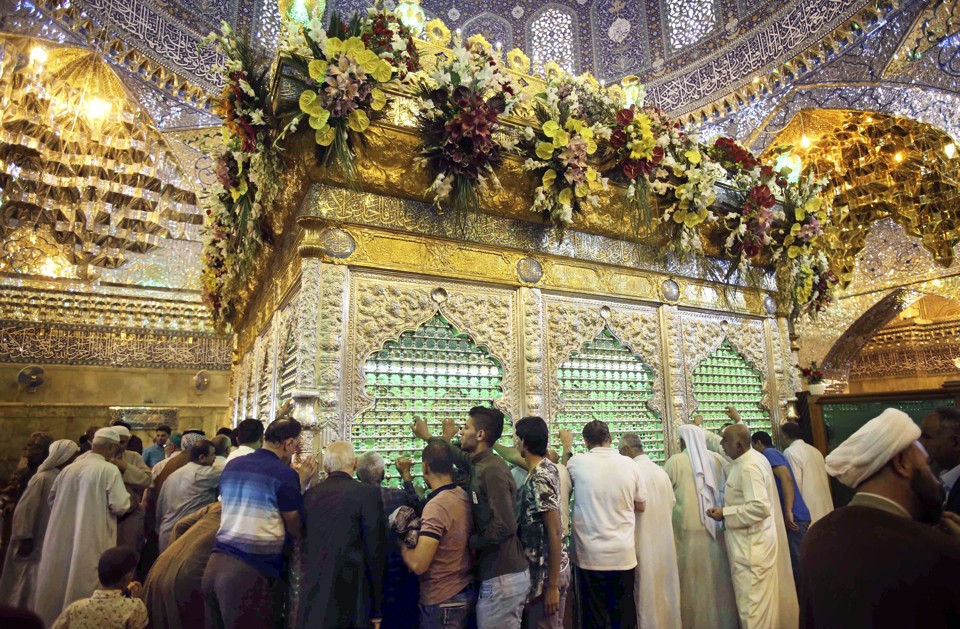
In recent years, however, a remarkable calm has taken root here. The city’s restive tribes have put aside historic feuds. Security forces have foiled Islamic State terror plots while preventing revenge attacks against ISIS sympathizers. The Askari Shrine, one of Shia Islam’s holiest sites, has been restored, after a 2006 attack, and is attracting more pilgrims than ever. Tourists from all over Iraq snap selfies at the Malwiya Tower, an Abbasid minaret that resembles a tiered wedding cake and is one of Iraq’s most famous monuments.

A visitor is hard-pressed to reconcile today’s orderly Samarra with the war zone it has largely been since the American invasion in 2003. The current calm is the product of the city’s unique experiment in nation building, or rebuilding, Iraqi-style.

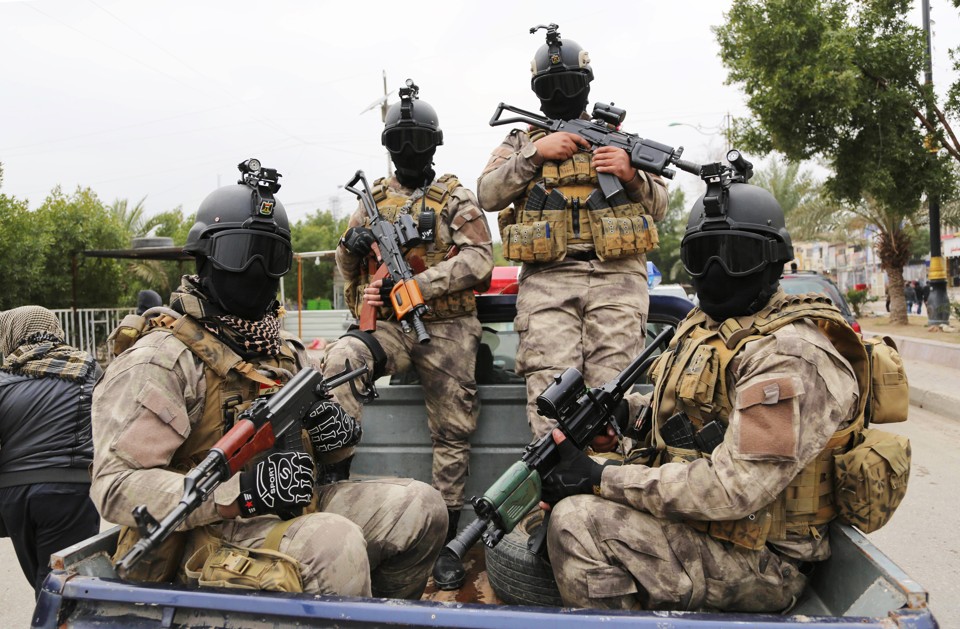
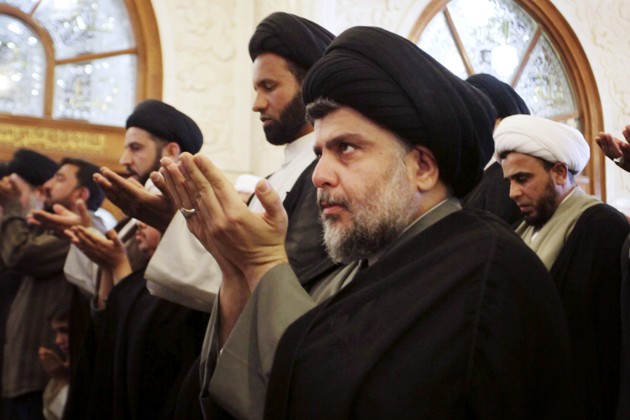
The cleric Moqtada al-Sadr dispatched the Saraya al-Salam, his widely feared militia once called the Mahdi Army but whose new name translates as the “Peace Brigades,” to secure Samarra in 2014, as ISIS forces bore down on the city. Sadr has unparalleled stature among Iraqi politicians because of his huge and enduring popular following—and because he has embraced a rhetoric of anti-sectarian nationalist unity, one that belies his militia’s record of sectarian killing during the country’s civil war, which ended in 2008.

“Peace Brigades” fighters leave Baghdad to head to Samarra in January 2016. (Karim Kadim / AP)

Sadr’s men played a major role five years ago in ensuring that Samarra did not fall to the terrorist group, and they have now undertaken the delicate task of trying to win the trust of skeptical Sunnis while reassuring Iraq’s Shia majority that they have the city under control.

[Read: After ISIS, Iraq is still broken]

The experiment in Samarra holds special significance for Iraq—and for would-be nation builders around the world. Since the end of the Cold War, there have been spectacular illustrations of how nations break apart, but no compelling examples of broken states coming back together. Should the burgeoning peace in Samarra be understood as a building block of an enduring new order, strong enough to undo the blood feuds in Iraq’s recent past, or as just one of many tactical alliances that will crumble at the first sign of real tension?

Iraq still carries the scars and baggage of state collapse and civil war, not least of which is the patchwork of militias that compete for authority with the central government. But its politicians and warlords say they understand that they all lose when they engage in sectarian feuds. Militants turned statesmen tout a new era of cooperation; they say the country has moved past the bitter violence of its civil war and the deadly years that followed the rise of the Islamic State.

Iraq today is a living test lab: Is this how functioning nations are built?


As Iraq wrested back control of territory lost to the Islamic State in 2014, it relied on Shia militias working alongside official security forces. Today those various militias wield authority in the mostly Sunni lands from the Syrian border through Anbar province and Mosul all the way to Iraqi Kurdistan; they rule alongside the national government, and sometimes in its place.

Out of all the places where Shia security forces are trying to engineer a new relationship with Sunni allies and citizens, Samarra offers the most direct assessment of whether forging a functional community out of what were once warring camps is possible. Although its residents are mostly Sunni Arabs, their tribes stretch across the nation and have a thoroughly cross-sectarian membership. And the city’s wealth has always stemmed in large part from the passage of Shia pilgrims headed to the Askari Shrine.

[Read: The Shia militias of Iraq]

The other ingredient that makes Samarra a telling trial is the man who ultimately calls the shots here: Sadr. On the national stage, Sadr has denounced sectarianism and advocated a secular government for Iraq. Hailing from a family of prominent clerics, he campaigned in last year’s parliamentary elections on a platform of reform, in coalition with Communists—and his party won the most seats. Sadr claims that he has purged the Peace Brigades of thugs who committed sectarian crimes a decade ago. Samarra is his showcase; here, he is trying to prove that patching up a broken society is possible.

His forces have reduced major attacks in the city almost to zero, and have limited the activities of the Islamic State and other extremist groups, which have long had a following here. The Peace Brigades rule Samarra with an iron grip, and at Sadr’s orders they have followed a distinct blueprint to secure the historically restive Sunni city.

Sadrists have cultivated business and political alliances with local Sunni businessmen; opposed the kidnapping of rich Sunnis for ransom, a common practice of other Shia militias; and speak with the nationalist, anti-sectarian rhetoric of their leader. Those stances have helped distinguish them from most other Shia groups in charge of other Sunni hotbeds. On the surface, the Sadrists seem to have produced a viable new order.


Nation building at gunpoint creates a combustible mix, and nowhere are relations more precarious than in Samarra’s Old City, where until not long ago Sunni merchants did vigorous business with Shia pilgrims.

In an effort to restore some semblance of vibrancy to the area, Sadr’s militia has enlisted Sunni businessmen in plans to reopen restaurants and hotels around the Askari Shrine, which lies at the heart of the Old City and is a five-minute walk from the Malwiya minaret. But there have been plenty of losers, too, in the new order, including the owners of some of the small shops in the area, which is ringed with checkpoints and blast barriers. Some streets have been entirely emptied of residents and sealed with iron gates.

Sadr attends Friday prayers at a mosque near Najaf in 2015. (Alaa Al-Marjani / Reuters)

“It’s like living under a military occupation,” groused a shopkeeper, who gave his name only as Abdelrahman. His family store is stocked with electric appliances that have no takers. “Poverty leads people to ISIS—they will plant a bomb for $100,” he said, fingering a set of white prayer beads. “We support the forces of law, but how can they get the confidence of the people like this?”

Muhannad Azawi, who has spent most of his adult life fighting in Sadr’s militias and now serves as the Peace Brigades’ spokesman in Samarra, gave the shopkeeper a long handshake and a pat on the shoulder. “We’re working on it,” he said. We shared tea with a circle of idle merchants, but as soon as we were out of earshot, Azawi made clear to me that there are no plans to reopen the market or loosen his forces’ grip on this part of the city.

He pointed along the road, toward the house where Baghdadi, the self-proclaimed caliph of the Islamic State, grew up. “ISIS didn’t come from outside this city—they came from here,” Azawi said. “ISIS is still here. And we haven’t totally uprooted them.”

[Read: The “caliphate” is gone. Where’s the “caliph”?]

Ali Majid Alawi is one of the chosen Sunnis who has thrived under the new order. He used to run a restaurant in the Old City and was one of the first to welcome the Sadrists in 2014. They rewarded him with a parcel of land and seed money for a new restaurant. Alawi controls the business and owns half of it. The Peace Brigades use the restaurant for official events and as an unofficial hangout. This type of arrangement has sputtered Samarra’s economy into slow motion.

Alawi is part of the city’s new elite, but he’s not afraid to criticize its shortcomings. He rattled off a list of failures to assembled guests at his restaurant, including several Peace Brigades fighters. “You can’t get a truckload of merchandise into town without paying a $100 bribe,” Alawi said, referring to checkpoints outside the city manned by other militias and the government. “A frightening number of people in Samarra say they would prefer the American forces to be in charge again.”

The difficult relationship many Sunnis in Samarra have with the Peace Brigades is perhaps best embodied by the Krayem tribe.

The Krayem are Sunni, and grew rich under the rule of Saddam Hussein, but are avowedly anti-extremist; they led their family militia, with about 1,000 fighters, into battle against al-Qaeda and then ISIS. They have fought alongside the Americans and, more recently, Sadr’s Peace Brigades.

Shalaan Krayem, one of the tribe’s leaders and a former parliamentarian, told me a year ago that he thought the Peace Brigades had exaggerated the threat from ISIS to justify their grip on Samarra, and to profit from their presence in the city. Since then, however, he has adopted a softer view. He now suspects that, despite their drawbacks, the Sadrists are the best guardians of his city.

“They have made Samarra into a prison. Don’t be deceived by their slogans; their words are in one valley and their actions in another,” Krayem told me recently. “But they are much better than they were a year ago, and we prefer them to the federal police or the army.”


Despite the nationalist and nonsectarian rhetoric, the fact remains that the most important decision makers in this Sunni city are Shia clerics who live a couple hundred miles to the south, in the shrine city of Najaf.

Shia Muslims visit the Askari Shrine. (Karim Kadim / AP)

Sadr is one of them; the others are the clerical authorities who control the administration of the Askari Shrine. They decide when it’s safe to allow more pilgrims to visit Samarra, and how much to pay local Sunni property owners if the shrine decides to buy up the dense surrounding neighborhood and transform it into a market, as Shia clerics have done in other Iraqi shrine cities. Local Sunnis are almost entirely shut out of the process.

“Our Sunni politicians are only interested in their own personal business,” Mahmoud Khalaf, a former Iraqi air-force pilot who has served as Samarra’s mayor since 2005, told me. He’s a Sunni politician himself, but the municipality has mostly symbolic power, so Khalaf feels like he’s exempt from his own critique. “The Shia politicians are not willing to invest in our city, because they don’t trust that it’s safe.”

There is a good reason, however, why Iraq’s political leaders don’t want to tinker with the status quo here. While politicians and analysts have for decades pointed to Kirkuk as a flashpoint that could send Iraq tumbling into an abyss, the real danger has lain in Samarra, which has none of Kirkuk’s oil or complex ethnic demographics, but whose religious symbolism turned out to be Iraq’s real tinderbox. Violence in this city, after all, sparked the apocalyptic sectarian civil war in 2006.

As state-building exercises go, Samarra’s record so far is inconclusive, but it suggests the limited possibilities for which Iraq might hope.

If a new nationalist arrangement is going to take shape in Iraq, it will grow from uncomfortable organic experiments like this one, under way in mixed-sect or Sunni areas under Shia tutelage. Success, for now, simply means a cessation of widespread violence. Whether mutual or not, minimal tolerance can evolve into active cooperation, and shared identity will be revealed after the next trial by fire that touches Iraq.

What has worked in Samarra has been this informal, evolving balance between fragmented groups that have limited authority but well-known chains of command. The city’s new stewards have stuck around long enough to build relationships while restraining their fighters. Local tribes have reached a modus vivendi with the Peace Brigades and the shrine administration, enough to get along, prevent violence, and even make a little money.

But so far, the promise hasn’t gone much further: The emergency seems to be over, but real state building remains a dream.

Wednesday, 8 May 2019

Privacy Experts, Senators Demand Investigation of Amazon’s Child Data Collection Practices

Last year, a coalition of privacy advocates and child psychologists warned against putting an Amazon Alexa speaker anywhere near your child on the fairly reasonable grounds that developing minds shouldn’t befriend always-on surveillance devices, no matter how cute the packaging. Now, a group of privacy researchers, attorneys, and U.S. senators are calling on the Federal Trade Commission to investigate Amazon’s alleged violations of COPPA, a law protecting the littlest users of all.

COPPA, the Children’s Online Privacy Protection Act, regulates how companies can collect and use data on users who might have trouble spelling “privacy,” let alone understand it enough to consent to relinquishing it. COPPA is the reason why so many sites, like Facebook, simply don’t allow children under 13 to sign up. Amazon, on the other hand, decided to court children for its data collection business, releasing the Amazon Echo Dot Kids Edition, an always-listening “smart speaker” that retains all of the functions of its adult counterpart, but tucks them inside a candy-colored shell. The kiddo speaker also adds child-specific features, like the ability to have Amazon’s virtual assistant Alexa read your child a story in her disembodied robo-voice, or play child-geared content from sources like Cartoon Network and Nickelodeon.

A new complaint drafted by the Campaign for a Commercial-Free Childhood, the consumer privacy group Center for Digital Democracy, and Georgetown University’s Institute for Public Representation says that Amazon is committing a litany of COPPA violations through the Echo Dot Kids Edition, and calls on the FTC to investigate.

Amazon’s COPPA violations, according to the complaint, include failure to provide parental notice and obtain parental consent for online services related to the kids’ Echo Dot, failure to tell parents that they have a right to review personal information submitted by their child, and failure to provide parents a way to delete such information or opt out of its collection.

Across 96 pages, the complaint gets more specific, offering examples of how Amazon dodges, obscures, and otherwise neglects its duties to parents. Given that the attorneys who drafted the complaint were confused by Amazon’s byzantine policies, it’s hard to imagine average parents faring much better:

Even if parents were for some reason motivated to seek out the website version of the Children’s Privacy Disclosure, the hyperlinked Privacy Notice is long, confusingly written, and contains a lot of unrelated material. It is unclear what, if any, parts apply to the Echo Dot Kids Edition, and some of the information seems to contradict the Children’s Privacy Disclosure. For example, the Privacy Notice discloses that Amazon collects “search term and search result information from some searches conducted through the Web search features offered by our subsidiary, Alexa Internet,” but it does not say whether it does so when a child is using the Echo Dot Kids Edition.

Perhaps most troubling is what the complaint says about Amazon’s treatment of child voice recordings, which aren’t supposed to be stored indefinitely, per recent FTC guidance: “The answer is clear: No, the company can’t keep it. Under Section 312.10 of COPPA, you’re allowed to retain children’s personal information ‘for only as long as is reasonably necessary to fulfill the purpose for which the information was collected.'”

But Amazon takes a different approach, the complaint explains: “In response to a Congressional inquiry about how long it keeps recordings and other information collected from children, however, Amazon responded: ‘Voice recordings are retained for the parent’s review until the parent deletes them.'” In other words, Amazon is keeping a child’s Amazon queries stored indefinitely, not “for only as long as is reasonably necessary.”

Worryingly, the researchers found that even if a concerned parent attempted to manually delete their child’s Alexa recordings, the feature is simply broken. In one example, Amazon recorded a young girl asking Alexa to remember a list of personal facts, such as a phone number, home address, and walnut allergy. When this same girl then asked Alexa to forget these things, the robot replied, “Sorry, I’m not sure about that.” Attempts to manually delete these recordings using software designed for parents appeared to have zero effect.

A demonstration of this apparent inability to forget is provided in a video created by the researchers:

In addition to the academics, advocates, and privacy researchers involved in its drafting, four senators are also supporting the complaint: Democrats Edward Markey of Massachusetts, Dick Durbin of Illionis, and Richard Blumenthal of Connecticut, along with Republican Josh Hawley of Missouri. In a letter addressed to FTC Commissioner Christine Wilson co-signed by his fellow senators, Markey wrote, “The Echo Dot Kids Edition captures not only the voice recordings of the children who speak to it, but also vast amounts of their personal information,” citing the new research. More than a dozen advocacy groups have also signed on to the original complaint, including the Consumer Federation of America, the Electronic Privacy Information Center, the Parents Television Council, and the U.S. Public Interest Research Group.”

Privacy policies aren’t generally written to be read by regular people, let alone understood, so none of the above should come as a surprise to anyone who’s tried to decipher one. A company is far likelier to get away with an invasive or otherwise unsavory data collection practice if its disclosure is buried beneath a tangle of legalese and vagaries. So far, there’s no law against asking adults to agree to an incomprehensible policy document before they can use your gadget or app. But there’s little point in having COPPA on the books if child privacy compliance is as hopelessly and inscrutably sloppy as what an adult might be up against on their own.

In a statement provided by an Amazon spokesperson, the company denied that it violates COPPA: “FreeTime on Alexa and Echo Dot Kids Edition are compliant with the Children’s Online Privacy Protection Act (COPPA). Customers can find more information on Alexa and overall privacy practices here: https://www.amazon.com/alexa/voice.”

The post Privacy Experts, Senators Demand Investigation of Amazon’s Child Data Collection Practices appeared first on The Intercept.

A U.S. Ally Is Turning to China to ‘Build, Build, Build’

CLARK, Philippines—Vince Dizon makes sure his guests take in the view from his ninth-story office before they leave. A set of windows looks out over a hazy, expansive airfield that was the center of the United States’ largest overseas military base, until it was handed back to the Philippines in 1991.

The concrete skeleton of a new commercial-airline terminal can now be seen in the distance. Dizon, who leads the Philippine government agency charged with redeveloping old military sites, is fond of telling visitors that the Americans built a runway of such quality that the U.S. Space Shuttle could have landed on it.

Three decades on, the area is still dotted with vestiges of Clark Air Base, where Americans first established a presence during the Spanish American War while searching for grazing land for their horses. A manicured veterans cemetery is managed by the U.S. government; a building that was once a base hospital sits abandoned outside the gates of a new water park; an American Legion post is wedged between two “entertainment bars”—the infamous red-light district, which flourished thanks to demand from U.S. troops, didn’t leave when they did.

Now, though, the Chinese, not the Americans, are the ones fueling investments here. Officials from Dizon’s agency, the Bases Conversion and Development Authority, and China’s Gezhouba Group, an engineering and construction company that has moved aggressively into foreign markets in recent years, are finalizing the details of a $2 billion, 500-hectare industrial park, Dizon told me, while Chinese loans will fund a railway linking Clark to the coastal city of Subic, the site of a former U.S. naval base.

[Read: The U.S. can’t make allies take sides over China]

The projects are part of Philippine President Rodrigo Duterte’s aptly, if not creatively, named “Build Build Build” economic strategy, under which the government plans to transform the Clark base into a green, disaster-resilient, stand-alone city that developers hope will relieve pressure on Manila, the perpetually gridlocked capital some 60 miles south.

Chinese investment in what will be known as New Clark City “is critical,” Dizon said in an interview. “It is how it all started.” He sees the investments as symbols of a “newfound friendship and relationship” between Manila and Beijing. It is one of several similar projects launched across the Philippines, and across Southeast Asia, as China and Chinese companies plow money into projects, largely as part of Chinese President Xi Jinping’s much-touted Belt and Road Initiative. The globe-spanning infrastructure and investment program has been criticized by Washington, but has nevertheless won admirers: Last month, Italy became the first major European economy to join.

This redevelopment of a former symbol of American might here in Clark by a Chinese developer may be the best example of the shift under way in Southeast Asia, as a more assertive Beijing courts traditional American allies in a part of the world where Washington’s power long went unchallenged. “It is so important,” Dizon, who worked on Duterte’s presidential campaign in communications and was appointed to his current job by the president, said. “I think it will be one of the major legacies of this shift in foreign policy under President Duterte.”

Though Southeast Asian countries such as the Philippines say they still need an American military presence in their backyard and fear a rising China—Duterte himself has told Beijing to “lay off” an island claimed by the Philippines in the South China Sea—a debate is raging on what that relationship with Washington should now look like. Analysts that I spoke with noted worries in the region that President Donald Trump’s White House appeared uninterested in Southeast Asia compared with its predecessors. At the same time, staunch American allies, including Indonesia, the Philippines, and Thailand, have looked to China as the rare country that is hungry to sink billions into infrastructure projects and fund development.

To be sure, China’s efforts in Southeast Asia have not been without difficulties. Beijing has inserted itself as a power broker in Myanmar’s (also called Burma) long-running civil wars and Rohingya crisis, and has stirred public resentment as it pushes to restart a highly controversial, and currently suspended, hydropower dam project. Though Malaysia has recently revived two major Chinese-backed projects, it had initially turned away Belt and Road investments whose price tags became too high to bear. And even as the Philippines invites Chinese investment, it has almost no security relationship with Beijing. (By contrast, Manila maintains exceptionally close ties with Washington, its former colonizer, which is still widely trusted and respected here.)

[Read: China is quietly reshaping the world]

Yet the shift in ties between the Philippines, as well as much of the rest of Southeast Asia, and the U.S. is clear. Vacancies for ambassadorships in the region have piled up and include Singapore and Thailand. Trump has yet to name an ambassador to ASEAN, the regional bloc, and Patrick Murphy, the nominee for ambassador to Cambodia, continues to face confirmation delays. David Stilwell, nominated last year to be assistant secretary of state for East Asian and Pacific affairs, also has yet to be confirmed.

Barack Obama—who lived for part of his childhood in Indonesia—took a particular interest in Southeast Asia, and while his administration’s “pivot to Asia,” meant to be a centerpiece of his foreign-policy legacy, was never fully realized, even those limited efforts have not been replicated. A 2016 summit convened by Obama with Southeast Asian leaders, the first of its kind, has not been held again. After attending part of the 2017 ASEAN Summit, Trump skipped two Southeast Asia–focused meetings last year.

The Trump administration has defended its handling of Southeast Asia. In particular, the White House has sent a large number of officials to visit the region. Murphy, who currently serves as the principal deputy assistant secretary for East Asian and Pacific affairs, met with Southeast Asian officials in March to “reaffirm our embrace of ASEAN centrality.” An increased number of military operations in the South China Sea have also been a central, and highly visible, part of the administration’s efforts to push back on China’s combativeness in the contested waters. And Washington, which will publish an Indo-Pacific strategy report this year, has announced new funds for technological and infrastructure initiatives across Southeast Asia, though the amounts on offer are a fraction of what China is spending.

These moves are not gaining much traction. A February survey of 1,008 Southeast Asian experts, business leaders, and policy makers by the ISEAS-Yusof Ishak Institute, a think tank in Singapore, found that 68 percent believed that U.S. engagement with the region has either decreased or decreased substantially. A similar proportion were unsure of, or had little confidence in, Washington’s reliability as a strategic partner and provider of regional security. Separate surveys last year from the Pew Research Center and Gallup found Trump’s image remains poor internationally, while countries continue to recognize the rising power of China.

[Read: China’s plan to buy influence and undermine democracy]

“How can you reportedly be spending so much time in Asia and yet not [be] reassuring anybody by doing it?” Greg Poling, director of the Washington-based Asia Maritime Transparency Initiative, part of the Center for Strategic and International Studies, told me. “There is a sentiment in Southeast Asia that U.S. officials come in and want to lecture about the things that matter to us and don’t have nearly enough patience for the things that matter to Asian partners.”

Nina Hachigian, who served as the U.S. ambassador to ASEAN during the Obama administration, said she doesn’t see “the strategic vision for Asia as a whole and what the U.S. role and interests are.” Hachigian, who now works in the Los Angeles mayor’s office, added that China could exploit that to tell regional allies “that we can’t be trusted, that we are not really Asian anyway, that we are unreliable, that we will leave, that we are only in it for our own interests.”

China’s infrastructure-building is perhaps something that the U.S. does not want to, or cannot, compete with—Manila’s finance secretary, Carlos Dominguez III, for example, publicly lamented last year that American investors “have no interest” in the country’s redevelopment plans. But the U.S.’s once rock-solid defense ties may also be under pressure.

Recent focus in Manila has been on the Mutual Defense Treaty, which was signed in 1951, five years after the Philippines gained independence from Washington. Secretary of State Mike Pompeo in March reassured the Philippines that the U.S. would come to the country’s defense if it were attacked in the South China Sea—a significant statement that aimed to address long-standing consternation here over the lack of a firm American position on the issue. But just a week later, Philippine Defense Secretary Delfin Lorenzana said that it was not the lack of reassurances that worried him, but rather that the Philippines would be drawn into “a war that we do not seek and do not want,” noting that increased U.S. naval operations meant the Philippines “is more likely to be involved in a shooting war.”

While stressing that the two countries remain steadfast allies, Sung Kim, the U.S. ambassador to Manila, admitted to me in an interview that “it may not be the simplest time to be working on the U.S.-Philippines relationship for various reasons.” He pointed to “political rhetoric” from the infamously brash Duterte as one of the factors that complicated the relationship. The U.S., Kim said, was looking at whether “any adjustments could be made to update and improve” the 1951 treaty, issues that might be “identified together” with counterparts from the Philippines. (Changes to the text of the treaty, though, would require ratification from lawmakers in both countries.)

Dizon’s concerns are more immediate: He is hoping to drum up more Chinese support for New Clark City. Local media reported that two deals were signed between China and the Philippines at a Belt and Road event in Beijing in April. As I said goodbye to Dizon after our interview, a team from Chinese state television was waiting outside his office, getting ready to film a story on the enormous construction project. The Clark development would, he told me as he walked to join them, “spur the long-term relationship between China and the Philippines.”

Tuesday, 7 May 2019

The Far Right Wants to Gut the EU, Not Kill It

BERLIN—Ahead of this month’s European Parliament elections, the far-right populist Alternative for Germany (AfD) party has been advocating leaving the euro zone and even, potentially, the European Union entirely.

A few years ago, the party membership’s decision to include a so-called Dexit in its 2019 platform—dependent, they say, on whether or not the EU accedes to its demands for significant reforms, including dissolving the European Parliament—would hardly have been notable. After all, the AfD was founded in 2013 as an anti-euro movement, and its counterparts across Europe rose to new electoral heights in part by portraying themselves as the bloc’s chief foes.

But among today’s far-right populist parties, that part of the AfD’s platform is more an exception than the rule. Leaders such as Marine Le Pen, of France’s National Rally, and Matteo Salvini, of Italy’s League, keen to consolidate right-wing support domestically and be taken more seriously internationally, have changed their tune when it comes to the EU. Instead of talking about referendums on EU membership or ditching Europe’s common currency, they advocate for a “Europe of nations” and more pragmatic change “from within.” Even the AfD’s top leaders seem to recognize that campaigning on Dexit isn’t as electorally helpful as it once was: The party now also talks about a “Europe of nations,” and co-leader Alexander Gauland has stressed that the AfD sees leaving the EU as a last resort and would prefer to “correct” it than “abolish” it.

The ultimate goal of the AfD and other parties, of course, remains the same: to return more decision-making power from the EU to the national level, particularly on policies related to refugees and migration. Were these parties to get their way, the EU would be gutted of all but its most basic duties—and after decades of greater integration and moves toward an “ever closer union,” the trajectory of Europe would turn back to having countries fend far more for themselves.

“None of them want to come across as crazy right-wing populists anymore—they all want to come across as serious politicians that represent the main right-wing party of their country,” Catherine Fieschi, the executive director of Counterpoint, a London-based think tank, told me. “They’ve all gone from deciding the best thing they could do is agitate and say outrageous stuff, to realizing … their best bet is actually to use [the EU] to make sure that they graduate to the next step, of legitimate politician.”

[Read: A new European political bloc wants to dismantle Europe]

Europe has had a difficult decade: Two major crises, one financial and one migration-related, have helped fuel euroskeptic rhetoric and given rise to parties that espouse it. After the 2008 financial crisis, the EU’s decision to bail out debt-ridden countries such as Greece helped bring about anti-euro movements. And when an influx of refugees arrived in Europe in 2015 and 2016, the resulting debate over who—if anyone—should take them in became the primary mobilizing issue for far-right parties.

Running as a euroskeptic in European Parliament elections seems, at first glance, a bit counterintuitive. If a party favors getting rid of EU structures entirely, why is it fielding candidates to serve in one of the bloc’s main institutions? When leaders of these groups have an answer to that question, they’ve suggested that as long as the EU exists, a seat at the table is better than being left standing on the outside. But contradictions aside, euroskeptic, far-right parties have typically performed well in European elections, benefiting from low turnout and a core base of energized supporters ready to air their grievances.

Still, the tide has changed since the last time these parties ran a European-level campaign—public support for the EU remains fairly high in many of their respective countries, and the ongoing Brexit saga makes replicating Britain’s path less palatable. In a Eurobarometer survey last fall, a record 68 percent of EU residents said that being part of the bloc has benefited their respective countries.

When Le Pen ran for president of France in 2017, opponents painted her as the potential destroyer of the EU. Anti-EU rhetoric, and especially her proposal to leave the euro zone, played a pivotal role in her campaign pitch. But after flopping in a televised debate when asked how her plan to ditch the euro would actually work, Le Pen paid the price at the polls, losing to now-President Emmanuel Macron by 32 points. After the election, she vowed to lead a “deep transformation” of her party and acknowledged that her strategy on Europe hadn’t helped. “We have heard the French people,” she said later that year. “In numerous areas it is possible to improve the daily life of the French without quitting Europe or the euro currency.”

[Read: How to discuss the far right without empowering it]

Italy’s Salvini has a similar story. After rising to the leadership of his far-right League in 2013, Salvini intensified the party’s rhetoric on both the euro and immigration. His strategy took the League from a struggling regional movement to a national force, earning 17 percent of the vote in last year’s Italian elections. Since entering into a governing coalition with the antiestablishment Five Star Movement last year, however, he’s taken a more pragmatic tack on Europe and talks today about “common sense” solutions and reforms, even as he blasts the bloc for its handling of migration policy. At his gathering of like-minded far-right parties in April, the tagline Towards a Common Sense Europe! appeared on a banner. “We don’t want to leave anything; we want to change the rules of the EU from the inside,” Salvini told Italian television in December.

In Austria, too, the far-right populist Freedom Party (FPÖ) had long been critical of the EU; some of its leaders even raised the possibility of a referendum for an “Oexit,” using the German name for Austria, Österreich, to build on the Brexit portmanteau. But when the FPÖ entered a governing coalition with Sebastian Kurz and his center-right People’s Party, in late 2017, Kurz took pains to make clear that the FPÖ had committed to a “pro-European” government. Standing alongside Kurz, the FPÖ’s leader, Heinz-Christian Strache, said at the time: “We stand by the European Union; we stand by Europe’s peace project.” (And earlier this year, the FPÖ’s top candidate in the European elections, Harald Vilimsky, said the party never actually wanted to leave the EU.)

The same transformation can be seen elsewhere. Jimmie Åkesson, the head of the right-wing populist Sweden Democrats, wrote in the Swedish newspaper Aftonbladet recently that his party was revising its stance on the EU. In order to truly be effective in today’s European political environment, Akesson wrote, one must “be pragmatic and fully utilize the opportunities that exist.”

How, precisely, these parties intend to actually reform Europe is typically not well explained. Apart from weakening the decision-making power of EU institutions and generally handing key functions back to individual nations, they have offered little in the way of concrete plans. Even among themselves, little agreement seems to exist, beyond the overall belief that Islam is a threat to what the parties perceive as a Christian Europe, and their desire to keep refugees and migrants out.

[Read: How the far right weaponized Europe’s interior ministries to block refugees]

“It’s mainly empty rhetoric; it’s really vague,” says Julian Göpffarth, a researcher at the London School of Economics who focuses primarily on the German far right. “I don’t think they have a real concept of what the EU would look like in the future.”

But these concerns will presumably only come to a head after this month’s vote is over. In the meantime, far-right leaders see a strong performance in the European Parliament elections as a key step toward being taken seriously as legitimate political players—and surely consider their toned-down EU rhetoric a way to realize that goal.

Jordan Bardella, the top candidate for Le Pen’s National Rally, put it this way in January: “There is this last step to reach—that of credibility, and we’re doing it.”