Monday, 25 March 2019

Mueller Was Trump’s Nemesis—Now He’s His Greatest Asset

More than 675 days, 19 lawyers, 40 FBI agents, 2,800 subpoenas, and 500 search warrants later, Attorney General William Barr has announced the core finding of Robert Mueller’s Russia probe: no collusion. The verdict was quickly celebrated by a White House legal team whose strategy was to treat the investigation more as a public-relations battle than as strictly a legal fight.

In a letter delivered on Sunday afternoon to Congress, Barr summarized Mueller’s principal conclusions, marking the end of an inquiry that shadowed Donald Trump’s presidency from the start and led to the indictment or conviction of a raft of campaign aides and associates. Barr wrote that according to Mueller, neither the Trump campaign nor anyone associated with it conspired or coordinated with Russians to win the election—despite “multiple offers” from “Russian-affiliated individuals” to assist the campaign. Mueller’s findings on whether Trump obstructed justice were far less definitive. Unlike on collusion, Barr wrote, Mueller was unable to make a judgment one way or the other: “While this report does not conclude that the president committed a crime, it also does not exonerate him.”

It was enough for the White House, however, to claim victory. If Trump’s team had one overarching theory since the special counsel’s probe began, it was that Mueller posed less of a legal threat than a political problem. Mueller’s conclusions, as explained by Barr on Sunday, appeared to vindicate that approach. Now, in a supreme irony, Trump figures to invoke the Mueller report in his 2020 reelection bid, making the case that an inquiry he labeled a “witch hunt” failed to prove any criminality, said campaign and legal associates, who requested anonymity in order to speak freely.

[Read: After Mueller, the ongoing investigations surrounding Trump]

The initial reaction from the White House was triumphant. “As we already knew, NO COLLUSION! Nothing different from what President @realDonaldTrump has been saying for the past TWO YEARS!!!” the White House’s social-media director, Dan Scavino, tweeted moments after Barr’s letter was posted online. Shortly thereafter, Press Secretary Sarah Huckabee Sanders offered an official statement from the White House. “The findings of the Department of Justice are a total and complete exoneration of the President of the United States,” she tweeted. Soon, the president himself broke his silence. Speaking to reporters before boarding Air Force One for his flight home from Palm Beach, Florida, Trump said, “It was complete and total exoneration. It’s a shame that our country had to go through this. To be honest, it’s a shame that your president had to go through this.”

The coming days and months will show how widespread that interpretation of Mueller’s report will be. Trump is hardly out of the woods legally, with congressional committees and other prosecutors at the federal and state levels examining his connections to Russia, his business dealings, and his private charity, among other matters. Indeed, the next two years could be just as busy for Trump’s legal team as the past two. But their mission is likely to stay the same: All along, they took the view that Trump had committed no crimes and couldn’t be indicted under Justice Department policy. They largely saw their role as preserving Trump’s electability—and that included inoculating him from a potentially damning final report from Mueller.

Their methods, however, differed.

At an early point, Trump’s lawyers sought to accommodate Mueller, in hopes of bringing the probe to a quick end. That’s what Trump wanted. He detested the investigation and wanted it stopped. “It was impeding and interfering with his ability to be president, which was an outrage,” Trump’s former lead outside lawyer, John Dowd, told The Atlantic. “It’s very upsetting when you’re in the middle of really important negotiations—trade negotiations and other things. And [Trump] would get asked about it.”

One of Trump’s complaints was that Mueller had a personal grudge. He has made reference to a 2011 dispute with Mueller over membership fees at Trump’s golf course in Northern Virginia. But his lawyers never made that an issue, believing that cooperation was the path to ending the probe. They made witnesses and documents available, avoiding legal showdowns over executive privilege.

In hopes of speeding things along, Trump and his legal team considered giving an interview to Mueller, discussing a sit-down at Camp David at the end of January 2018. But in the end, Trump’s lawyers concluded that face-to-face testimony would be too risky. They instead gave answers to Mueller in writing. “I didn’t want to put [Trump] in that position,” Dowd said, adding that “he does the best he can, but isn’t always right on the money.”

As time passed, Trump began to recognize that Mueller wasn’t going away, and changed tactics. He stepped up efforts to turn public opinion against the special counsel, and clashes among him, Dowd, and Ty Cobb, a White House lawyer who favored a more cooperative approach, became more frequent. Dowd resigned in March 2018, and Cobb stepped down two months later.

Into the void stepped Rudy Giuliani, whose appetite for combat matched that of Trump. Giuliani told The Atlantic that he built his strategy around public polling that showed Mueller was far more popular than the president. “I said we had to defend him legally, but we also have to defend him publicly,” the former New York mayor said. In his view, the prospect of a “nasty report” wasn’t Trump’s biggest concern; it was how popular, or unpopular, he would be by the time of its release. A “mild” report coupled with an unpopular president could have still opened the door to impeachment. But if Trump’s approval ratings were on the rise, House Democrats “may not take the risk,” Giuliani said.

Giuliani likened what came next to a public-relations campaign: “I said … we’ve got to go public, and we’ve got to point out what’s wrong with Mueller and what’s wrong with the investigation.” Trump was all too happy to oblige. His tweets targeting Mueller picked up. Over and over, he described the probe as a “witch hunt.” “We will be doing a major Counter Report to the Mueller Report. This should never again be allowed to happen to a future President of the United States!” Trump tweeted in December.

Polling showed that the attacks had some success. A CNN survey in December showed that 43 percent approved of Mueller’s handling of the investigation—down five points since October. A Suffolk University/USA Today poll this month showed that 50 percent agreed with Trump’s characterization of the Mueller probe as a “witch hunt,” compared with 47 percent who did not agree.

[David Frum: The question the Mueller report has not answered]

Still, not everyone in Trump’s orbit liked the assault. Cobb told The Atlantic recently, “My views of Bob Mueller’s professionalism and character are well known. I’ve never been comfortable with the term witch hunt.” Giuliani said he knew that others in the West Wing weren’t pleased with his more aggressive tactics either. “The White House has been mad at me from the beginning,” he said. “Because they wanted to cooperate, cooperate, cooperate. They didn’t want to fight back.” But Giuliani never cared much about anyone’s opinion other than the president’s. “Trump has been very happy with it—I don’t care about them,” he said. “He’s my client.”

How the White House will respond to Mueller’s conclusions and Democrats’ reaction in the days to come remain open questions. As anticipation built last week for the release of something, anything, Trump’s legal team privately wondered whether a simple announcement from Barr that he had received the report was preferable to releasing its findings immediately. “I’d almost be willing to say, ‘Put out whatever you got, because we can answer it,’” Giuliani said.

Giuliani said in an interview on Friday that he had full and condensed versions of an 87-page counter-report ready to deploy the moment Mueller’s findings were made public. If Mueller were to accuse the president of wrongdoing, Giuliani predicted, it would likely be for obstruction of justice rather than collusion. “I can’t imagine they’re going to do anything on [collusion],” he said. “I think if they’re going to do anything nasty they’re going to do it on obstruction,” he added, referencing Trump’s dismissal of former FBI Director James Comey, as well as the conversation Comey and Trump reportedly had in which the president asked him to “let go” of an FBI inquiry into former National Security Adviser Michael Flynn. Now, with Mueller having made no conclusion about obstruction in his report, the matter will fall to Congress and its investigations.

Mueller’s report looks to become a Trump-campaign selling point. Not too long ago, that would have seemed unfathomable. Trump has spent much of his presidency demonizing Mueller. On Friday, Trump questioned whether the special counsel even had the standing to write the report. No one voted for Mueller, Trump said; why should he get to pass judgment on a duly elected president?

Now, though, an investigation that once seemed to imperil Trump’s presidency could conceivably help him prolong it, said close Trump associates speaking on the condition of anonymity. They said that if even Mueller couldn’t find wrongdoing, surely none exists. “This is the most powerful investigatory team in the 21st century, tasked with finding out if a candidate for president conspired with a rival to take control of the government. And they succeeded in proving that he didn’t,” says Michael Caputo, a senior adviser to Trump’s 2016 campaign. “It’s an incredibly successful talking point and an aggressive campaign message.”

Its ultimate success—that is, Trump’s reelection—could depend on what congressional investigators and other prosecutors find out. But for now, Trump’s legal team is as chipper as it was when it learned that the investigation was over. “It’s a great day in Washington. The weather got nice as soon as the report was submitted,” Giuliani enthused in a phone call on Saturday. “God loves Republicans. Well, maybe not all of them, but enough.”

Sunday, 24 March 2019

Violent Far-Right Extremists Are Rarely Prosecuted as Terrorists

On a narrow street in Charlottesville, Virginia, James Alex Fields Jr. pressed the accelerator of his gray Dodge Challenger. Dozens of people were walking in front of him. They had come to protest Fields and hundreds of other white supremacists who’d descended on this pleasant Southern college town for the “Unite the Right” rally in August 2017.

“Our streets!” the protesters chanted in response to the white supremacists. “Our streets!”

When some protesters realized the gray car wasn’t stopping, they screamed. Then came the scrapes and thuds and finally a crash as Fields barreled into the crowd, sending people into the air and diving for safety, before the Dodge slammed into the back of another car.

“Holy shit!” one of the protesters said. “That Nazi just drove into people. Oh my God! We need paramedics right now!”

Fields then shifted the car into reverse and backed out toward the main road, the front bumper scraping the pavement and the engine squealing.

Heather Heyer, a 32-year-old Charlottesville resident, was killed in the attack. At least 19 others were hurt.

Fields, a 20-year-old from Ohio who had been open about his racist views since high school, had marched in Virginia with the white supremacist group Vanguard America. He was charged in Virginia state court with murder and in federal court with hate crimes. He was not charged as a terrorist, despite then-Attorney General Jeff Sessions having initially described the Charlottesville attack as meeting “the definition of domestic terrorism.”

In announcing Fields’s federal indictment 10 months later, however, Sessions avoided using the word “terrorism” altogether, saying instead that the Justice Department remains “resolute that hateful ideologies will not have the last word and that their adherents will not get away with violent crimes against those they target.”

An Intercept analysis of federal prosecutions since 9/11 found that the Justice Department has routinely declined to bring terrorism charges against right-wing extremists even when their alleged crimes meet the legal definition of domestic terrorism: ideologically motivated acts that are harmful to human life and intended to intimidate civilians, influence policy, or change government conduct.

If Fields had been a Muslim aligned with an international terrorist group, the Justice Department almost certainly would have handled his case differently. According to The Intercept’s review, 268 right-wing extremists prosecuted in federal court since 9/11 were allegedly involved in crimes that appear to meet the legal definition of domestic terrorism. Yet the Justice Department applied anti-terrorism laws against only 34 of them, compared to more than 500 alleged international terrorists.


The FBI has acknowledged that federal prosecutors charge many violent domestic extremists with crimes other than terrorism, saying that simpler charges are often more effective in such cases. But the consequences of treating domestic and international terrorism differently are broad and deep. Terrorism charges carry stiffer penalties and often serve as an official statement about the severity of the offense.

“Terrorism is considered the most important kind of crime,” said Jesse Norris, a criminal justice professor at the State University of New York at Fredonia. “It’s not a crime against some; it’s a crime against all. When you put people and crimes in that category, it places more importance on them. People take these crimes more seriously. That’s why it’s a problem that we have this double standard in classifying international terrorism violence as terrorism and domestic terrorism violence as not terrorism.”

Take the case of Sayfullo Saipov, an Uzbek immigrant, who drove a rented Home Depot truck through a bike lane in Lower Manhattan nearly three months after the Charlottesville attack, killing eight people. Saipov, who was injured in the assault, was so proud of his militant allegiances that he asked federal agents if he could display the Islamic State’s black flag in his hospital room.

Saipov’s crime was almost identical to Fields’s, but Sessions called his attack “a calculated act of terrorism in the heart of one of our great cities.” He was charged in federal court with murder and providing material support to ISIS.

Both Saipov and Fields grabbed the nation’s attention. Both were extremists who allegedly turned vehicles into deadly weapons. But because one was motivated by a foreign extremist ideology and the other by a domestic one, federal prosecutors treated one as a terrorist and the other as a crazy white guy filled with rage.

As a string of deadly attacks and plots by alleged domestic terrorists have made headlines in recent months, there is some evidence that federal prosecutors and law enforcement may be changing their approach. Officials have repeatedly used the term “domestic terrorist” to describe Christopher Hasson, a Coast Guard lieutenant and self-described white nationalist arrested last month for allegedly plotting to kill politicians and journalists, though they have yet to charge him with a terrorism offense. And current and former Justice Department officials have begun talking more openly about domestic terrorism as a pressing concern.

Nevertheless, a significant disparity remains in how these two types of ideologically motivated violence are handled, one rooted in the highly politicized way that U.S. laws and Justice Department officials define acts of terrorism. Terrorism has always been a political construct — there’s even a cliché for this — but its legal definition in the United States dates back only to 1986, when the Omnibus Diplomatic Security and Antiterrorism Act made terrorist attacks against U.S. diplomats or citizens traveling abroad a crime.

In the 1990s, the Biological Weapons Anti-Terrorism Act and the Antiterrorism and Effective Death Penalty Act made acts of terrorism committed within the United States, including those inspired by domestic ideologies, federal offenses. Before these laws, there was no crime of terrorism under the U.S. penal code, and it was only after the 9/11 attacks that anti-terrorism laws came to be widely used in federal criminal prosecutions. Such laws have raised critical questions among legal scholars and civil libertarians about whether the inherent difficulty in defining terrorism essentially guarantees prosecutorial abuse.

Domestic terrorism suspects enjoy basic legal protections denied to those accused of ties to international terrorism.

The U.S. State Department provides a broad framework — and the political cover that goes with it — for federal prosecutors to bring charges against alleged international terrorists. In those cases, charging someone with terrorism is relatively simple. The State Department administers a list of designated foreign terrorist organizations; anyone caught supporting one of these groups can be charged with terrorism-related crimes.

Domestic terrorism suspects enjoy basic legal protections denied to those accused of ties to international terrorism. Because of First Amendment concerns that a list of domestic terrorist groups would unconstitutionally criminalize unpopular ideas and ideologies, there is no such list, making the abusive types of prosecutions used to target alleged international terrorists more difficult to pursue against domestic actors. But prosecutors still have plenty of legal tools at their disposal to go after alleged domestic extremists.

Among them is an expansive law against providing material support to terrorists, which has two provisions. One outlaws nearly any kind of support to organizations on the list of State Department-designated foreign terrorist groups, and has been widely and controversially used by prosecutors to tar even nonviolent political or charitable activity with the international terrorism brush.

“The material support regime as a general matter is extremely broad, and we have concerns about its overbreadth and vagueness,” said Hina Shamsi, director of the American Civil Liberties Union’s National Security Project. “A disturbingly high number of material support prosecutions, including abusive sting operations, are against people who don’t actually have a tie to a terrorist or extremist group or haven’t actually committed a violent act or even attempted to commit a violent act.”

But the other provision of the material support law allows the Justice Department to prosecute suspects for their role in supporting about 50 proscribed offenses, including bombing government buildings, murdering government employees, using weapons of mass destruction, and hostage taking. The material support law does have some practical limitations concerning domestic extremists. Attacks not involving a bomb or radiological device — such as Dylann Roof’s mass shooting in South Carolina or Fields’s car attack in Virginia — require the killing or attempted killing of a U.S. government employee or the destruction of U.S. government property for the material support law to be applicable. There are no such legal requirements under material support when the attacker is affiliated with or inspired by an international terrorist organization.

WASHINGTON, DC - OCTOBER 26 - President George Bush delivers speech before signing Patriot Act Anti-Terrorism Bill at the White House. Shown next to Bush,  Vice President Dick Cheney, shown in background (L-R) Rep. James Sensenbrenner, Attorney General John Ashcroft, FBI Director Robert Mueller and CIA Director George Tenet. (Photo by Rich Lipski/The Washington Post via Getty Images)

President George W. Bush delivers a speech before signing the Patriot Act at the White House on Oct. 26, 2001. Behind Bush are Vice President Dick Cheney, Rep. James Sensenbrenner, Attorney General John Ashcroft, FBI Director Robert Mueller, and CIA Director George Tenet.

Photo: Rich Lipski/The Washington Post via Getty Images

Terrorism by the Numbers

Hundreds of prosecutions of Muslims on terrorism charges in the wake of the 9/11 attacks have created the perception that international terrorism is a significantly graver and more persistent threat in the United States than right-wing domestic extremism. But whether one is more serious than the other is the subject of ongoing debate. Some studies by academics, think tanks, civil rights groups, and news organizations have suggested that right-wing terrorism poses the greater threat. A 2017 report from the U.S. Government Accountability Office on terrorist violence from September 12, 2001 through December 31, 2016 found that while slightly more people have been killed by Muslim extremists than by their right-wing counterparts, right-wing extremists were responsible for three times as many violent acts. Research by the Anti-Defamation League on 573 “extremist-related fatalities” from 2002 to 2018 found that 80 percent of the victims were killed by right-wing extremists.

“It all depends on how you count,” Norris said.

But one thing is clear: By almost exclusively charging international extremists as terrorists, the Justice Department inflates the perceived threat of those actors, compared to those with right-wing domestic ideologies. The press has reinforced this notion; a recent University of Alabama study found that terrorist attacks by Muslim extremists receive 357 percent more media coverage than attacks committed by non-Muslims.

The double standard has had powerful consequences for how the FBI allocates counterterrorism resources, leading invariably to international threats being prioritized over domestic ones.

This double standard has had powerful consequences for how the FBI and other law enforcement agencies allocate counterterrorism resources, leading invariably to international threats being prioritized over domestic ones. While no public government report quantifies the number of domestic extremists arrested by federal, state, and local authorities, Justice Department officials have fastidiously maintained a list of international terrorism prosecutions since 9/11. That list has been released periodically, in 20102014, and 2015, and the data is often used to bolster political initiatives, as happened last year when the Trump administration apparently manipulated it in an attempt to justify its so-called Muslim ban.

So who are the right-wing domestic terrorists in the United States? The current system has left that to individual federal prosecutors to decide. After a Donald Trump supporter sent pipe bombs to Democratic Party leaders and critics of the president in October, and in the wake of the deadliest anti-Semitic attack in U.S. history, these charging decisions seem more critical than ever.

“We clearly have domestic terrorist groups in the United States. We just don’t call them terrorist groups,” said Brendan R. McGuire, a former prosecutor who served as the terrorism chief for the U.S. Attorney’s Office for the Southern District of New York. “Generally speaking, there continue to be challenges within the government to applying the terrorism label to purely domestic conduct. We’re just much more experienced and comfortable with exporting that label, with seeing terrorism as something that comes only from the outside.”

In this Oct. 27, 2018 photo, Rabbi Eli Wilansky lights a candle after a mass shooting at Tree of Life  Synagogue in Pittsburgh's Squirrel Hill neighborhood. Robert Bowers, the suspect in Saturday's mass shooting, expressed hatred of Jews during the rampage and told officers afterward that Jews were committing genocide and he wanted them all to die, according to charging documents made public Sunday. (Steph Chambers/Pittsburgh Post-Gazette via AP)

On Oct. 27, 2018, Rabbi Eli Wilansky lights a candle after a mass shooting at the Tree of Life Synagogue in Pittsburgh, Pa.

Photo: Steph Chambers/Pittsburgh Post-Gazette via AP

Vague Guidelines, Underused Laws

What makes a white supremacist’s attack on a group of minorities terrorism, rather than, say, a hate crime? When an anti-abortion zealot plants a bomb at a women’s clinic, should he be charged with using weapons of mass destruction or with a lesser explosives charge?

Terrorism is subjective. In the eyes of federal prosecutors, an American-born ISIS sympathizer who has never met another ISIS supporter, for example, is a terrorist as long as he commits an act of violence and credits the terrorist organization. A white supremacist who consorts with other white supremacists and bombs a mosque could be a terrorist, but more often is only charged with possessing and using explosives. That accusation may describe the facts of the alleged crime, but it doesn’t instantly conjure the sense of collective peril implied by a charge of attempting to use weapons of mass destruction.

“Like so much of the counterterrorism discourse, it’s based on these feelings that we have about how things happen, rather than data,” said Michael German, a former FBI agent who is now a fellow at the Brennan Center for Justice at New York University Law School. “Back in the ’90s, terrorism was usually used as a rhetorical device. If I wanted to say this kind of violence was extremely bad, I’d say it’s terrorism. But it had no meaning in the courtroom, where we’re charging murder or conspiracy or whatever we’re charging. By bringing a pejorative term like ‘terrorism’ into the court, you’re politicizing the prosecution.”

“By bringing a pejorative term like ‘terrorism’ into the court, you’re politicizing the prosecution.”

Internal Justice Department guidelines are so vague that prosecutors often come up with their own criteria to determine whether to file a terrorism-related charge in domestic extremism cases, former federal prosecutor Henry E. Hockeimer Jr. said. While Hockeimer was at the Justice Department, he and his colleagues developed their own set of rules to determine when to charge a suspect with a terrorism offense, basing decisions in part on who and how many people were targeted in an attack, even though the law doesn’t contain specific references to either. “You have to ask yourself: Is the attack aimed at causing a high-volume loss of life? Or is it targeting a particular area in order to kill one or two people?” Hockeimer said. “You have to look at what the ultimate result of it was.”

FBI and Justice Department officials have used the recent resurgence of far-right extremism to make the case for a new domestic terrorism law, in an echo of what occurred after the 9/11 attacks, when members of Congress demanded new laws to combat Al Qaeda and approved the Patriot Act, which created and expanded a host of anti-terrorism laws and government surveillance powers. But is an aggressive new law needed, when prosecutors already have powerful and controversial anti-terrorism laws at their disposal – laws that they have only rarely chosen to use against right-wing extremists?

Among the relatively few right-wing defendants to face weapons of mass destruction charges since 9/11 was anti-government extremist Jerry Drake Varnell. An FBI agent posing as a fellow anti-government extremist provided Varnell with a van loaded with a fake bomb. Varnell then tried to detonate the bomb next to a bank in Oklahoma City. He was charged with and convicted of several offenses, including attempting to use weapons of mass destruction — a charge that is almost universally applied to Muslims caught in counterterrorism stings similar to his.

But Varnell is one of only 24 right-wing extremists since 9/11 to face a weapons of mass destruction charge. Prosecutors more often bring less serious charges against violent right-wing actors like Thaddeus Cheyenne Murphy, who bombed an NAACP office in Colorado and was charged with firearms violations and being a felon in possession of firearms, or, more recently, Paul M. Rosenfeld, who was convicted of an explosives charge for plotting to detonate a homemade bomb on the National Mall on Election Day 2018 to raise awareness about “sortition,” a political theory that advocates the random selection of government officials over their election.

FILE - In this Jan. 6, 2015 file photo, Colorado Springs, Colo., police officers investigate the scene of an explosion at a building in Colorado Springs that houses a barber shop and the Colorado Springs chapter of the NAACP. (AP Photo/The Colorado Springs Gazette, Christian Murdock, File

On Jan. 6, 2015, police officers investigate the scene of an explosion at a building in Colorado Springs, Colo., that housed a barber shop and the local chapter of the NAACP.

Photo: Christian Murdock/The Colorado Springs Gazette via AP

The infrequent and lower-profile use of anti-terrorism laws in right-wing cases has set the stage for claims that new laws are needed to combat domestic terrorists. Thomas E. Brzozowski, a former FBI official who is now the Justice Department’s Domestic Terrorism Counsel, has argued that current laws limit prosecutors’ ability to charge and describe domestic terrorists. “In many instances, the government is going to be constrained, to a certain degree, from stepping in front of a podium and saying, ‘Ladies and gentlemen, we’re revealing domestic terrorism here,” Brzozowski said at an event hosted by George Washington University’s Program on Extremism in January.

Brzozowski has been joined by a chorus of current and former Justice Department and FBI officials. Last month, Thomas T. Cullen, the U.S. attorney for the Western District of Virginia who is prosecuting Fields, the Charlottesville attacker, wrote an opinion piece in the New York Times calling for a domestic terrorism law. In 2017, Thomas F. O’Connor, a counterterrorism agent in Washington, D.C., who is also the president of the FBI Agents Association, the union that represents the bureau’s more than 13,000 agents, made a similar case in The Hill. Because there are no penalties attached to the legal definition of domestic terrorism, O’Connor reasoned, “‘domestic terrorism’ is not a crime in and of itself under federal law.”

“The answer is that a new law is not necessary to take on the scourge of white supremacist violence. The government already has the tools necessary to take on this threat.”

But Cullen’s and O’Connor’s arguments are flawed. The crime of “international terrorism” doesn’t exist either, yet hundreds of people with alleged links to foreign groups have been charged under anti-terrorism laws. In addition to material support — which the Patriot Act expanded and for which it increased the maximum punishment from 10 years to 15 years, or life in prison if the crime results in death — statutes available to prosecute domestic and international terrorists include a law that prohibits the use of “weapons of mass destruction” — including everything from a nuclear weapon to a pressure-cooker explosive or a pipe bomb — and another that defines attacks on mass transit systems as terrorism.

Even when prosecutors decline to charge defendants with terrorism-related offenses, they have an opportunity to ask for a so-called terrorism adjustment at sentencing that results in longer prison terms if a judge agrees that the crime meets the definition of domestic terrorism. But prosecutors have only asked for such enhancements in a handful of right-wing cases, according to The Intercept’s analysis. One was the case of Wayde Lynn Kurt, a white supremacist in Washington state who was convicted by a jury in 2011 of firearms violations. Recordings he had made indicated that he was planning a terrorist attack called the “final solution,” which included a plot to kill then-President Barack Obama.

“It’s important to emphasize that whenever you see a terrorism-related legislative proposal, you have to ask, ‘Is it necessary? How will it be used against the very minority groups that we need and want to protect and who have historically and wrongly been FBI targets and still largely are?’” said Shamsi of the ACLU. “The answer is that a new law is not necessary to take on the scourge of white supremacist violence. The government already has the tools necessary to take on this threat.”

Since stepping down shortly after Trump’s inauguration, Mary B. McCord, a former top official in the Justice Department’s National Security Division, has been making a public argument similar to those of Brzozowski, Cullen, and O’Connor. McCord has written that while state and federal laws can provide significant punishment for domestic terrorists — including life sentences and the death penalty — “they fail to equate it under federal law, as it deserves to be equated, with the actions of ISIS-inspired terrorists who engage in violence in pursuit of their equally insidious goals.”

WASHINGTON, D.C.-MAY 10: Acting Assistant Attorney General Mary McCord is moving on from the Department of Justice after 25 years. As head of the National Security Division, she oversaw a variety of investigations ranging from the potential Trump-Russian ties to counter terrorism, cyber and export control crimes. She was photographed in the courtyard of the Department of Justice in Washington, D.C. (Photo by Michael S. Williamson/The Washington Post via Getty Images)

Then-Acting Assistant Attorney General Mary McCord, photographed in the courtyard of the Department of Justice in Washington, D.C., on May 10, 2017.

Photo: Michael S. Williamson/The Washington Post via Getty Images

Asked why she supports the creation of a new domestic terrorism law when prosecutors could use laws already on the books, such as the one that prohibits providing material support to terrorists, McCord, who as head of the National Security Division was responsible for authorizing terrorism charges nationwide, told The Intercept during a phone interview that the material support law requires “an international component.”

In fact, the material support provision that is focused on terrorists generally, and includes the approximately 50 proscribed offenses, has been used against domestic extremists — but only three times. In the only such case since 9/11, Eric J. Feight, a New York man, was charged with and convicted of material support for helping a white supremacist build a radiological “death ray” for use against Muslims.

The material support charge against Feight was approved when McCord was second-in-command at the National Security Division. When asked about it, she said the case “was tied to international terrorism.” Told that this was untrue, McCord asked for 15 minutes to review Feight’s prosecution, then called back to acknowledge that she had been mistaken. In hindsight, she said, maybe the Justice Department could use the material support law more aggressively against domestic extremists. “Certainly, if I were still at the Department of Justice, and I saw a person who was contributing material support to one of these enumerated offenses, I would definitely approve charging that,” McCord said, “including in situations that have no nexus to international terrorism.”

Although a small case history exists of prosecuting domestic extremists under material support and other anti-terrorism laws, officials at the Justice Department wring their hands over whether to use such laws in cases of domestic terrorism and generally avoid public discussions about the use of anti-terrorism laws against domestic extremists, more than a dozen current and former prosecutors told The Intercept. Instead, they suggest that new and even more powerful laws are needed to pursue right-wing extremists.

A Lack of Transparency

The U.S. government does not track acts of domestic terrorism or related federal prosecutions in any systematic way, leaving the Justice Department with few tools to determine whether domestic extremist threats are on the rise at a time when white supremacists have been emboldened by Trump’s nationalistic, anti-immigrant rhetoric.

FBI Director Christopher Wray told the Senate Homeland Security and Governmental Affairs Committee last October that “domestic extremist movements collectively pose a steady threat of violence and economic harm to the United States.” A year earlier, before the Senate Intelligence Committee, Wray described the threat of domestic terrorism as “very, very serious” and “something that we spend a lot of our time focused on.” He has declined in congressional testimony to say how many agents are working on the problem but mentioned in 2017 that “about 1,000 open domestic terrorism investigations as we speak.” The FBI also declined requests from The Intercept to provide the number of agents assigned to such cases, stating, “While we cannot comment specifically on this breakdown, the FBI’s top priority remains protecting the United States from terrorist attacks — both international and domestic.”

Yet in fiscal year 2009, the most recent year for which such data has been made public, just 335 of the bureau’s more than 13,000 agents were assigned to domestic terrorism. By contrast, international terrorism is the FBI’s top priority, with thousands of agents devoted to it.

This frame grab from video provided by WPLG-TV shows FBI agents escorting Cesar Sayoc, in sleeveless shirt, in Miramar, Fla., on Friday, Oct. 26, 2018. Sayoc is an amateur body builder and former male stripper, a loner with a long arrest record who showed little interest in politics until Donald Trump came along. On Friday, he was identified by authorities as the Florida man who put pipe bombs in small manila envelopes, affixed six stamps and sent them to some of Donald Trump's most prominent critics. (WPLG-TV via AP)

This screenshot from video provided by WPLG-TV shows FBI agents escorting Cesar Sayoc, in the sleeveless shirt, in Miramar, Fla., on Oct. 26, 2018.

Photo: WPLG-TV via AP

False Positives

One man’s nutjob can be a federal prosecutor’s domestic terrorist. The Justice Department’s internal case management system reveals how subjective, and sometimes ridiculous, it can be to try to define acts of terrorism.

Federal prosecutors nationwide use an internal system called the Legal Information Office Network System, or LIONS, which stores data about cases. The data is only released publicly in the aggregate, but as part of its review of federal prosecutions, The Intercept, working with another database maintained by federal court administrators, unmasked 752 cases that prosecutors have designated as involving an alleged domestic terrorist, accounting for approximately half the cases in LIONS that were coded as domestic terrorism.

The data suggests that, while the Justice Department follows a very narrow definition of domestic terrorism publicly and when bringing criminal charges, prosecutors take an expansive and at times comically inconsistent view of it internally, labeling hundreds of cases as involving domestic terrorism even when the facts do not support the designation.

While the Justice Department follows a very narrow definition of domestic terrorism publicly, prosecutors take an expansive and at times comically inconsistent view of it internally.

Of those cases, only 15 appeared to meet the federal statutory definition of domestic terrorism, which requires that violence be motivated by a domestic ideology. A handful of cases involved violent acts that may have met the definition of domestic terrorism, but nothing in the case files suggested an ideological motivation. Others related to international terrorism, involving defendants accused of supporting Hamas, the Colombian guerrilla group FARC, ISIS, and others.

But the vast majority — more than 700 cases — involved incidents that don’t appear to match the legal definition of terrorism at all, such as a Connecticut man making menacing phone calls and sending a threatening letter to ESPN sportscasters over a personal grievance. Prosecutors designated an Alabama man’s case as domestic terrorism after he fired rifle rounds into an energy facility, even though there was no indication that the shooting was ideologically motivated. In another case marked as domestic terrorism, a West Virginia man firebombed a mobile home using a Molotov cocktail in exchange for $400 and some Oxycontin.

The Growing Threat

The FBI logged 176 domestic terrorism arrests between September 2016 and September 2017, according to Wray’s 2017 Senate testimony. That number is significantly higher than media reports and Justice Department and local police announcements during that period suggest. When The Intercept asked under the Freedom of Information Act for any documents or communications to support Wray’s number, the FBI responded that it could find no records to support the director’s statement. Then, earlier this month, law enforcement sources provided “approximate” numbers to the Washington Post, suggesting that in 2017 and 2018, the FBI conducted more investigations of domestic terrorists than international ones. The claim appeared to signal a reversal of priorities at the FBI, but could not be vetted, as the source material for the number wasn’t provided to the Post.

It’s impossible to know from publicly available information and the leaked aggregate numbers that the Post reported how effective the FBI and other law enforcement agencies have been at thwarting right-wing extremists before they transform their hate into violence. But what is clear is that a significant number of violent extremists are slipping through the FBI’s dragnet.

Among the domestic terrorists the FBI recently missed was a 56-year-old strip club DJ who wore a “Make America Great Again” hat and once posted a video selfie from a Trump rally in Florida. A prolific Twitter user, Cesar Sayoc posted far-right conspiracy theories and sent threatening messages to Trump’s opponents, including one to former Vice President Joe Biden with a photo of an alligator that had eaten a man.

The FBI was unaware of Sayoc until October 2018, when more than a dozen pipe bombs began to arrive at the homes and offices of Democratic Party leaders and Trump critics. Two of the bombs, one addressed to former CIA Director John Brennan and the other to former Director of National Intelligence James Clapper, were mailed to CNN. None detonated, though all contained explosive material and in some cases shards of glass to maximize injury. A fingerprint on an envelope matched one Sayoc had provided following an earlier arrest in Florida, where, over the previous two decades, he’d been charged with theft and threatening to bomb the local power company in an attack that he said would be “worse than September 11.”

MELBOURNE, FL - FEBRUARY 18:  In this file picture from 2017, Cesar Sayoc (far right in red hat) is seen as President Donald Trump speaks during a campaign rally at the AeroMod International hangar at Orlando Melbourne International Airport on February 18, 2017 in Melbourne, Florida. Mr. Sayoc was arrested on allegations that he was the person who mailed pipe bomb devices that targeted critics of President Donald Trump and have been recovered in New York, Washington D.C., California and South Florida, all with the return address of Debbie Wassermann-Schultz's office.  (Photo by Joe Raedle/Getty Images)

Cesar Sayoc, far right, at a rally for President Donald Trump at the Orlando Melbourne International Airport in Melbourne, Fla., on Feb. 18, 2017.

Photo: Joe Raedle/Getty Images; Illustration: The Intercept

Sayoc was initially charged in U.S. District Court with mailing explosives, making threats, and assaulting federal officers. He was not charged as a terrorist, though his alleged crimes appeared to meet the U.S. statutory definition of domestic terrorism. Sessions, then the attorney general, instead referred to Sayoc as “a partisan” who had committed “political violence.”

But soon after prosecutors filed the indictment, amid unprecedented media coverage and public debate about the scourge of right-wing domestic terrorism, the Justice Department’s language began to change. In a filing supporting Sayoc’s extradition from Florida to New York, where he faces criminal charges, federal prosecutors described his offenses as “a domestic terrorist attack targeting at least 15 victims” waged as part of a “terror campaign.”

On November 9, 2018, two weeks after Sayoc’s arrest and three days after an election gave Democrats, including some Sayoc had targeted, a majority in the House of Representatives, federal prosecutors in New York issued a new indictment, filing 30 charges against Sayoc, including five that alleged he used weapons of mass destruction — an anti-terrorism charge that has been applied against 79 international terrorists since 9/11 but just 23 other right-wing extremists during the same time period.

Sayoc pleaded guilty on Thursday to 65 charges, including 35 newly filed counts. He faces the possibility of life in prison — a harsh sentence that sends a message about how seriously our society takes the crime he committed. What’s unusual is that this standard is being applied to someone who can’t be cast as an agent of an international terrorist group.

So far, that isn’t the case for Hasson, the Coast Guard lieutenant living in Maryland who put together a cache of firearms and steroids and a target list of journalists and prominent Democrats. A self-described white nationalist, Hasson allegedly plotted an attack that he hoped would spark a race war.

“The defendant is a domestic terrorist, bent on committing acts dangerous to human life that are intended to affect governmental conduct,” federal prosecutors wrote in a court filing last month.

Although those prosecutors announced after Hasson’s arrest that they were considering the addition of terrorism-related charges, they haven’t filed any. Hasson faces charges of firearms and drug violations.

He’s like many right-wing extremists in the United States: labeled a terrorist, but not prosecuted as one.

The post Violent Far-Right Extremists Are Rarely Prosecuted as Terrorists appeared first on The Intercept.

Saturday, 23 March 2019

Brexit Has Triggered Britain's Most Ambitious Migration Exercise Ever

Rebecca Goodall first moved to Britain when she was 10, and lived in the country on and off before settling here permanently in 2010. She teaches real estate at a university about two hours north of London, has a child who was born and raised here, and speaks unaccented English—she has, she told me in frustration, a “bloody master’s degree.”

But until recently, Goodall didn’t know if she could still live here.

As a German citizen, Goodall is among the millions of European Union nationals living in the U.K. whose immigration status was thrown into doubt after the 2016 Brexit referendum. Under the bloc’s rules, EU nationals can freely live, work, and settle anywhere across its 28 member states. Putting an end to this free flow of migration from Europe was one of the central planks of the Brexit debate and, now that Britain is leaving, all EU nationals who wish to remain in the country indefinitely need to apply for a new post-Brexit migration designation, otherwise known as “settled status.”

It won’t be easy, though. An estimated 3.5 million EU nationals are expected to apply for settled status over the next two years. It’s a massive undertaking—one of the largest and most ambitious migration exercises the British government has ever faced. It’s also, in the grand scheme of things, just one of a litany of bureaucratic challenges that London must address because of Brexit, from the seemingly minor (keeping food-supply chains going undisrupted) to the indisputably major (maintaining peace on the island of Ireland).

British Immigration Minister Caroline Nokes, who is overseeing the rollout of the EU Settlement Scheme, assured EU nationals that the process for them to stay would be “easy and straightforward,” and would allow them to continue their lives more or less as they do now. Still, some migration advocates fear that the sheer volume of applications could overwhelm the country’s ever-more antagonistic immigration regime—one that hasn’t exactly been known for its competence in recent years. Others worry that the most vulnerable EU nationals—such as the elderly, people with limited English, and even children—are at risk of being left behind.

[Read: The millions left marooned by Brexit]

When I first spoke with Goodall in January about her experience applying for settled status, she said she couldn’t help but feel nervous. “I’ve spent two and a half years stressing about this,” she told me by phone from her home in Derbyshire, in England’s East Midlands. “I feel like I’ve always been British, so to have to go through this process is emotionally demanding.”

Goodall first moved to the U.K. as a child with her family in 1990, and has lived here full-time since getting married in 2010. Speaking with her, you wouldn’t presume her to be anything but British—her unaccented English is only briefly betrayed when she switches into fluent German to talk to her mother.

Through her position as a senior lecturer teaching real-estate economics and valuation at Nottingham Trent University, she gained access to the the EU Settlement Scheme test phase, which was open to EU citizens working in select academic, health, and social-care institutions. The test phase in which Goodall took part received 30,000 applications and resulted in 27,211 decisions, with the remaining still pending as of January 14. Seventy percent received settled status. The rest were granted “pre-settled status,” a time-limited right to remain given to those who have lived in the country for less than the requisite five years. Those who receive pre-settled status must apply for settled status again once they have achieved the five-year requirement. Though European passport holders could begin applying as part of a wider public test phase as of January 21, the scheme’s full launch isn’t scheduled until March 30, regardless of when Britain leaves the EU. At that point, it will be open to all EU nationals (which, for scale, is more than 20 times the number of applicants who took part in the test phases so far). EU nationals will have until June 2021 to apply, though if Britain leaves the EU without a deal, the deadline will be moved to the end of 2020.

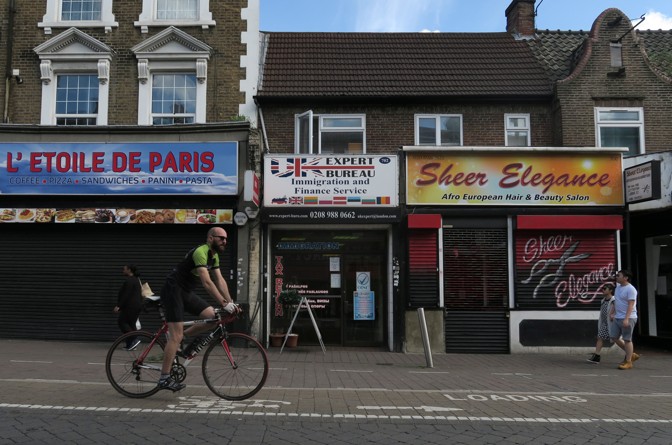
A man bikes past a shop offering information on immigration and finance days after the U.K. voted in 2016 to leave the EU. (Russell Boyce / Reuters)

In practice, the process is simple: Applicants must first verify their identity using the British government’s “EU Exit: ID Document Check” mobile application, which uses facial-recognition and biometric software to scan the user’s photo and passport. Once that part is done, they must then complete their application online by submitting their National Insurance number (which is used to verify their work history and residency in the country) and criminal history. The whole process is estimated to take up to 20 minutes, though some say it took less than half that time.

For Goodall, it wasn’t so simple. First, there was the issue of her phone: The mobile application only works on newer Android devices so far. Like nearly half of all people in the U.K., she didn’t have an Android, nor did she know someone who did. When she eventually managed to borrow a phone from a colleague, the mobile app’s scanning function didn’t work, prompting her to mail her passport to the Home Office, the government department overseeing the process, for a manual check. After she submitted the rest of her information online, the system erroneously offered her pre-settled status because it recognized only two of the past five years she spent in the country—a lapse that Goodall surmised might have had to do with the gap in her employment history when she was on maternity leave. She had to submit additional proof of residence, such as utility bills and bank statements, to account for the missing years.

[Read: Welcome to the new Britain, where every week is hell]

Goodall finally got the news that she was granted indefinite leave to remain in January, nearly two months after she began her application. She said the process overall was “broadly positive,” but a far cry from the ease and simplicity she had expected. “This scheme has been marketed like it’s going to be 99 percent easy for people,” she said. “It wasn’t easy for me. I would bet money that it’s not going to be easy for my mum.” (Goodall’s mother, who is retired and disabled, also faced issues with the system, but after submitting additional documentation, she was granted indefinite leave to remain in early February.)

“I’ve got a bloody master’s degree and a professional qualification, and I found all of this quite taxing,” Goodall said.

Alexandra Bulat, who applied in the same test phase, faced similar issues proving her time spent here. Like Goodall, the scheme didn’t recognize her years of continuous residency, despite having lived in Britain since 2012, when she emigrated from Romania to attend university. “As a student working mainly part-time, temporary, and short-term contracts, I didn’t ever earn enough to pay income tax,” she told me.

Ultimately, though, Bulat said the experience was easier and less onerous than applying for permanent residency. After submitting additional documentation, she received an email confirming that she had been granted indefinite leave to remain the next day. “It was surprisingly quick,” she said.

Taken alone, processing millions of people like Goodall and Bulat—each of whom will likely face his or her own issues with the application—is a bureaucratic nightmare. Still, it’s merely one illustration of just how complex an undertaking Brexit is for Britain. Across the government, the country is facing the challenges of extricating itself from a 45-year relationship with the EU, from forging its own trade agreements (it has only agreed to continue a handful of the 40 trade deals it currently has as a member of the EU) to ensuring the flow of goods through its ports.

And with each of these challenges comes the added task of addressing their unintended consequences. What, for example, should EU nationals who don’t have an Android phone do to complete their application? Who will ensure that applicants such as the elderly and those who don’t speak English get the help they need?

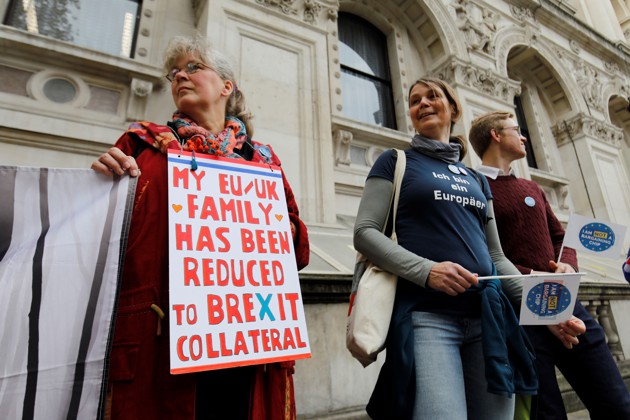
A November protest outside Parliament calls attention to families that are spread across the U.K. and the EU. (Tolga Akmen / AFP / Getty)

In all, Goodall’s and Bulat’s experiences could be classified as success stories: They applied for settled status and, despite a few hiccups, ultimately achieved it. But if their experiences demonstrate just how difficult this process can be for EU citizens who have the documentation to prove that they’ve lived in the country continuously, they also show how impossible it can feel for those who don’t.

“This app is designed around a kind of stereotype of the ideal citizen: in work, contributing, present,” Maike Bohn, a co-founder of the3million, an advocacy group for EU citizens in the U.K., told me. “The people who will struggle are the people with intermittent records.”

Those who are self-employed or unemployed, stay-at-home parents, or elderly are among the groups that migration advocates like Bohn fear could be most at risk of falling through the cracks of this new system. British Future, a London-based migration think tank, warned in a January report that even a 5 percent rejection rate would render as many as 175,000 people undocumented, a crisis tantamount to last year’s Windrush scandal, in which thousands of migrants (this time from Britain’s former colonies in the Caribbean) were erroneously targeted with deportation orders as a result of the government’s “hostile environment” policies to clamp down on unwanted immigration. Dozens were wrongly removed. The Home Office’s track record of being heavy handed—and, in some cases, even cruel—in its immigration verdicts has spurred deep-seated mistrust in the department.

[Read: When even legal residents face deportation]

The government has taken steps to assist EU citizens with the application. In addition to setting up an email alert system (to which at least 300,000 people have so far subscribed, according to a Home Office spokesperson), the government has allocated £9 million ($11.7 million) to support voluntary and community organizations assisting vulnerable applicants. In an effort to ease the process further, Prime Minister Theresa May announced in January that the government would scrap the scheme’s £65 ($85) application fee.

But for those doing outreach on the ground, these efforts alone aren’t enough. Cristina Tegolo, an outreach coordinator for the3million, told me that many communities, such as the Roma, of which there are an estimated 300,000 people in the U.K., still aren’t aware of what they need to apply for settled status, or that they need to apply at all.

“They know nothing,” she said. “They know probably that Brexit is going to change something, but they still do not know about the application. They hardly speak any English.”

Among the biggest challenges is ensuring that applicants have a valid form of identification, such as a passport, and enough time to apply for one if they don’t. Another is access to the necessary technology: Not everyone has an Android phone, or someone to borrow one from. And though the Home Office has set up at least 27 document-scanning centers across the country to address this issue (with plans to open more than 50 after the scheme launches at the end of March), some are easier to get to than others. As of this writing, there is only one center, in Edinburgh, for the whole of Scotland, an area roughly the size of South Carolina. The closest center for applicants living in Liverpool is 34 miles away.

When I asked Tegolo whether she was confident that everyone would be able to apply, she did little to hide her pessimism. “It is a crisis in waiting,” she told me. “There are about 4,000 people that need to apply every day. The Home Office will be overwhelmed with applications.”

She paused, then added: “The system will collapse. This is what I think.”

Friday, 22 March 2019

Trump Gives Netanyahu Part of Syria to Boost Israeli Leader’s Flagging Reelection Campaign

With a tweet posted on Thursday, President Donald Trump dismissed five decades of international consensus on the status of the Golan Heights, Syrian territory seized by Israel in 1967 during a preemptive war, declaring that the United States would recognize Israel’s annexation of the region.

Offered without explanation, the move looked to many Israeli, Palestinian and American observers like a transparent attempt to boost the reelection prospects of Trump’s embattled ally, Prime Minister Benjamin Netanyahu, who faces corruption charges and could be defeated at the polls next month.

In reply to Trump’s tweet, Mohamed ElBaradei, the former head of the International Atomic Energy Agency, suggested that the American president “might want to consult with your international lawyers.” Trump’s declaration, ElBaradei noted, flies in the face a United Nations Security Council resolution adopted unanimously in 1967, which called for the “Withdrawal of Israel armed forces from territories occupied” in that summer’s conflict — including the Golan, as well as the West Bank, East Jerusalem and Gaza — and emphasized, “the inadmissibility of the acquisition of territory by war.”

It was not lost on some analysts that U.S. recognition of Israel’s right to annex territory it seized by force would also seem to pave the way for Trump to recognize Russia’s annexation of Crimea.

Calling Trump’s declaration, “a brazen violation of international law,” which “doesn’t change protections occupied Syrians of Golan have,” Omar Shakir, the Israel and Palestine director of Human Rights watch, observed that “moves like this only isolate the U.S. further from international consensus and make its voice even more irrelevant.”

Standing alongside Secretary of State Mike Pompeo, who was in Israel for the announcement, a beaming Netanyahu described Trump’s gift to his reelection campaign as “a miracle of Purim,” the Jewish holiday celebrated this week.

“He did it again,” the Israeli prime minister said of an American president who seems determined to make every wish of Israel’s far-right nationalist leader come true. “First, he recognized Jerusalem as Israel’s capital and moved the U.S. Embassy here,” Netanyahu said, “then he got out of the disastrous Iran treaty and reimposed sanctions, but now he did something of equal historic importance — he recognized Israel’s sovereignty over the Golan Heights.”

By accepting Israel’s 1981 annexation of the Golan Heights, after withdrawing from the Iran nuclear deal and moving the U.S. Embassy, Trump also checked off another item on the pro-Israel wishlist of one of his biggest donors, the American casino magnate Sheldon Adelson, who spent more than $20 million to support his 2016 presidential campaign, and is also Netanyahu’s most important backer.

A measure of how far the White House has tilted in Israel’s favor since Trump took office can be seen in reports from 1981, when Israel’s annexation of the Golan Heights prompted President Ronald Reagan to respond by ordering a halt to a military cooperation agreement with Israel. The U.S. and the entire U.N. Security Council quickly approved a resolution stating that “the Israeli decision to impose its laws, jurisdiction and administration in the occupied Syrian Golan Heights is null and void and without international legal effect.”

As the Israeli-American journalist Mairav Zonszein noted, Jason Greenblatt, the Trump administration’s peace envoy for the region seemed only mildly less excited by the news than Israel’s prime minister.

The American envoy — who is working with the president’s son-in-law, Jared Kushner, on a peace plan that seems to begin with total surrender to every Israeli demandeffusively thanked Trump for a “bold, courageous, and historic decision” by a president “who understands Israel and its security needs.”

“Thieves,” was the concise description of the move from Ali Abunimah, the Palestinian-American activist and writer whose book, “One Country: A Bold Proposal to End the Israeli-Palestinian Impasse,” calls for a one-state solution to the conflict, with equal rights for Israelis and Palestinians. “But it’s good that the U.S. makes explicit its bias and removes once and for all the pretense that it was ever an ‘honest broker,'” he added.

Since Trump has now declared his support for Israel’s previously unrecognized annexations of both East Jerusalem and the Golan Heights, speculation naturally turned to what might come next: the annexation of most or all of the occupied West Bank. When Israeli citizens go to the polls on April 9th, more than half a million Israelis who live in Jewish-only settlements in the West Bank will cast ballots. Millions of their Palestinian neighbors, who continue to live under military rule 52 years after the Six-Day War, remain disenfranchised, with every aspect of their lives controlled by an Israeli government they have no say in choosing.

“When Israel annexes the West Bank,” Lara Friedman, the president of the Foundation for Middle East Peace in Washington observed on Twitter, “Trump can just copy-paste this same text, change ‘Golan’ to ‘Judea & Samaria,’ and presto — with one final tweet, the Israeli-Palestinian conflict will be resolved!”

Trump’s decision to cede the Golan to Israel, following his move of the U.S. Embassy to Jerusalem, “pretty much tells us where the Kushner peace plan is going,” Paul Danahar, a former BBC Middle East bureau chief, tweeted. “It will likely recognise all of Israel’s ‘facts on the ground’ across most of the disputed regions. The weakness of the Palestinian Authority will be exploited and when it refuses to accept what’s on offer, the administration will throw its hands in the air, blame Palestinian intransigence and begin to formally recognise Israel’s claims on parts of the occupied West Bank.”

“There is almost an unseemly haste from Saudi Arabia and Israel to refashion the region as they want it while they have what has proved to be the most pliable US administration in modern history where the Middle East is concerned,” Danahar concluded.

Yousef Munayyer, the executive director of the U.S. Campaign for Palestinian Rights, made the same point in a slightly less nuanced way.

The post Trump Gives Netanyahu Part of Syria to Boost Israeli Leader’s Flagging Reelection Campaign appeared first on The Intercept.
Thursday, 21 March 2019

Destroying Istanbul to 'Restore' It

ISTANBUL—The Valens Aqueduct is one of this city’s most recognizable monuments, a Roman-built fixture that stretches proudly above the busy Atatürk Boulevard. Most visitors have the pleasure of seeing it, and the fourth-century structure reaches well into an array of residential neighborhoods. It is a source of pride among Istanbulites.

When news broke, however, that the aqueduct was slated for restoration, many residents were alarmed, concerned that efforts at preservation would instead compromise its integrity. That fear is not unfounded: Historic buildings and structures dating from the Byzantine era to the 20th century have been subjected to disastrous restorations in recent years here, prompting public outcry and fostering a cynical attitude toward planned projects.

“We have seen examples of so many botched restorations that we have lost faith,” Ebru Erdem-Akçay, a Turkish American political scientist, told me. When tweeting the news of the restoration, Erdem-Akçay wrote that she hoped to see the aqueduct again “before they restroy it,” coining a portmanteau of restore and destroy that many say is apt.

Istanbul is a dynamic, fascinating city of 15 million, and much beauty can be found, thanks to a rich architectural heritage and an ideal location on the shores of the Black and Marmara Seas, between which runs the Bosporus strait. Traces of history await around every corner of the city’s older parts—living, open-air museums with innumerable artifacts from Byzantine and Ottoman times. Istanbul nevertheless moves at a rapid pace, and its streets are overflowing with life and sounds, ranging from the pleasant call of vendors selling fresh pastries to the ever-present din of construction.

[Read: Turkey’s identity crisis]

In recent years, those construction noises have become more prevalent. President Recep Tayyip Erdoğan and his ruling Justice and Development Party (AKP) have presided over a wave of economic growth due in no small part to a construction boom that has nearly gone bust. In Istanbul and throughout the country, hundreds of shopping malls were built, in addition to a staggering number of housing projects. New airports, public and private universities, hospitals, and transit systems sprouted up in cities. And ambitious restoration and development projects were launched one after the next. But many have not turned out well, speaking to concerns here that Istanbul’s long history is not sufficiently respected, worries that extend beyond urban planning and have real political implications.

With Turkey heading to the polls for municipal elections this month, Erdoğan is keen to maintain power in the city that he grew up in and where he rose to prominence as mayor in the 1990s. His former prime minister Binali Yıldırım is the AKP candidate to be Istanbul’s next mayor, and a loss would be a strong statement from voters, one rooted in concerns for their city and its governance.

Some of the most controversial examples of restoration here have occurred in the heart of the Beyoğlu district, home to Istanbul’s busiest and liveliest street, the pedestrian-only Istiklal Avenue.

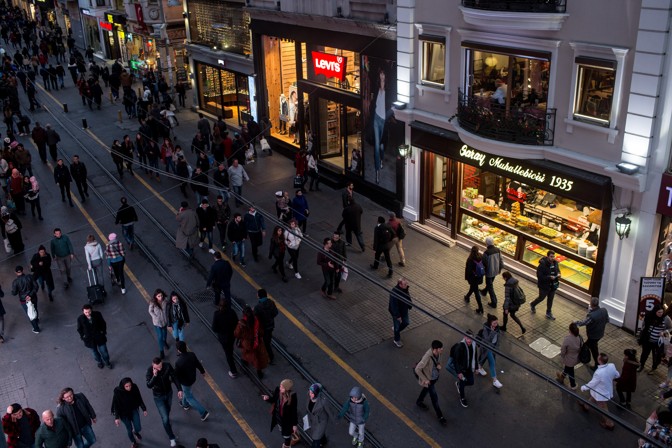
People shop on Istiklal Avenue, whose storefronts now include international staples such as McDonald’s and Levi’s. (Chris McGrath / Reuters)

Istiklal is lined with dozens of grand European-style buildings, a number of which house foreign consulates, and was once a street packed with cinemas and cafés that people wouldn’t enter unless they were dressed to the nines. It was closed to traffic in the early 1990s, which was instrumental in breathing new life into the area after it had picked up a rather seedy reputation in the previous two decades. Beyoğlu soon became the epicenter of Istanbul nightlife as its narrow, buzzing backstreets filled with restaurants, dive bars, and clubs. Its popularity peaked during the AKP years, though it has been gradually transformed into a sterilized shopping mecca, with new malls and an extended stretch of chain stores and fast-food restaurants along Istiklal.

Anger over unbridled development reached a tipping point in May 2013, when protests broke out against Erdoğan’s controversial plan to construct a shopping center over Gezi Park, the largest green space in the area, just a short stroll away from the beginning of Istiklal, on the other side of Taksim Square. Tens of thousands of people took to the streets of Istanbul, and the demonstrations spread to nearly every province in Turkey. Erdoğan fiercely denounced the rallies and the police response was swift and severe, but the project was abandoned and Gezi Park remains relatively untouched.

Ill-advised restorations, however, continued full speed ahead. In 2015, the Beyoğlu municipality restored its district headquarters, a neoclassical gem built in the late 19th century, but added a floor on top, a jarring contrast to the historic edifice. In another instance, a pair of businessmen purchased the splendid 1830s-era Narmanlı Han, an aging gray building near the end of Istiklal that once housed the Russian embassy and was later home to the celebrated novelist Ahmet Hamdi Tanpınar, for $57 million. But the restoration involved painting it a regrettable shade of peach and paving over the leafy courtyard, which was once home to a groundskeeper, street cats, and lush layers of wisteria. Many Istanbulites were horrified when they saw the building in its restored state in 2017. The owners plan to outfit Narmanlı Han with shops and restaurants.

Elsewhere, a century-old building near Taksim Square once held Majik, Istanbul’s first cinema, and the iconic nightclub Maksim. A furniture company bought it in 2004, and announced plans to turn it into a hotel. The historic facade was renovated and finally unveiled last year, revealing an enormous metal-and-glass structure equaling the size of the original building built on top, in what amounts to a truly head-scratching sight. A popular Twitter account called Ugly Istanbul, which documents restoration disasters and other instances of aesthetically questionable urban planning and development, dubbed the Majik/Maksim restoration one of the most hideous efforts of 2018.

[Read: The decline and fall of Turkish democracy]

“Unfortunately there is an understanding that prioritizes the reuse value or real-estate value of these buildings—particularly if they are in centrally located, high-rent neighborhoods—rather than protecting them as cultural assets to be inherited by future generations,” Mücella Yapıcı, an architect with the Istanbul branch of the Union of Chambers of Turkish Engineers and Architects (TMMOB), told me.

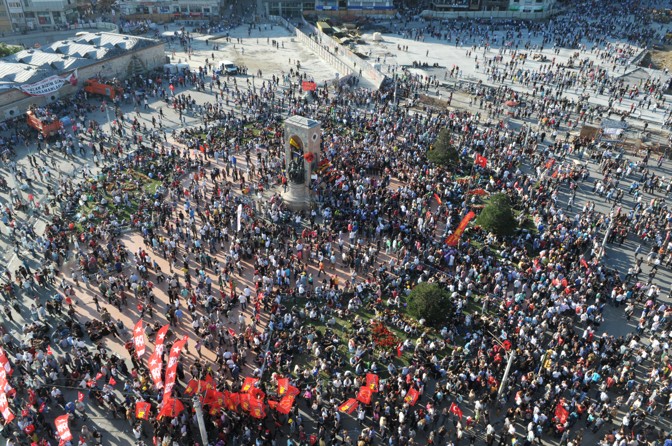
The 2013 Gezi Park protests spill into Taksim Square. (deepspace / Shutterstock)

Yapıcı is a visible opposition figure and an outspoken critic of the untamed development that has dominated Istanbul during the AKP years. A representative of the Taksim Solidarity group that played an active role in the Gezi Park protests, Yapıcı was taken into custody for her involvement in the rallies. Though she was later acquitted, she was nevertheless summoned to give a statement in November as part of an ongoing investigation into the protests, more than half a decade after they began. (In February, prosecutors said they were calling for life sentences for 16 suspects, who are being charged with attempting to overthrow the government in relation to the protests. Among them are the journalist Can Dündar and the actor Memet Ali Alabora, who are both in exile; the jailed philanthropist Osman Kavala; and Yapıcı, who once again faces charges.)

Those requested sentences reflect Erdoğan’s hatred of the protests, and his insistence that they were a deliberate attempt to unseat him from power. Yapıcı’s inclusion among the suspects also sends a clear message to those who publicly and actively oppose the government’s controversial projects.

The relentless rattle of drills and jackhammers punctuated my conversation with Yapıcı—the TMMOB Istanbul office is located immediately behind a construction site where a billion-dollar effort aims to boost tourism by revamping a coastal section of the Karaköy neighborhood, enabling increased access for cruise ships. A historic post office and passenger terminal were demolished as part of the project.

The various construction plans break no laws, Yapıcı acknowledged. “They have projects, there are architects carrying them out, there are advisers, councils granting approval, and municipalities providing licenses.” She and others worry that after years of intense growth and transformation, which has included the demolition of historic buildings and the destructive restoration of others, Istanbul has paid no small price. And though there is no shortage of urban activists and architects like Yapıcı who risk their own freedom and well-being to stand up for the city’s history, the cards are stacked against them.

“When it comes to cultural assets, a balance can be struck,” she said. “That balance is established between the necessity for science and engineering, and capital’s drive for generating profit. But since the system does not want this at all, organizations like ours are excluded entirely.”

Wednesday, 20 March 2019

The Jump-Seat Pilot and the Boeing 737 Max

Previously on this topic: “Is It Time to Worry About the Boeing 737 Max?”, “A Shorter Guide to the Ethiopian Tragedy and the 737 Max,” “What Was On the Record About Problems With the 737 Max,” “‘Don’t Ground the Planes, Ground the Pilots,’” “The Implications of the 737 Max Crashes,” and “Training, Regulation, and the 737 Max.”

A few hours ago Bloomberg broke a story, by Alan Levin  and Harry Suhartono, with a potentially significant detail about the first of the recent two crashes of the Boeing 737 Max. This was the crash last October of a Lion Air flight, into the sea off Indonesia, in which all 189 people aboard died. (The second, outside Addis Ababa, was of an Ethiopian Airlines flight this month, causing 157 deaths.)

The Bloomberg story says that just one day before the fatal Lion Air accident, the very same airplane had suffered a similar pitch-control anomaly. But in this preceding case, an additional pilot, riding in the jump seat of the cockpit, had recognized the problem and disabled the errant automatic control system. The plane flew on to its destination.

The Bloomberg story says:

As the Lion Air crew fought to control their diving Boeing Co. 737 Max 8, they got help from an unexpected source: an off-duty pilot who happened to be riding in the cockpit.

That extra pilot, who was seated in the cockpit jumpseat, correctly diagnosed the problem and told the crew how to disable a malfunctioning flight-control system and save the plane, according to two people familiar with Indonesia’s investigation.

If true, this detail would shed light on what I suggested earlier was the crucial question about the fatal Lion Air flight: whether its pilots did not know how to override or disable the failing system, or whether they knew what to do but could not disable it, because the command systems failed to respond.

Again if true, this report would suggest:

  • That one specific aircraft—not the 737 Max model line as a whole, but the specific airplane that eventually crashed—had an instrument failure, presumably the “angle of attack” indicator that triggered the automatic pitch-control system. It would suggest that the instrument failed one day; the flight crew coped; the same airplane was sent up with the same failure-prone system the next day; and this time the results were tragically different.
       
  • That flight crew training and familiarity played a fundamental role in the overall 737 Max drama. That is, a pilot who knew what was happening, could correct the situation; and pilots who didn’t, couldn’t, and flew to their (and their passengers’) deaths.

Does this detail, if confirmed, establish the cause of the second crash, on Ethiopian Airlines? Not necessarily. That investigation goes on.

Does it establish whether the 737 Max is “safe” or “dangerously flawed”? Again, not in itself.

But if true, it could be significant in emphasizing the importance of familiarity, and awareness of the MCAS pitch-control traits, in safe flight aboard the 737 Max. At face value it would indicate that the very same airplane, with the very same (or similar) defect, completed a flight one day, and plunged into the sea the next day, with the life-and-death difference turning on whether someone in the cockpit recognized what an automated system was trying to do.

Think of this, the next time you hear that modern airplanes “just fly themselves,” with professional pilots as paid bystanders.

And investigators will think of it, in assessing whether Boeing, the FAA, and airlines adequately alerted pilots to the traits of this new airplane. (Also see a relevant earlier post, “Don’t Ground the Airplanes. Ground the Pilots.”)