Chelsea Manning, photographed in Washington, D.C., in January 2018.
Photo: Jesse Dittmar/Redux
On Thursday afternoon, a District Court judge in Virginia ordered that Chelsea Manning be released from jail, where she has been held since last May for refusing to testify before a grand jury.
The ruling itself is striking in what it fails to recognize. “The court finds Ms. Manning’s appearance before the Grand Jury is no longer needed, in light of which her detention no longer serves any coercive purpose,” the judge noted. The fact that the coercive purpose of Manning’s detention had long been shown to be absent — Manning has proven herself incoercible beyond any doubt — was not mentioned. Nor was the fact that on Wednesday, Manning attempted suicide. It was the most absolute evidence that she could not be coerced: She would sooner die.
She endured months of extreme suffering, driving her to near death, but never wavered on her principled refusal to speak.
While Manning’s release is vastly long overdue and most welcome, the framing and timing of the decision are galling. On Friday, Manning was scheduled to appear at a court hearing on a motion to end her continued imprisonment, predicated on her unshakeable resistance proving coercion to be impossible, and her incarceration therefore illegal. She endured months of extreme suffering, driving her to near death, but never wavered on her principled refusal to speak.
The day before this hearing — and the day after she made an attempt on her own life — the judge ruled that Manning is “no longer needed” by the grand jury. The court did not recognize that she is incoercible, nor that her detainment had become punitive. Indeed, a profoundly punitive element of her treatment will remain, even after her release: The judge denied a motion to vacate the exorbitant fines Manning faces. She owes the state $256,000, which she is expected to pay, even though the fines were only accrued on the condition that they might coerce her to speak.
Again and again, Manning and her legal team showed that her imprisonment was nothing but punitive, and thus unjustifiable under the legal statutes governing federal grand juries. Yet for nearly a year, Manning has been caged and fined $1,000 per day. Ever since she was subpoenaed to testify before the grand jury, which is investigating WikiLeaks, Manning has also insisted that there was never any justifiable purpose to asking her to testify.
As her support committee noted in a statement last May, “Chelsea gave voluminous testimony during her court martial. She has stood by the truth of her prior statements, and there is no legitimate purpose to having her rehash them before a hostile grand jury.”
For the court to admit, after nearly a year of torturous treatment, that further testimony from her is unnecessary adds insult to very real injury.
The government’s treatment of Manning has been putrid and continues to be — especially as she remains under the yoke of state-enforced financial ruin. For her unwavering resistance to government oppression, in the name of social justice struggle and press freedom, Manning is owed our deepest admiration and all the support we can muster.
Editor’s Note:The Atlantic is making vital coverage of the coronavirus available to all readers. Find the collection here.
COVID-19 is not the flu. We have a vaccine for the flu. We have anti-viral medications designed to treat the flu. We have a sense of what to expect when we catch the flu, and when it’s necessary to seek medical attention. Doctors have experience treating the flu, and tests to help diagnose the flu, right there in the office, while you wait.
Against the new disease, we have none of this. This coronavirus is unknown to our species. Once it breaks into one of our cells, the extent of its spread through the body seems to vary significantly. The experience can slowly progress from the familiar—cough, congestion, fever—to a life-threatening inflammatory response as the virus spreads down into the lungs, filling the airways with fluid. Survivors can have permanent scarring in the lungs. The virus can also spread into other organs, causing liver damage or gastrointestinal disease. These effects can play out over longer periods than in the flu, sometimes waxing and waning. Some patients have begun to feel better, then fallen critically ill. The disease can be fatal despite receiving optimal medical care.
None of this is meant to cause panic. Panic is not useful. But as we all begin to comprehend the nature and extent of the new virus and its spread, questions should arise about what to do with those early, familiar symptoms. At what point should you ask for testing? When do you need to self-quarantine, and for how long? Who needs to be in a hospital, and who can ride things out at home? If you’re sick, should you bring your illness into a crowded clinic or emergency department, possibly shedding virus that infects others? Should you stay home, maybe using telemedicine, and risk infecting roommates or family members?
The source of most panic is uncertainty. While much remains uncertain in the realm of virology and immunology, other sources of anxiety could be mitigated. Everyone could have clarity and certainty on those fundamental questions, or at least on the most immediately pressing: What should I do if I start to feel sick?
In an ideal outbreak scenario, at the first signs of illness—or even after a concerning exposure—everyone would go get a quick test. It could assure them that they’re okay to go to work, or to go to a public gathering, or even to go home. If a test were positive, that person’s close contacts would be alerted of an anonymous exposure. They would be advised to come get tested. The process would be fast, easy, ubiquitous, and free.
Given the nature and spread of this particular virus, though, this textbook public-health approach to tracking and containment has proven infeasible. Even if perfect tests were widely available, and everyone agreed to get tested as soon as possible whenever they felt sick, demand for screening and evaluation would overload existing doctors’ offices and hospitals.
Emergency funds could theoretically be used to set up makeshift screening clinics in parking lots and public spaces. After being screened, some people could be escorted to a hospital for further treatment and evaluation. Others could be reassured that they were clear and go back to work. Still others could be advised to self-isolate at home until the illness passes, and to call, text, or return if symptoms escalated.
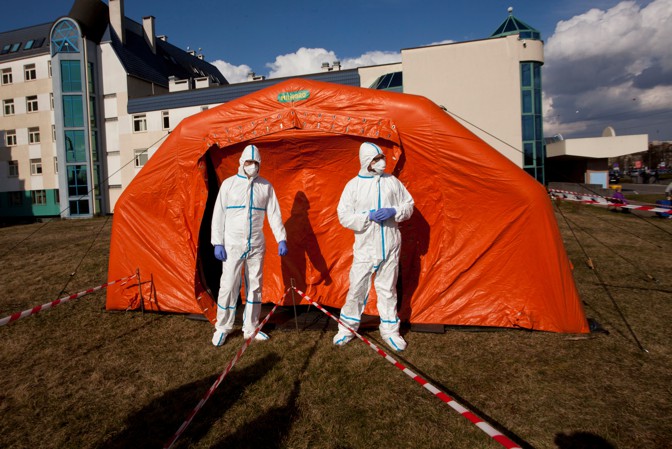
A series of tents in a field adjacent to University Clinical Hospital in Wroclaw, Poland, now precedes the entrance to the emergency department (Agencja Gazeta / Krzysztof Cwik / Reuters).
The best possible monitoring and communication will nonetheless prove vital to determining who needs hospital beds in the midst of a rapidly spreading, temperamental disease. Without it, to simply tell people to “stay at home if you’re sick” will be inadequate. Most cases of COVID-19 are reportedly “mild,” but that term can be misleading. As the World Health Organization adviser Bruce Aylward clarified last week, a “mild” case of COVID-19 is not equivalent to a mild cold. Expect it to be much worse: fever and coughing, sometimes pneumonia—anything short of requiring oxygen. “Severe” cases require supplemental oxygen, sometimes via a breathing tube and a ventilator. “Critical” cases involve “respiratory failure or multi-organ failure.”
The disease can sometimes escalate unexpectedly, and even healthy young patients will need people checking in on them. They may be fine at home initially, but would need to know precisely what to watch out for, and when to seek care. People who do require medical supervision—but not hospital care—need a place to go and stay. This could include people with escalating symptoms or underlying risk factors. Even patients with a mild case will need places to self-isolate if they live with others who have not yet been infected, especially if those people are older or immunocompromised.
China addressed this issue by mandating that sick people in Wuhan go into quarantine for two weeks, at one of the dozens of hastily adapted or constructed emergency facilities that look almost like military field hospitals. People are given food, beds, and medical monitoring. They can socialize with other sick people, and they can be transferred to a hospital if that becomes necessary.
In the U.S. and most other countries, the process of removing oneself from society for two weeks is not so straightforward—or even possible, for many people. The Centers for Disease Control and Prevention has ordered some mandatory two-week quarantines, but so far only for a few hundred travelers. The contained have passed their days at military bases, of which the country has 15 with designated space for quarantines. The capacity for housing and feeding larger numbers of people is nowhere near what may be needed. In February the Pentagon “ramped up” the military bases in preparation to quarantine 1,000 people.
Though mandatory quarantining at large scales would be infeasible (and legally treacherous), governments might at least offer facilities for people who have nowhere else to go when they get sick. To that end, Washington State’s public-health officials have already procured an Econolodge. Others could anticipate similar needs and secure local hotels, or retro-fit empty stadiums or dead malls, or even cruise ships at port. Ideally the accommodations would be nicer than military bases and would not feel punitive—or else people will not use them.
Given the expanding global recommendations to avoid large gatherings and limit travel, such arrangements might also keep the hospitality industry from collapsing.
If all of this were happening, the United States might be able to avoid the sort of widespread shutdowns of cities, businesses, and institutions that are playing out in Italy, China, and elsewhere. But it is not happening. People who are sick are told only to go home. A shortage of tests means that many people are staying home who do not need to. Many others are going out because they can’t afford to stay home and miss work. Many don’t have health insurance, or fear the costs of being hospitalized. There is a strong financial incentive to conceal symptoms, to try to keep working and caring for children, and by consequence spreading the virus.
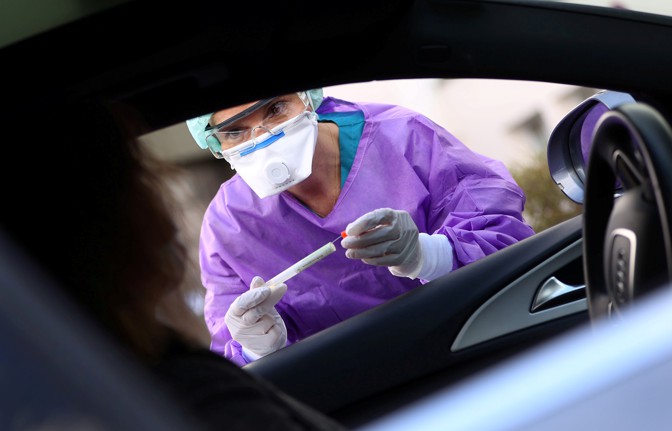
As of last week, at Prohealth clinics in central Connecticut, patients who arrive with a fever and respiratory symptoms are instructed to wait in their car and call the clinic to announce their arrival. Then a doctor or nurse dons a full shield mask, a gown, and gloves and comes out to the parking lot. The patient is to roll down a window and be evaluated on the spot. If a flu test shows no sign of the flu, the patient is to wait in the car while the clinic contacts the state health department.
Health officials are then faced with a challenge. What to do with this person, sick and alone in their car, and not allowed into their own doctor’s office? This is where a test for the coronavirus would be of use. Until this week, though, the state of Connecticut had received only one coronavirus testing kit from the CDC. Testing capacity is increasing now, in partnership with private labs. But as of Monday afternoon, an ongoing Atlanticinvestigation could only confirm that 4,384 tests had been conducted nationally.
This number is projected to increase quickly, but not instantly. Anthony Fauci, the director of the National Institute of Allergy and Infectious Diseases, said in an interview with JAMA that aired on Monday: “The goal over the next week or two is to get to the point of having a million diagnostic tests ready for shipment.”
A doctor prepares a test kit at a drive-in coronavirus check at a hospital in Germany. (Gross Gerau / Reuters)
Expectations are tempered; a similar promise from Vice President Mike Pence of 1.5 million tests by the end of last week did not come to pass. But even when these tests eventually are available, some limitations will have to be realized. Among them, these are diagnostic tests, not screening tests—a distinction that should shape expectations about the role doctors will play in helping manage this viral disease.
The difference comes down to a metric known as sensitivity of the test: how many people who have the virus will indeed test positive. No medical test is perfect. Some are too sensitive, meaning that the result may say you’re infected when you’re actually not. Others aren’t sensitive enough, meaning they don’t detect something that is actually there.
The latter is the model for a diagnostic test. These tests can help to confirm that a sick person has the virus; but they can’t always tell you that a person does not. When people come into a clinic or hospital with severe flu-like symptoms, a positive test for the new coronavirus can seal the diagnosis. Screening mildly ill people for the presence of the virus is, however, a different challenge.
“The problem in a scenario like this is false negatives,” says Albert Ko, the chair of epidemiology of microbial diseases at the Yale School of Public Health. If you wanted to use a test to, for example, help you decide whether an elementary-school teacher can go back to work without infecting his whole class, you really need a test that will almost never miss the virus.
“The sensitivity can be less than 100 percent and still be very useful,” Ko says, in many cases. But as that number falls, so does the usefulness of any given result. In China, the sensitivity of tests has been reported to be as low as 30 to 60 percent—meaning roughly half of the people who actually had the virus had negative test results. Using repeated testing was found to increase the sensitivity to 71 percent. But that means a negative test still couldn’t fully reassure someone like the teacher that he definitely doesn’t have the virus. At that level of sensitivity, Ko says, “if you’re especially risk-averse, do you just say: ‘If you have a cold, stay home’?”
“An inaccurate test—one prone to false positive or false negative results, can be worse than no test at all,” Ian Lipkin, an epidemiology professor at Columbia University, told me in an email. The CDC has not shared the exact sensitivity of the testing process it has been using. When Fauci was asked about it on Monday, he once again hedged. “If it’s positive, you absolutely can make a decision,” he said. If it’s not, that’s a judgment call. Usually a second test is recommended, and it depends on the patient’s symptoms, exposures, and how sick they appear to be.
The tests involve other variables, too. Samples must be taken using a long cotton swab that goes into the back of the patient’s nose (or mouth, though this seems to be a less sensitive method). In either case, sometimes you just don’t get enough mucus on the swab. It can be hard to know if that was the cause of a negative test result when results come in from the lab a day later.
In attempt to increase sensitivity of the testing process, China not only swabbed people multiple times, but also added CT scans for an additional clue. The scans can sometimes help identify the unique patterns of lung damage caused by the virus, says Howard Forman, who practices radiology in the emergency department at Yale–New Haven Hospital. But scanning is a slow process to do at large scales, and it’s costly and involves exposure to radiation. “You would need dedicated scanners as well, so as not to contaminate other patients,” he told me. “So it becomes very difficult to use CT for high-level screening.”
Given the number of variables, widespread screening tests for the virus are not looming on the horizon as a way to obviate the urgent need for social distancing.
Some hope is being placed in biotech companies that are working to develop quick, mobile tests that could give results anywhere—be it at a doctor’s office or in a modified parking lot. “The goal would be to allow people to know if they have a cold or if they have the virus and need to self-quarantine, right there in the doctor’s office,” says William Brody, a radiologist and former president of Johns Hopkins University. He is currently working on one such project with Hong Cai, a molecular biologist, at a small company called Mesa. The duo told me this is, at best, months away from being tested widely. Even then, its sensitivity will remain to be seen, and will likely be less than that of the current, slower tests. But Hong says her team is working as expeditiously as possible to solve the problem.
In the absence of a quick, sensitive, ubiquitous screening test that can decisively rule out coronavirus infection—and send healthy people back out into the world to work and to live— we face unique challenges. The World Health Organization is lately signaling that a declaration of pandemic is imminent. Leaders point to dramatic shutdown and mass quarantine measures taken in China in laudatory terms—as evidence that lives can be saved, and this is how. Other countries are already following China’s example. Italy has banned weddings and funerals as the number of cases exploded in recent days. Japan has closed schools for a month. France has banned large public gatherings, and Iraq has banned even small ones. The United Nations has canceled all in-person meetings to address climate change.
For now at least, it seems, minimizing damage will involve sweeping and imprecise action. To shut down a city, or a country, is to gamble that incurring disastrous economic consequences in the short term will prevent even more disastrous consequences in the longer term. In the nightmare scenario that everyone is trying to avoid, the disease spreads so quickly that a country’s health-care system is overwhelmed, and people go untreated amid panic and chaos.
A pandemic is like a slow-motion hurricane that will hit the entire world. If the same amount of rain and wind is to hit us in any scenario, better to have it come over the course of a day than an hour. People will suffer either way, but spreading the damage out will allow as many people as possible to care for one another.
Slowing the disease requires asking people to isolate themselves and, in most cases, stop working. Most of the world cannot shelter in place for long without income. When people are asked to survive alone—without the cultural, social, and financial inputs that typically keep us alive—new ways of attending to basic needs become immediately necessary. “For people who can’t afford time off work, we absolutely need to come up with out-of-the-box solutions right now,” Ko says.
Among them is the idea that everyone receive cash, immediately. People need to feel able to skip work and still make rent and feed their family. They need cash without strings attached, and they need it now, not via a complex omnibus economic stimulus package next month. With each day that such bills are debated by skeptical senators, people will continue to go into their communities, out of a need to work, spreading the disease simply because they have no other choice.
Planning for emergency cash transfers is underway in Hong Kong, where permanent residents are to receive the equivalent of $1,282 later this year, in an effort to keep both the economy and people alive.* In response to a month of nationwide school closures in Japan, the government is paying out $80 per worker per day to help cover child care or the costs of staying home to parent. Other government payments could be conditional on taking sick leave—a sort of emergency national sick-leave policy, whereby your employer might simply have to verify that you did indeed miss work for two weeks. Or, as with President George W. Bush’s $152 billion economic-stimulus bill in 2008, people could simply get a check in the mail.
“There’s precedent internationally for this idea,” says Natalie Foster, who studies economic policy at the nonprofit Economic Security Project. She says the cash could easily come in the form of earned-income tax credits. “We have an entire tax system that has been doing this for decades … We could expand and modernize it for this precarious moment.”
“Unconditional or conditional cash transfers may be wise in a situation like this, where you’re asking people to stay home to protect themselves and others,” says Paul Farmer, a global-health professor at Harvard Medical School. “If people know there will be support, and other things like soup kitchens and nursing care at home, those would make a big difference overall in suffering involved with an illness like this. If people feel like Hey, we got you, they would be a lot less lonely and frightened. Pandemics bind us together, and often not in great ways. But sometimes in great ways.”
* This article previously misstated that emergency cash transfers are already happening in Hong Kong.
No dia 7 de fevereiro, uma sexta-feira, o cantor goiano Amado Batista se apresentou no Carranca Grande Hotel, em Xique-Xique, município da Bahia, às margens do Rio São Francisco. No dia seguinte, ele fez mais um show no interior baiano, no Espaço Las Roças Club, em Filadélfia. Representantes dos dois espaços confirmaram as apresentações, mas não deram detalhes de lotação e valor dos ingressos. Ambos constavam na agenda de Batista, divulgada em sua página oficial. Semana que vem, aliás, tem show em São Paulo. Mas, mesmo com a agenda pública deixando clara a localização do cantor semana a semana, o Ibama e a Justiça do Mato Grosso não conseguem citá-lo nos processos judiciais e administrativos que responde por desmatamento ilegal.
Amado Rodrigues Batista está entre as pouco mais de 4.600 pessoas físicas e jurídicas que receberam multas milionárias por desmatamento do Ibama nos últimos 25 anos. Único cantor conhecido a fazer parte da lista de autuações milionárias por devastação, Batista guarda algumas semelhanças com outros mega multados pelo Ibama. A mais notável é a dificuldade de ser citado para responder pelas infrações: centenas deles só foram notificados por editais, publicados no Diário Oficial, depois de vencidas as outras formas de comunicá-los sobre os procedimentos e prazos de defesa. Com o julgamento à revelia, quando o réu não está presente, eles ganham tempo em busca de uma prescrição e criam argumentos para adiar alguma decisão da justiça ou recorrer dela. Não por acaso, apenas 3,3% das multas ambientais foram pagas desde 1980.
Amado Batista recebeu uma multa de R$ 1,24 milhão por desmatamento em sua fazenda em Cocalinho, na divisa do Mato Grosso com Goiás, em 2014. O município, na região do rio Araguaia, tem um dos maiores índices de desmatamento no estado, diretamente relacionado à pecuária.
A Fazenda Sol Vermelho, dedicada à engorda de bezerros, já havia sido alvo de uma ação criminal da Promotoria do Meio Ambiente do Ministério Público do Mato Grosso por “grave dano ambiental provocado nas áreas de preservação permanente e de reserva legal”. Segundo o advogado Maurício Vieira de Carvalho Filho, que representa o cantor, a fazenda Sol Vermelho “está de acordo com as normas legais, e devidamente autorizada a promover a exploração da agropecuária”. O termo de infração, diz, refere-se apenas “a menos de 1% (um por cento) da área total da propriedade”.
O advogado afirma que tal área está preservada e que a autuação se deve a uma “falha técnica” na licença ambiental. “A multa será paga, aguardando apenas a decisão e deliberação do órgão competente”, afirma. No processo, a justiça também teve dificuldades em citar o cantor, mesmo encaminhando a intimação para o cumprimento pelos oficiais de justiça de Goiás, estado onde mora o cantor.
A última movimentação que consta no Ibama sobre a mega multa é que ele foi “notificado via edital para alegações finais”. Ou seja: os órgãos responsáveis por cobrar a multa sequer conseguem encontrá-lo para avisá-lo sobre a infração.
Eu sei que o sol vermelho vem trazer pra mim algum recado
O “Sol Vermelho” que dá nome à propriedade vem da canção-título do álbum lançado por Batista em 1982. É ainda o nome de um filme do mesmo ano, com pretensões autobiográficas, em que ele faz o papel de si mesmo. A produção é um caça-níquel produzido pelo cantor e dirigido por Antonio Meliande, figura de filmografia extensa e variada da Boca do Lixo paulistana. Na época em que foi filmado eram comuns filmes que pegavam carona no público de artistas populares. “Eu sei que o sol vermelho vem trazer pra mim algum recado das coisas que eu deixei ficar adormecidas no passado”, diz a letra da música.
A fatídica fazenda coleciona controvérsia. Em 2003, a Polícia Militar apreendeu 464 cabeças de gado pertencentes à dupla Zezé di Camargo e Luciano sob a suspeita de sonegação fiscal. Os animais estavam sendo vendidos a Batista. Carvalho diz que desconhece qualquer tipo de relação com o gado apreendido. “Não participamos, ou temos conhecimento disso, e a questão de apreensão de gado há quase 16 anos deve ser questionada aos proprietários da época”.
‘Referência de artista brasileiro’.
Em 2010, três anos após a Assembleia Legislativa do Mato Grosso conceder ao cantor o título de cidadão mato-grossense, a Sol Vermelho já tinha mais de 10 mil cabeças. Quatro anos depois, Batista obteve do governo estadual a aprovação de um financiamento rural para a aquisição de mais mil matrizes de gado para sua propriedade.
Em 2016, um funcionário da propriedade morreu em um acidente de trabalho, quando colocava cercas. O Tribunal Regional do Trabalho da 23ª Região condenou Batista a indenizar a família da vítima em R$ 60 mil, por entender que ele não ofereceu os equipamentos de segurança, os materiais nas especificações corretas nem o treinamento adequado ao trabalhador.
Auditores fiscais do Trabalho já haviam encontrado irregularidades na propriedade em 2011, como problemas de alojamento, falta de equipamentos de segurança e trabalhadores sem registro. Mas o Ministério Público do Trabalho arquivou o procedimento depois da apresentação de documentos que comprovariam a solução das irregularidades. O advogado garante que o cantor “segue todas as normas do Ministério do Trabalho, e a mesma é constantemente fiscalizada por todos os órgãos competentes”.
Amado Batista ainda responde na justiça estadual do Mato Grosso por um crime ambiental por desmatamento cometido no município de Água Boa, no Vale do Araguaia. O processo teve início em 2018 e a última movimentação registrada é de janeiro de 2020. A autuação é na mesma fazenda que as multas de Cocalinho. A propriedade fica na região dos dois municípios.
Recém eleito, Jair Bolsonaro almoça com Amado Batista no dia 11 de dezembro de 2018.
Foto: Walterson Rosa/Folhapress
Foi um golpe fatal, foi mais forte que nós
Amado Batista não é o único grande desmatador de seu círculo de convivência. Seu empresário, Paulo César Dias Gonçalves, também figura no rol de mega multados, com uma sanção do Ibama ainda não paga no valor de R$ 1,12 milhão em São Félix do Xingu, no Pará, de março do ano passado. Segundo o advogado de Batista, o trabalho com o empresário foi uma parceria que durou apenas o ano de 2016.
A área de Gonçalves, conhecida como Fazenda Mutum, está em um dos principais focos de aumento do desmatamento na Amazônia nos últimos dois anos. Entre agosto de 2018 e julho de 2019, São Félix do Xingu atingiu o patamar mais alto de desflorestamento desde 2008. Essa devastação é puxada pela pecuária, com invasão de áreas públicas e de preservação ambiental. Mais de 70% do município é composto por áreas de proteção.
Gonçalves tem ainda uma fazenda agrícola em Bela Vista de Goiás, onde foi homenageado com o título de cidadão no ano passado. PC, como também é conhecido, é empresário de cantores e duplas sertanejos. Seu principal trunfo foi o impulso na carreira do primo, Nivaldo Batista Lima, conhecido pelo nome artístico de Gusttavo Lima. O cantor rompeu com o empresário em 2015.
Lima e Gonçalves enfrentaram problemas com órgãos ambientais na mesma época. O problema do músico foi o risco de rompimento de uma barragem em sua fazenda em Bela Vista de Goiás, onde o primo também tem propriedades. A represa teria sido construída sem autorização dos órgãos ambientais estaduais. Após ser multado, o sertanejo entrou com um pedido de licenciamento, mas não teria feito as obras emergenciais necessárias.
Ao te ver pela primeira vez eu tremi todo
Criador de gado, Batista costuma se apresentar em festas de boi pelo Brasil e faz parte, desde 2011, da Associação Brasileira dos Criadores de Zebu. O cantor é garoto propaganda de produtos pecuários e dono de uma rádio em Anápolis, no interior de Goiás, além da empresa que cuida das suas gravações e shows, com sede na grande São Paulo. Ele costuma conceder entrevistas e receber personalidades na Fazenda Sol Vermelho e, principalmente, em Goianápolis, na região metropolitana de Goiânia, onde tem outra fazenda.
A propriedade goiana de Batista chegou às páginas de política no ano passado. Em julho, ele recebeu para um almoço o presidente Jair Bolsonaro e o governador de Goiás, Ronaldo Caiado. Além da refeição com música, foi servida a bajulação como sobremesa. “Nós temos a sorte de ter uma pessoa corajosa como você, bem intencionada, para botar esse país nos eixos, que estava perdido”, declarou o cantor. “Me sinto honrado de ter a amizade sua e de ter uma pessoa como você, com a coragem que tem. Não é fácil enfrentar o que aconteceu nesse nosso país, ter a vida quase ceifada tentando ser nosso presidente”.
‘Almoçar com Amado Batista não é para qualquer um, não’.
O cantor de 68 anos se apresenta como “o mais amado do Brasil”. Em sua página oficial, ele se coloca como parte de uma leva de “artistas geniais que criaram um gênero”. A biografia em terceira pessoa diz que “ele uniu no meio dos anos 1970 a sonoridade das modas de viola, o apuro melódico da Jovem Guarda, o viés popular da música brasileira e escreveu letras em forma de crônicas, com as quais todo mundo se identifica, o que lhe confere também um quê de Bob Dylan brasileiro”.
Bolsonaro devolveu as cortesias a Batista. “Referência de artista brasileiro, estamos na chácara dele, a campanha praticamente começou aqui, há 10 anos”, disse o presidente, em um vídeo divulgado em suas redes. “Cara humilde e adorado em todo Brasil. Muita honra e satisfação estar com ele aqui em Goiás”.
Antes do almoço, Bolsonaro dissera que “almoçar com Amado Batista não é para qualquer um, não”. Dois meses depois, em setembro, Bolsonaro nomeou o cantor para ser embaixador do turismo brasileiro, ao lado do ex-jogador de futebol Ronaldinho Gaúcho. O advogado diz que a amizade de Amado com o presidente, apesar de ter sido usada como campanha política, “é de foro íntimo, e como tal, deve ser tratada apenas entre eles”.
Só que o tema não é de foro tão íntimo assim. Ao sentar na mesa com um notório mega multado por desmatamento, Bolsonaro reforça seu total desdém pelos atuais mecanismos de combate ao desmatamento e a crimes ambientais no país.
O presidente já afirmou várias vezes que o Ibama é uma “indústria de multas” que age de forma “ideológica” para prejudicar agricultores e pecuaristas. Hoje, os responsáveis por aplicar multas e abrir processos administrativos são os servidores ambientais do órgão, subordinados ao Ministério do Meio Ambiente. Mas Bolsonaro, com o apoio de seu vice, Hamilton Mourão, e do ministro da Justica, Sergio Moro, está empenhado em esvaziar o Ibama, delegando a uma nova força policial ambiental o poder de aplicar as penalidades.
Nós já mostramos que a “indústria da multa” que Bolsonaro alardeia, na verdade, não existe. O Ibama até aplica as multas – o problema é que a maioria delas não é paga. Dos R$ 75 bilhões aplicados em multas desde 1980, só R$ 2,5 bilhões foram efetivamente pagos, apenas 3,33% do valor total. E os grandes desmatadores, que têm multas acima de R$ 1 milhão – categoria em que Amado Batista se enquadra – são a parcela que menos paga suas dívidas ambientais. A burocracia judicial é a maior causa de inadimplência. Se não há movimentação judicial em três anos, as multas prescrevem. Além disso, no caso de grandes multas, compensa recorrer e submeter a sanção a análises administrativas: desta forma, aumenta a chance de o Ibama cometer alguma falha no processo ou deixar o caso prescrever.
No caso da mega multa de Batista, seu advogado afirma que o Ibama enviou uma notificação para uma antiga residência do cantor, que havia sido informada no processo, mas que já foi anexado ao processo uma procuração com amplos poderes para o escritório dele. Ele nega qualquer problema para encontrar o sertanejo. “Ele tem endereço fixo na cidade de Goiânia, todas as notificações e intimações são enviadas normalmente. Desconheço qualquer tipo de dificuldade, até porque os endereços são públicos e o Poder Judiciário tem acesso a todos”, afirmou.
Caso não consiga localizar Batista para citá-lo, o Ibama terá uma nova chance nesta semana. Não será num almoço na fazenda do cantor, porque, como diz Bolsonaro, isso não é para qualquer um. Na noite de sábado, dia 14 de março, Batista cumpre agenda com dois shows em São Paulo, um na capital e outro em São Bernardo do Campo. Ambos constam em sua página oficial e foram confirmados por representantes das casas.
O primeiro será na Associação dos Funcionários Públicos, em São Bernardo. Em seguida, ele se apresentará no Tropical Dance, na zona oeste da capital paulistana. Quem for notificá-lo não é obrigado a ver o show.
Democratas anti-Sanders e Michael Bloomberg concentraram ataques contra o Bernie Sanders após a Super Terça. Sanders enfrenta uma batalha multifacetada contra as forças políticas e econômicas mais poderosas do país. O apresentador do Intercepted, Jeremy Scahill, discorre sobre as táticas usadas contra Bernie. “A grande diferença entre Sanders e quem o ataca é: Sanders se opôs de forma consistente contra a hegemonia dos EUA”. Agora seus adversários apelam ao medo do comunismo dos americanos para contra-atacar a candidatura de Sanders.
You are standing before a huge barrel of apples. You can’t see the apples, but you can reach in and pick them out. Most are delicious, but a very small number of them are rotten—just about one in 12,000, your friend assures you. You reach in blindly and miraculously pick out a rotten apple. You reach in again and withdraw a whole heaping bushel of apples, maybe 50 in all. Most are good, but when you look closely you see them: one, two, three, four more rotten apples. One rotten apple is an amazing coincidence. Five means your barrel has lots of rotting apples in it and your friend was lying to you.
As of yesterday, according to Johns Hopkins University’s Coronavirus Resource Center, Iran has reported 6,566 COVID-19 cases, or about one in every 12,000 people in its population. The first case appeared on February 19. Right now Iran is third behind China (80,695) and Korea (7,314), and just ahead of Italy (5,883). But the official Iranian number is almost certainly an undercount, probably due to the Iranian government’s attempt to hide a desperate situation for which it is partially responsible. When the final history of the coronavirus epidemic of 2020 is written, it may go something like this: The disease started in China, but it became finally and irrevocably uncontained in Iran. Knowing that the Iranian number is much higher than currently disclosed tells the rest of the world that the epidemic is even further along than official statistics indicate.
The first sign of dishonesty came on February 28, when Masoumeh Ebtekar, one of the country’s vice presidents, announced that she had the virus. Ebtekar is one of the most famous politicians in the country, well known even in the West for her role as a particularly sadistic member of the group that held U.S. diplomats hostage in 1979 in Tehran. Of course, being a notorious sociopath confers no immunity against COVID-19. But here is where the rotting apples come in.
If COVID-19 is so rare—fewer than 400 cases had been reported in Iran by the day she announced her diagnosis—what are the chances that one of the afflicted would be a famous politician? Soon we learned of three other senior officials who not only contracted the virus but were killed by it: Mohammad Mirmohammadi, a member of a senior advisory council to Iran's supreme leader, and Hossein Sheikholeslam and Hadi Khosrowshahi, both former high-level diplomats. Mohammad Sadr, another member of the council, announced his infection last week, as did Ebtekar’s fellow cabinet member Reza Rahmani. Recently, the speaker of parliament said 23 of his fellow members of parliament had tested positive. Two of them, Mohammad Ali Ramezani (February 29) and Fatemeh Rehber (March 7), have died.
That’s a lot of tainted apples, statistically speaking. Why would Iran lie? On February 21, Iran conducted the latest in a series of sham elections in which only government-selected candidates could run for office. To show disapproval, many Iranians refuse to vote, and as participation has dropped, the appearance of electoral legitimacy has dropped as well. Iran’s government told its people that the United States had hyped COVID-19 to suppress turnout, and Tehran vowed to punish anyone spreading rumors about a serious epidemic. Forty-three percent of Iranians voted, unaware that the outbreak had already begun. Quick action could have allowed quarantines to be put in place. Instead Iran greased its own path toward the most catastrophic outbreak in modern history.
Remember that the official number of cases is 6,566. Yet a variety of other indicators suggest that far more people in Iran have become infected:
A paper by the University of Toronto’s Ashleigh Tuite and others noted that, by February 23, cases of Iranian origin had surfaced in Canada, Lebanon, and the United Arab Emirates. Given the volume of air travel between Iran and these countries, Tuite’s team estimated how many native COVID-19 cases must have occurred in Iran to produce one case each in these other countries. Their estimate for February 23: 18,300. Since the epidemic reached 100 cumulative cases, the official numbers have doubled roughly every three days. If that rate held, the estimate as of today would be 586,000.
On March 3, 23 out of 290 members of parliament—about 7.9 percent—had the disease. (Unlike ordinary people, these MPs probably had reliable access to diagnosis. State media insisted they contracted the disease not from one another, but from their home districts.) The rate of infection of parliamentarians would, if applied to Iran’s total population, come to 6.4 million cases.
Let’s consider the other politicians. The senior advisory council has experienced two known deaths out of 39 members; the cabinet has two known infections out of 30. Even if no other council or cabinet members had COVID-19, that’s an infection rate of 5.8 percent. That would mean an estimate of 4.7 million.
A government website invited Iranians to submit details of symptoms they were experiencing. After 2 million responses, about 9 percent reported COVID-19 symptoms. In the United States, among those whose symptoms and history have led them to be tested for COVID-19, about 10 percent have eventually tested positive. If that rate holds, Iran would have 730,000 cases.
On March 4 and 5, two evacuation flights of Chinese citizens were allowed to leave Tehran for China’s Gansu province. Chinese authorities were of course wary of introducing more coronavirus carriers into the country, so they tested passengers and found 11 COVID-19 cases out of 311 passengers. If Chinese people in Iran got the disease at the same rate as Iranians, that suggests a rate of 3.5 percent, for a total of 5.7 million at the time of the flight. Tuite, the researcher who studied earlier flights, cautions that this number would undercount total cases, because it represents the number of cases on that plane at that time (the “point prevalence”) and not total cumulative cases—which would be higher, about 8 million. “It’s alarming, and I have a hard time wrapping my head around the implications of this,” she told me. “But I think it’s possible.”
Seven of the 21 COVID-19 patients in British Columbia had traveled recently in Iran. Finding a denominator for this number is difficult, but we can try. British Columbia has about 50,000 Iranian Canadians, and let’s assume they visit Iran, say, once every four years on average and stay for a month. That means in any given month, about 1,000 return from Iran. That suggests a total COVID-19 burden of 590,000 cases.
On March 8, health authorities in Golestan province declared that hospitals there were full. Golestan has about 2.2 percent of Iran’s population, and if we assume it has the same percentage of its hospital beds, the province should have 2,600 hospital beds. Let’s assume that at least some people with other conditions are already in those beds and that roughly 2,000 beds are now filled with COVID-19 patients. About 15 percent of COVID-19 patients need a hospital stay. That suggests that 13,000 people—or about 0.8 percent of the province’s population—have COVID-19 in Golestan. If that rate applies countrywide, it yields 610,000 infections, which suggests a cumulative total of about 1 million infections—if we include those who have already recovered. Finally, because hospitalizations are a lagging indicator, double that number to account for growth in the past week: 2 million.
The average of these estimates is about 2 million, which is about 250 times the official number and 15 times the total cases acknowledged worldwide. According to models, Tuite told me, the point-prevalence of COVID-19 in Canada could rise to 5 to 10 percent of the total population when the epidemic reaches its peak. These numbers, which I have shown to experts, suggest that Iran might be at or near that point.
Does Iran really have 2 million citizens with COVID-19? Perhaps politicians spend more time in public, and are therefore more susceptible to infection; if so, some of the estimates above would overstate the number of cases. Then again, it’s also possible that they were aware of the epidemic earlier and took precautions. In that case, those estimates would understate the number of cases. Edward Kaplan, who studies epidemics at Yale, looked at my numbers and noted that many of Iran’s politicians are old men—the average age of senior advisory council members is 70—who are therefore especially likely to show symptoms of COVID-19, leading to a higher share of sufferers in political circles than in the general population. It’s also possible—perhaps likely—that these numbers over-sample for Tehran and Qom, both cities hammered by the epidemic. COVID-19 is in every Iranian province, but some provinces are earlier in their cycle than others.
Many similar unknowns make these estimates difficult to assess—which is why experts have to attack the problem from multiple angles, with the assumption that errors in one approach do not correlate to errors in the others, and get rounded out in the average. Even if the estimates are off by a lot, they still reveal an outbreak completely out of control, beyond the capacity of Iran or perhaps any country to manage.
The messages coming out of Iran on social media, especially from health-care workers, do little to convince me that my doomsday figures are inaccurate. David N. Fisman, a colleague of Tuite’s at the University of Toronto, notes that the virus reportedly spread after panicked residents of Qom and Tehran fled to smaller cities, thereby sowing COVID-19 all over the country. Circulating on social media are reports that some provinces, such as Mazandaran, have set up roadblocks to keep more people with the infection from spilling into their territory.
The situation the doctors describe is desperate, with nurses wrapping themselves in tablecloths because they have long since run through their supply of proper gear. They swear that the official numbers are wrong. “Just stay overnight in the hospital to find out what I'm talking about,” one wrote. Or if you want to live, go home, and don’t come out until the plague passes. “[Our] society now needs fear more than hope.”
Former U.S. Vice President Joe Biden listens during the Planned Parenthood Action Fund’s We Decide 2020 Election Membership Forum in Columbia, S.C., on June 22, 2019, where Democratic presidential candidates spoke to members about their plans to protect and expand abortion access and other reproductive health care.
Photo: Al Drago/Bloomberg via Getty Images
The Supreme Court is currently deliberating a case that threatens to further retrench already imperiled abortion rights in the U.S. Louisiana is fighting to uphold a law requiring doctors at abortion clinics to also have admitting privileges at a nearby hospital. Under the bogus guise of patient safety concerns — abortion is one of the safest common medical procedures — the law would make ever scarcer access to legal abortions in the state and, if sanctioned by the Supreme Court, the country.
Despite the fact that the court struck down a nearly identical Texas law in 2016, the presence of misogynist Justices Brett Kavanaugh and Neil Gorsuch — both President Donald Trump appointments — on today’s conservative bench could see the established legal precedent rejected in favor of anti-abortion ideology. In restrictive states like Mississippi, medical abortions are already de facto inaccessible; now the reactionary dream of legally entrenching that inaccessibility — overturning Roe v. Wade — is closer to becoming a reality.
Joe Biden’s rise should concern anyone who believes that reproductive rights and choice are essential to social justice.
Abortion rights will likely not survive another term under Trump. Even under a Democratic president, the current makeup of the Supreme Court will continue to pose a grave threat. That is the bleak terrain in which voters who care about reproductive rights need to consider the Democratic presidential nominees. They must look for someone who offers an unwavering commitment to not only protect the right to abortion, but to make the choice to terminate a pregnancy a readily available option for all.
And that is what’s so concerning about the frontrunner, former Vice President Joe Biden, and his record on abortion rights. He is worse than inconsistent — and his rise should concern anyone who believes that reproductive rights and choice are essential to social justice.
During a February Democratic primary debate, Biden aligned himself with the other candidates on stage by calling for the protection of abortion rights. Alongside Sen. Elizabeth Warren, D-Mass., the former vice president said that if the Supreme Court were to overturn Roe, he would put forward legislation to uphold the law’s protections.
“If they ruled it to be unconstitutional, I will send to the United States Congress, and it will pass I believe, a bill that legislates Roe v. Wade adjusted by Casey,” Biden said, referring to a later Supreme Court case that prohibited undue burdens on abortion rights. “It’s a woman’s right to do that. Period.”
That “period,” however, has for much of Biden’s career been a comma — a qualified and compromised support of abortion’s legality at best, and a commitment to limit funding for abortions at worse. Up until last summer, Biden supported the Hyde Amendment, which prohibits federal funding for abortion under programs like Medicaid, enforcing a hideous denial of affordable care to poor people.
One might generously frame Biden’s changing stance on abortion as a righteous journey, navigating his Catholic faith with a willingness to learn and change in the interest of women’s rights. As vice president, Biden actively worked to undermine reproductive rights by trying to cut mandated coverage for contraception from the Affordable Care Act.
His reversal on the Hyde Amendment last year, meanwhile, smacked of electoral expediency: On June 5, Biden’s campaign said that he continued to support the law. He received immediate censure from activists, other lawmakers, and his opponents for the Democratic nomination. The very next night, at a Democratic National Committee gala in Atlanta, Biden said he no longer supported the ban on federal funding for abortions.
Biden claimed that recent Republican anti-abortion efforts around the country prompted his change of position. But widespread abortion restriction laws have hacked away at abortion access for years — including throughout President Barack Obama’s tenure — and Biden’s support of the Hyde Amendment did not shift.
“I can no longer support an amendment that makes that right dependent on someone’s ZIP code,” Biden later said, explaining his about-face. He had, however, managed to support such legislation for nearly a decade after the Center for Constitutional Rights reported in 2010 that, since the Hyde Amendment passed in 1976, more than a million women have been unable to afford abortions and had to carry unwanted pregnancies to term. Of his many years supporting the dangerous and discriminatory law, Biden said he made “no apologies for the last position.”
Abortion is, of course, only one among a number of crucial issues on which Biden has a poor record, riddled with discriminatory positions; he worked with segregationists and helped bolster racist mass incarceration. Contrary to claims in his current campaign ads, he has argued for cuts to Social Security throughout much of his career. And, as I wrote last year, Biden’s pathetic excuse for an apology to Anita Hill was decades too late, insufficient, and transparently timed around the launch of his presidential campaign; it was further evidence that he will not address the power structures that enable patriarchal sexual abuse to prevail.
Biden’s supporters, meanwhile, highlight his record against sexual violence to parry allegations of misogynist behavior. He championed the 1994 Violence Against Women Act, which introduced crucial provisions for domestic violence victims, like rape crisis centers, the National Domestic Violence Hotline, and battered women’s shelters.
Biden should be commended for this. It should not be forgotten, however, that the Violence Against Women Act was tucked inside the pernicious 1994 crime bill, which he helped draft; support for the provisions on violence against women went a long way toward gaining liberal backing for the broader bill. In other words, even Biden’s proudest legacy when it comes to addressing sexual violence must be considered in the context of his efforts to bolster the violent, racist criminal justice system.
The former vice president’s very recent shift to support abortion access should be measured against his long history of compromise, and indeed complicity, with Republican agendas. A politician who treats such compromise as moral value in and of itself should not be trusted to fight hard for an issue on which he’s shown unacceptably wavering commitments. The risk to too many people’s lives, health, and well-being — particularly the risk to poor women of color — is too high to allow the decimation of abortion access to proceed. He would make an insufficient bulwark against the conservative anti-abortion tides.
What delineates robust from weak support for abortion rights is an understanding that the issue of abortion intersects with structural questions of economic and racial equality, health care access, and how society treats gestational labor. A promise to protect Roe is insufficient to defend abortion rights, which require abortion access to be meaningful. That sort of commitment seems unlikely to come from the man who, in 1973, said that the Supreme Court had gone “too far” in its Roe v. Wade ruling.
Sen. Elizabeth Warren speaks to media in the spin room following the ninth Democratic primary debate in Las Vegas, Nev., on Feb. 19, 2020.
Photo: Bridget Benett/AFP via Getty Images
Ahead of the 2016 election, Elizabeth Warren made a calculation. She had spent the last several years in the U.S. Senate building a base of power and wielding that influence to shape White House personnel and policy decisions, particularly in the Treasury Department. She planned to do the same when it came to Hillary Clinton who, all of Washington presumed, was going to be the Democratic nominee for president.
Warren first met with Clinton in December 2014 and urged Clinton not to surround herself with Wall Street bankers. The Clinton campaign followed up with her chief aide, Dan Geldon, who was also chief of staff on Warren’s 2020 campaign. At the time, Warren was in the midst of a high-profile campaign against an Obama-nominated banker, Antonio Weiss, to the Treasury Department — a fight that she would later win. Geldon brought it up.
Is it better to endorse Sanders or preserve capital to influence Biden?
“He was intently focused on personnel issues, laid out a detailed case against the Bob Rubin school of Democratic policy makers, was very critical of the Obama administration’s choices, and explained at length the opposition to Antonio Weiss,” wrote a Clinton official in an email describing the conversation, later published by WikiLeaks. “We then carefully went through a list of people they do like, which EW sent over to HRC earlier … Over all, it was a polite and engaged but not exactly warm conversation. They seem wary – and pretty convinced that the Rubin folks have the inside track with us whether we realize it yet or not – but open to engagement and to be proven wrong.”
In 2016, Warren met with Clinton again and reiterated the demand to shut down the revolving door between Wall Street and Washington, making the pressure public at a speech at the Center for American Progress.
“Personnel is policy,” she said. “When we talk about personnel, we don’t mean advisers who just pay lip service to Hillary’s bold agenda, coupled with a sigh, a knowing glance, and a twiddling of thumbs until it’s time for the next swing through the revolving door, serving government then going back to the very same industries they regulate. We don’t mean Citigroup or Morgan Stanley or BlackRock getting to choose who runs the economy in this country so they can capture our government. No.”
BlackRock was a reference to CEO Larry Fink, a rumored choice for Clinton’s Treasury secretary. In order to win influence over Clinton’s personnel decisions, Warren believed at the time, she needed both carrots and sticks. By spiking Obama nominees, she had proven that she had a stick. The carrot was her decision not to endorse Sen. Bernie Sanders during the primary, despite an ideological affinity among the two. Sanders wasn’t going to win, Warren calculated, so she ought to husband her political capital and put it to the best use influencing Clinton. Shortly after the Associated Press called the primary for Clinton, and after their second meeting, Warren endorsed.
Warren, of course, would never get to test out her theory, as Clinton never got the chance to put together a cabinet, though the names floated toward the end of the campaign were arguably less bad — though still bad — than they would have been without Warren’s pressure. (Fink was swapped for Sheryl Sandberg or Lael Brainard.)
And the decision came at a cost to Warren, as Sanders did better in the primary than most expected, and Warren took fire for a lack of loyalty, creating bad blood that spilled into the 2020 cycle.
As Warren weighs again whether to endorse Sanders or stay neutral — allies are certain she would not endorse Joe Biden while the contest is still alive — that same calculation is at play again. Is it better to endorse Sanders or preserve capital to influence Biden?
Hillary Clinton held a campaign rally with Sen. Elizabeth Warren in Manchester, N.H., on Oct. 24, 2016.
Photo: Mark Peterson/Redux
The problem with this kind of calculation is that it relies on an utterly flawed premise: that influence is best won in return for political favors. To the extent that Clinton would have moderated her hiring of Wall Street executives as president, she would not have done so out of gratitude toward Warren, but out of a fear of what Warren was capable of. In 2013, as a member of the Banking Committee with a coalition of allies, both inside and outside, she had managed to block the appointment of Larry Summers to be chair of the Federal Reserve. That’s where her power came from: sticks, not carrots.
And she was able to block Summers and other nominees because of her rock-solid alliance with activist elements of organized labor, outside progressive groups, and the broad social movement they represent. Her 2012 Senate campaign had smashed records for small donors. The stronger her bond to that outside movement, the more power she had on the inside.
Had Warren endorsed Sanders first, she’d likely have been able to bring more Sanders people with her when she switched to Clinton.
The more power she had on the inside, the more good she could do for people on the outside. Indeed, the amount of harm she may have prevented by the single act of blocking the mercurial Summers from the Fed is incalculable.
From Warren’s perspective, then, the question of whether to endorse Sanders doesn’t need to be about what’s best for Sanders. It should be about her — and how she can position herself to do the most good. And the stronger association Warren has with the progressive movement broadly, the stronger she is.
There are some who argue that Warren should refrain from endorsing Sanders and make a play to be Biden’s running mate — which would be a powerful position, given Biden’s declining faculties and well-known lazy streak. But that argument also presumes that the best way for Warren to curry influence with Biden is by doing him a political favor (it also presumes that Biden would ever choose her, a dubious assumption.)
But Warren’s real power with Biden rests in what she’s capable of doing to him politically, and for him politically — not in the goodwill a nonendorsement of Sanders might generate with the Biden camp.
Warren’s longterm threat to Biden and the party establishment is only as strong as her ties to the progressive movement, and the same is true of an eventual endorsement of Biden. Her value in a general election to Biden is her ability to bring Biden the progressive vote and help him unite the disparate wings of the party. Clearly, then, Warren is more valuable to Biden as an eventual endorser if she can actually bring progressives with her, and the most effective way she can do that is if she has endorsed and campaigned for Sanders. The same calculation was true in 2016. Warren’s endorsement of Clinton would have been more valuable to Clinton had Warren originally endorsed Sanders, and would have had more of a unifying effect than it ultimately did. Had Warren endorsed Sanders first, she’d likely have been able to bring more Sanders people with her when she switched to Clinton.
The other possibility — that with Warren’s endorsement, Sanders might surge back and claim the nomination — would also be a boon to Warren, who could name her position(s) in the new administration. And, indeed, with an unstable president and an unpredictable pandemic, any outcome is possible. But given the possible head-to-heads in the general election, and Biden’s demonstrated inability to campaign effectively, there’s more likely to be an administration for Warren to serve with Sanders as the nominee.
But, again, if Sanders falls short, and Warren and Sanders both endorse Biden, she will, paradoxically, have done Biden a significant favor by previously endorsing against him.
After a bruising primary, endorsing Sanders might not be what she wants to do. But Warren should do it not for him, but for herself — and, as Sanders might say, for us.