Sunday, 7 April 2019

When It Comes to the Death Penalty, the Supreme Court Legalized Torture Long Ago

Months before the U.S. Supreme Court sparked fresh outrage over the death penalty by upholding the planned execution of a man who risks drowning in his own blood, Justice Stephen Breyer invited Missouri Solicitor General D. John Sauer to consider the matter “as a person rather than a lawyer.”

It was November 2018. Oral arguments in Bucklew v. Precythe were about halfway done. The issue at hand: Russell Bucklew, condemned to die for a murder and rape committed in 1996, suffered from a rare medical condition called cavernous hemangioma. Blood-filled tumors in his throat, neck, and mouth made it difficult for him to breathe — at night he slept at a 45 degree angle to avoid choking. If subjected to a lethal injection, experts warned, the tumors could rupture, causing a gruesome death. To avoid this fate — and as required by law when challenging a state’s execution protocol — Bucklew chose a different way to die: nitrogen gas, currently allowed in Missouri and three other states. But his proposal was rejected without a trial or hearing.

The courts conceded that Bucklew may well suffer under lethal injection, but found “no basis to conclude that Bucklew’s risk of severe pain would be substantially reduced by use of nitrogen hypoxia instead.” But a dissenting judge on the 8th Circuit Court of Appeals was not convinced. There were too many lingering questions. Would Bucklew be lying flat during the execution — and would his airway would be blocked as a result? How much pain would he experience if subjected to Missouri’s one-drug pentobarbital protocol versus nitrogen gas? The state’s medical expert claimed that the pentobarbital would render him immune very quickly. Bucklew’s expert disagreed.

Then there were unsettling questions brought up in the first half of the oral argument. Shielded by Missouri’s secrecy law, the state would not disclose the identities of anyone involved in carrying out the execution. So there was no way to know their qualifications — or their preparedness should something go wrong. The last time Missouri was poised to execute Bucklew, his attorney told the justices, the execution team “got a one-page summary of his condition. … It didn’t mention the tumor in his throat. It did not indicate any breathing issues.”

With so many lingering uncertainties, Breyer suggested to Sauer, it seemed logical to do more fact-finding. “Go back and hold a full hearing on it,” he said. Present the evidence and consider the alternatives. “Why not?”

Untried and Untested

One answer is that’s just not how the death penalty works. Medical practitioners may gather all information to ensure a risky procedure goes smoothly, but lethal injection is only designed to look clinical. The end goal, after all, is death. Besides, prosecutors aren’t the people who will be faced with killing a man strapped to a gurney. They have different priorities.

“First, the state of Missouri has a compelling interest in seeing this just and lawful sentence is carried out as quickly as possible,” Sauer told Breyer. To send the case back for further inquiry “would interject yet more delay before the execution of a sentence that’s been in place for 22 years now.” Plus, there was a problem with Bucklew’s chosen alternative. “At this time, no protocol exists for execution by nitrogen hypoxia. No state has ever tried it.” In its 2008 ruling in Baze v. Rees, Sauer argued, the court said repeatedly “that an alternative method of execution that is untried and untested, that no state has ever used, that no study supports showing its efficacy, is not an alternative that’s reasonable.”

For anyone who has paid attention to the controversies over lethal injection in the past decade, this argument was specious at best. It was a distortion of Baze, for one. (In that decision, which rejected a challenge to the country’s prevailing execution protocol, Chief Justice John Roberts wrote that it did not violate the Eighth Amendment to deny condemned prisoners the option of “untried and untested” alternatives to lethal injection — not that new alternatives should never be an option at all.)

But more to the point, “untried and untested” has been the name of the game for years when it comes to executions. After Baze, states strayed wildly from the three-drug protocol upheld by the court, swapping out old drugs with products never before used in lethal injection. One-drug, two-drug, and three-drug combinations were tried and discarded across the country, with a series of botched executions generating revulsion and controversy along the way.

Death penalty opponents have decried these executions as human “experiments.” But Dr. Joel Zivot, a veteran anesthesiologist and the expert in the Bucklew case, argues that it is actually worse than that. An experiment is a scientific inquiry; the testing of a hypothesis based on some kind of foundation. The states’ approach to lethal injection has been far more reckless and cruel. Calling it an experiment, Zivot said, “gives credibility where no credibility is deserved.”

In a Nov. 21, 2014 photo, death row inmate Richard Glossip is pictured at the state penitentiary in McAlester, Okla. Glossip is scheduled to be executed Wednesday, Sept. 16, 2015. (Janelle Stecklein, Community Newspaper Holdings Inc. via AP)

Death row inmate Richard Glossip at the state penitentiary in McAlester, Okla. on Nov. 21, 2014.

Photo: Janelle Stecklein, Community Newspaper Holdings Inc. via AP

State-Sanctioned Torture

The chaos over lethal injection eventually led to the case that is the precursor to Bucklew, and which is critical to understanding it: Glossip v. Gross, decided in 2015. Following the gruesome 2014 execution of Clayton Lockett in Oklahoma, a man named Charles Warner, who was next in line to die, sought an injunction in district court, protesting the “ever-changing array of untried drugs of unknown provenance.” The courts denied the challenge — Neil Gorsuch, a 10th Circuit judge at the time, was among those who rejected his petition — and Warner was executed in January 2015. Witnesses reported his last words were “my body is on fire.” Just days after his death, however, the Supreme Court granted certiorari in the challenge to Oklahoma’s execution protocol, with a man named Richard Glossip replacing Warner as the named plaintiff.

The drug at the center of the case was midazolam. Experts insisted the sedative was incapable of rendering a person insensate to the pain associated with lethal injection. But that didn’t seem to trouble conservatives on the court. “Because some risk of pain is inherent in any method of execution, we have held that the Constitution does not require the avoidance of all risk of pain,” Justice Samuel Alito reasoned in Glossip. “After all, while most humans wish to die a painless death, many do not have that good fortune.”

Glossip was a travesty. The oral arguments were spiteful and tense; Alito and and then-Justice Antonin Scalia blamed anti-death penalty activists for making it impossible for states to acquire reliable execution drugs, making clear that they would settle for a lesser alternative. The 5-4 decision sanctioned an execution protocol that was rooted in junk science and peddled by a state that would be revealed to have misled the court. Most devastating, Glossip imposed a grim new requirement that would make it nearly impossible to challenge lethal injection: People on death row now had to offer an alternative way for the state to kill them.

This “second prong” of Glossip, as it is known in legal terms, put a major burden on the condemned and their attorneys. It also put medical experts in an ethical quandary; few would be willing to overtly endorse a method of execution as a reasonable alternative. As death penalty lawyers lost case after case, new evidence emerged that states had been quietly torturing people to death on the gurney. It came to light at a trial over Tennessee’s lethal injection protocol last summer, where a slew of witnesses testified to disturbing scenes during executions using midazolam. Their descriptions were backed up by a pathologist who had reviewed every available autopsy of people executed with the drug and found evidence of pulmonary edema, a buildup of fluid in the lungs, indicating that the condemned had drowned in their own fluids. A federal judge in Ohio was so disturbed by this evidence earlier this year, he issued a ruling decrying midazolam executions as akin to waterboarding — a finding that led the newly elected governor to put scheduled executions on hold.

It is against this backdrop that the Supreme Court handed down its controversial 5-4 decision in Bucklew earlier this week. In his opinion, Gorsuch reiterated what Alito wrote in Glossip, that the Constitution “does not guarantee a prisoner a painless death — something that of course, isn’t guaranteed to many people, including most victims of capital crimes.” Only executions that were deliberately cruel would be considered unconstitutional.

Gorsuch’s opinion sparked shock and indignation. Commentators called it “bloodthirsty,” “medieval,” and “immoral,” a guarantee that more people will die “in agonizing pain.” Legal analysts warned that it dismantled the “evolving standards of decency” framework that has been so fundamental to Eighth Amendment jurisprudence, while marking “the start of a new, brutal era in American capital punishment.”

In truth, it is hard to know how Bucklew might impact Eighth Amendment law beyond death penalty cases. And on this front, it would be hard to do more damage than has already been done. Neither Baze nor Glossip had much to say about “evolving standards of decency.” Both rulings upheld methods of lethal injection — once seen as advanced and enlightened — at the very moment they were being revealed to be just as cruel as its predecessors. Although the Supreme Court has curtailed the execution of vulnerable populations — juvenile defendants, people with mental disabilities — it has always given constitutional cover to even the most grotesque executions. While the ruling in Bucklew is certainly callous and cruel, it is also a reminder of how little most Americans have paid attention to what states have been doing in their name. For the people on death row, the court legalized torture long ago.

A group of death penalty opponents hold a vigil outside St. Francis Xavier College Church hours before the scheduled execution of Missouri death row inmate Russell Bucklew Tuesday, May 20, 2014, in St. Louis. A federal appeals court has granted a stay of execution for Bucklew, hours before he was scheduled to die for killing a southeast Missouri man in 1996. The 8th U.S. Circuit Court of Appeals on Tuesday cited concerns about Bucklews' rare medical condition, which raised the risk of "unnecessary pain and suffering by the inmate." (AP Photo/Jeff Roberson)

A group of death penalty opponents hold a vigil outside St. Francis Xavier College Church in St. Louis, hours before the originally-scheduled execution of Missouri death row inmate Russell Bucklew on May 20, 2014.

Photo: Jeff Roberson/AP

Build Your Own Gas Chamber

So why did Bucklew strike a nerve? For one, it was one of the first death penalty rulings handed down by the new Supreme Court bench. For those seeking clues on just how cruel the new conservative court might be going forward, Bucklew certainly gives reason for alarm.

Bucklew only made it to oral argument in the first place because of the bench as it existed on March 20, 2018 — the day Missouri planned to kill him. To win a stay of execution, five Supreme Court justices must vote in favor — Roberts, Gorsuch, Alito, and Clarence Thomas all voted against. (Then-Justice Anthony Kennedy, the longtime swing voter in death penalty cases, voted in favor.) A few weeks later, the justices agreed to consider Bucklew’s claim that executing him would violate the Constitution.

But in the intervening months, Kennedy left the court and was replaced by Brett Kavanaugh. Bucklew would be his first death penalty case. To his credit, Kavanaugh asked some key questions during the oral argument last fall, pushing Missouri’s solicitor general to answer whether there was any constitutional limit to the suffering imposed by an execution method in the absence of a viable alternative. (“So you’re saying that even if the method imposes gruesome, brutal pain, you can still go forward?” Kavanaugh asked. Yes, Sauer said, unless the punishment was seen as “superadding terror, pain, or disgrace.”) But ultimately, Kavanaugh fell in line with his right-wing colleagues.

For those in the trenches of lethal injection litigation, there is plenty to hate about Bucklew. But it is hardly a shock. “It’s disappointing that the court seems to be wedded to this idea that defendants have this obligation to endorse methods of execution,” said Tennessee Federal Public Defender Kelley Henry, calling Bucklew “an additional tie on our hands.”

At the same time, Henry said, “the court did clear up a dispute in the lower courts.” Until Bucklew, it was unclear whether Glossip required the condemned to propose alternatives that were already on the books in their respective states. Bucklew held that any existing execution method that petitioners believed could reduce the risk of pain is on the table. In the through-the-looking-glass world of lethal injection litigation, this is what passes as progress.

Henry points out the double standard that exists among the justices over “untried and untested” execution methods. (“It seems to me that if you have a method that no state has ever used, that that danger is magnified,” Roberts mused at oral arguments last fall.) “If the state wants to experiment on its own, that’s fine,” Henry says. “But if we want to say that the state’s method is unconstitutional,” and propose an alternative method, “we have this additional burden of proof.”

Indeed, one of the most gratuitous sections of Gorsuch’s opinion is a portion criticizing Bucklew’s “bare bones proposal” of using nitrogen gas to kill him. Among the “essential questions” Bucklew failed to address: “how nitrogen gas should be administered (using a gas chamber, a tent, a hood, a mask, or some other delivery device); in what concentration (pure nitrogen or some other mixture of gases); how quickly and for how long it should be introduced; or how the State might ensure the safety of the execution team, including protecting them against the risk of gas leaks.”

To Zivot, the alternative method requirement was already bad enough. Now “the question is, are you therefore asking Bucklew to build his own gas chamber? And then ‘with how many bricks?,’ I suppose, and ‘what kind of chair?,’ and ‘where would the nitrogen go?’ And then he would have to conduct some sort of test, I guess, with volunteers, and try them out and see perhaps a randomized prospective trial comparing, say, lethal injection to nitrogen hypoxia or some such thing. Obviously it’s absurd.”

There is an additional irony in Gorsuch’s insistence on a better blueprint for executions. Like its historical predecessors, lethal injection was never the subject of rigorous study by the states that have adopted it. From its invention in the 1970s, the design was merely copied from one state to the next, with prison officials tasked with choosing drugs and figuring out doses. In recent years, states have relied on increasingly dubious sources, seeking out compounding pharmacies to acquire drugs, while occasionally breaking federal law. To ward off scrutiny, states have passed measures to keep secret their sources, claiming that intimidation by anti-death penalty zealots creates a security risk.

Missouri is no exception. Although it has escaped the controversies over midazolam, having never adopted it, the state chose its current drug protocol the same way as others have: based on availability rather than its efficacy. In an exposé published last year, BuzzFeed News uncovered the identity of the pharmacy that sold the drugs used in Missouri’s executions going back to 2014, a compounding pharmacy “based in the suburbs of St. Louis that has been repeatedly found to engage in hazardous pharmaceutical procedures and whose cofounder has been accused of regularly ordering prescription medications for himself without a doctor’s prescription.” Under its “cloak and dagger” drug procurement process, prison officials attended “a clandestine meeting with a company representative, exchanging an envelope full of cash for vials of pentobarbital.”

A Last Gasp for the Death Penalty?

There may be another reason the ruling in Bucklew was so widely condemned. The death penalty is on the decline. Public support has fallen to historic lows. Despite a president who fantasizes about executing drug dealers, a stance against the death penalty is no longer seen as a liability among his opponents in the 2020 election. For the first time in decades, it is the default position among Democratic candidates.

It may also be that Bucklew, despite being guilty of horrible crimes, is indisputably vulnerable to the agony and torture of lethal injection in a way that others are not. If Missouri law allows executions by nitrogen gas, it seems senseless not to try to grant his request. Bucklew was not challenging all pentobarbital executions, after all. He was merely asking to avoid the certainty of a tortuous death for himself. As Breyer might put it, “Why not?”

Because it “invites pleading games,” writes Gorsuch, in one of the most callous parts of his opinion. If the court granted relief to Bucklew, soon others would be trying the same thing. Gorsuch may be relatively new to the Supreme Court bench, but he has made clear that he is tired of lethal injection challenges — or as he casts them, “tools to interpose unjustified delay.” If Bucklew teaches us anything, it is that the death penalty’s many cruelties will never be ended by the same court that sanctioned it for generations. If Americans truly care about the torture committed in their name, they must stop looking to judges who can only think like lawyers and not as people.

The post When It Comes to the Death Penalty, the Supreme Court Legalized Torture Long Ago appeared first on The Intercept.

Saturday, 6 April 2019

Novo estudo sugere que algoritmo de anúncios do Facebook é uma máquina de estereotipar raça e gênero

Como exatamente o facebook decide quem vê o que é um dos grandes segredos na era da informação, escondido atrás de acordos de confidencialidade, lei de sigilo comercial e uma cultura geral de opacidade. Uma nova pesquisa realizada por especialistas na Universidade Northeastern, na Universidade do Sul da Califórnia e pelo grupo de defesa do interesse público Upturn não revela como funcionam os algoritmos de segmentação do Facebook, mas traz um resultado alarmante: eles parecem exibir determinados anúncios, incluindo os de habitação e emprego, de uma forma que se alinha com os estereótipos de raça e gênero. Isso ocorre mesmo quando os anunciantes pedem que as peças sejam exibidas a um público amplo e inclusivo.

Existem duas etapas para se anunciar no Facebook. A primeira é realizada pelos anunciantes, ao escolherem determinados segmentos da população do Facebook como alvo: mulheres canadenses que gostam de badminton e Weezer, pais que acompanham os filhos em jogos de lacrosse com mais de 40 anos com interesse em genocídio branco e assim por diante. A segunda etapa é realizada pelo Facebook, ao fazer um anúncio aparecer nas telas de determinadas pessoas, conciliando as preferências de segmentação do anunciante com o fluxo de pessoas por meio de aplicativos e páginas da web do Facebook em um determinado período de tempo. Os anunciantes podem ver quais audiências acabaram por ver o anúncio, mas nunca têm a permissão de conhecer a lógica subjacente de como aqueles públicos específicos foram selecionados.

A nova pesquisa foca na segunda etapa da publicidade no Facebook: o processo de entrega dos anúncios, ao invés da segmentação deles. Basicamente, os pesquisadores criaram anúncios sem qualquer segmentação demográfica e observaram onde o Facebook os colocou. Os resultados, conforme os pesquisadores, foram perturbadores:

Criticamente, observamos uma significativa distorção na entrega ao longo de linhas de gênero e raciais de anúncios “reais” de oportunidades de emprego e moradia, apesar dos parâmetros de segmentação neutros. Nossos resultados demonstram mecanismos anteriormente desconhecidos que podem levar à entrega de anúncios potencialmente discriminatórias, mesmo quando os anunciantes estabelecem seus parâmetros de segmentação para serem altamente inclusivos.

Em vez de terem como alvo um nicho demográfico, os pesquisadores solicitaram apenas que o alcance de seus anúncios do alcançassem usuários do Facebook nos Estados Unidos, deixando as questões de etnia e gênero totalmente a cargo da caixa preta do Facebook. Como o próprio Facebook informa a anunciantes potenciais, “Nós tentamos mostrar às pessoas os anúncios que sejam mais pertinentes a elas”. O que exatamente a caixa preta de segmentação de anúncios da empresa, deixada para trabalhar por conta própria, considera pertinente? Os algoritmos de veiculação de anúncios do Facebook tendem a ser distorcidos como tantos outros? A resposta não será surpreendente.

Para uma parte do estudo, pesquisadores publicaram anúncios para uma ampla variedade de vagas de emprego na Carolina do Norte, de zeladores e enfermeiros a advogados, sem qualquer outra opção de segmentação demográfica. Com todo o restante sendo igual, o estudo descobriu que “o Facebook entregou nossos anúncios de vagas na indústria madeireira para um público composto de 72% de brancos e 90% homens, empregos de caixa de supermercado foram exibidos para um público 85% de mulheres, e vagas em empresas de táxi, a uma fatia de 75% de negros, muito embora o público-alvo especificado fosse idêntico para todos os anúncios”. Exibições de anúncios para “desenvolvedor de inteligência artificial” também penderam para brancos, enquanto vagas de trabalhos de secretariado foram esmagadoramente exibidas para usuárias do sexo feminino.

Embora o Facebook não permita que os anunciantes vejam a composição racial de quem visualizou um anúncio, os pesquisadores disseram que conseguiram inferir esses números com bastante confiança através da referência cruzada dos indicadores fornecidos pela empresa, particularmente as regiões em que os usuários moram, o que, em alguns estados, podem ser cruzadas com dados raciais existentes nos registros de recenseamento eleitoral.

No caso de anúncios habitacionais – uma área em que, no passado, o Facebook já mostrou ter potencial para abuso discriminatório – os resultados também foram fortemente distorcidos pelas linhas raciais. “Em nossos experimentos”, escreveram os pesquisadores, “o Facebook entregou nossos anúncios com segmentação ampla de casas à venda para públicos compostos por 75% de usuários brancos, enquanto que anúncios de imóveis para alugar foram exibidos a um público mais equilibrado demograficamente”. Em outros casos, o estudo descobriu que “o Facebook entregou alguns de nossos anúncios de moradias a públicos de mais de 85% de usuários brancos ao mesmo tempo em que entregavam outros anúncios a 65% de usuários negros (dependendo do conteúdo do anúncio), embora os anúncios tenham sido segmentados de maneira idêntica”.

O Facebook pareceu reforçar estereótipos algoritmicamente mesmo no caso de fotos de bancos de imagens simples, até mesmo sem graça, indicando que não apenas verifica e classifica automaticamente imagens no site como sendo mais “relevantes” para homens ou mulheres, como modifica quem vê o anúncio baseado em se ele inclui uma foto de, digamos, uma bola de futebol ou uma flor. A pesquisa usou uma seleção de imagens estereotipadas de gênero – uma cena militar e uma luta de MMA do lado do estereótipo masculino, uma rosa no feminino – e alterou as imagens para que ficassem invisíveis ao olho humano (marcando as imagens como canais “alfa” transparentes, em termos técnicos). Então usaram essas fotos invisíveis em anúncios publicados sem qualquer segmentação baseada em gênero. Mesmo assim, foi descoberto que o Facebook, provavelmente após analisar as imagens com software, tomou decisões retrógradas e baseadas em gênero em relação a como entregá-las: anúncios com imagens do estereótipo “macho” foram exibidos majoritariamente a homens, muito embora os homens não fizessem ideia do que estavam vendo. O estudo concluiu que “o Facebook possui um mecanismo de classificação automática de imagens usado para direcionar diferentes anúncios para diferentes subconjuntos da população de usuários”. Em outras palavras, o viés estava do lado do Facebook, não no olho de quem vê.

O relatório chega em um momento inconveniente para o Facebook, que está enfrentando acusações do Departamento de Habitação e Desenvolvimento Urbano sobre seu potencial de permitir que os anunciantes excluam ilegalmente certos grupos. E embora o estudo tenha o cuidado de observar que “nossos resultados falam apenas sobre como nossos anúncios específicos são entregues (ou seja, não podemos dizer como os anúncios de imóveis ou de emprego em geral são entregues)”, ele ainda assim conclui que “a significativa distorção que observamos até mesmo em um pequeno conjunto de anúncios sugere que os anúncios de emprego e de moradia no mundo real provavelmente têm o mesmo destino”. Em outras palavras, mesmo na ausência de senhorios intolerantes, a plataforma de publicidade em si parece inerentemente preconceituosa.

Por meio de um porta-voz, o Facebook forneceu o seguinte comentário:

Somos contra discriminação de qualquer forma. Realizamos importantes mudanças em nossas ferramentas de segmentação de publicidade e sabemos que este é apenas um primeiro passo. Estamos estudando nosso sistema de entrega de anúncios e envolvemos líderes do setor, acadêmicos e especialistas em direitos civis no tema – e estamos explorando mais mudanças.

A essa altura, esse já é um refrão conhecido, e que provavelmente não servirá para tranquilizar aqueles que apenas querem saber que terão as mesmas oportunidades que os outros, mesmo no contexto da publicidade onipresente. A velha apologia pela publicidade direcionada costuma ser a de que a segmentação é a favor do consumidor, poupando-o de anúncios “irrelevantes” e, em vez disso, fornecendo a ele oportunidades de procurar por produtos e serviços que lhes sejam “pertinentes”. O que esse raciocínio superficial deixa passar é que decisões quanto a pertinência podem se tornar um auto-reforço. Na melhor das hipóteses, é uma tolice pensar que as mulheres têm mais interesse em trabalhos de secretariado porque clicam em anúncios para essas vagas em vez de clicarem nelas porque é tudo o que o Facebook mostra a elas.

Tradução: Cássia Zanon

The post Novo estudo sugere que algoritmo de anúncios do Facebook é uma máquina de estereotipar raça e gênero appeared first on The Intercept.

Thursday, 4 April 2019

Why France’s Former Prime Minister Wants to Be a Mayor in Spain

BARCELONA—As Manuel Valls walked through La Sagrada Família, the Antoni Gaudí basilica, French tourists would every so often look with a start and point his way. Trailed by one of his security guards, Valls listened impassively as a guide explained the challenges to the over-the-top building project—sandcastle on the outside, sci-fi columns on the inside—which has been ongoing for more than a century and remains unfinished.

C’est Manuel Valls,” one tourist said. Oui, it was Manuel Valls, the former prime minister of France. , it is Manuel Valls, a candidate for mayor of Barcelona.

On the face of it, Valls’s latest political adventure is revolutionary. A French career politician who served as prime minister from 2014 to 2016—years marked by terrorist attacks that Valls controversially called acts of “war”—is now running to be mayor of another country’s city, where he was born but hasn’t lived since infancy.

His candidacy is a grand gesture—one that represents the ideal of the European Union, of late so beleaguered, as a space where national borders and identities can dissolve into a glorious, larger transnational project. In practice, Valls’s campaign is a living example, even a cautionary tale, of how all politics is local, and of how that European ideal can be a vague and elusive abstraction in the rough-and-tumble of an election.

That much is immediately clear the minute Valls speaks about his candidacy. Valls is a dual French-Spanish citizen and a fluent speaker of Catalan and Spanish. When I asked him why he wanted to run for mayor of Barcelona in the first place, he began with a long windup. “I’m very attached to nations, to nation states,” he told me, speaking in French as we sat on a sunny morning in his campaign headquarters on Passeig de Gràcia, one of the most elegant avenues in Barcelona.

“Europe,” he continued, is a “very beautiful alliance between democracy, liberty, and the market economy,” and its social-welfare state distinguishes itself from North America. It upholds a respect for the rule of law, and an independent judiciary. It is, he said, “a space of civilization,” and one that “we must, above all, defend.”

It was just after 10 a.m. Barcelona had roused itself and was headed to work. And Valls, the consummate French politician, refreshed by a morning workout, was already making speeches, as if unspooling white papers from his brain. He studied history at the Sorbonne before dedicating himself fully to the French Socialist Party, and tends toward the lofty rhetoric that defines French political life but that feels out of place in Spain, where political discourse and most human interaction tend to be far more direct. After a detour through the differences between the United States and the EU, an entity of “intergovernmental actions,” as he put it, Valls alighted on the answer—or one of the answers—to my original question: Why did he decide to leave France, move to Barcelona, and run for mayor?

“I think it’s a beautiful way of telling the story of Europe, which today lacks a heart, a soul,” he said. “Europe is the euro, it’s trade, it’s the economy, it’s the economic crisis. But how to talk about Europe and how to embody it? How to give it a soul, and feelings? So that’s why I came to Barcelona. I was following the path of a European.”

The path of a European. It’s a noble idea. Upon further inspection, though, it also looks a lot like the path of man who needs a fresh start after a significant political defeat. Or the path of an outsider into a city with its own unique identity. Or, quite simply, the path of a Frenchman into Spain.

Valls was born in Barcelona. His father, a painter who went into exile under Franco, was Catalan. His mother, a retired teacher, is Swiss-Italian. He was raised in France, with occasional visits to Barcelona. (His sister, Giovanna, an author who has written about her struggles with drug addiction, has lived here for years.)

He joined France’s Socialists, the party of François Mitterrand and, later, François Hollande, as a youth and rose through their ranks, eventually becoming mayor of Évry, a suburb of Paris, in 2001, and later winning election to the country’s National Assembly. Hollande made him his interior minister in 2012, before promoting him to prime minister (a move largely seen as an effort to neutralize him as a rival).

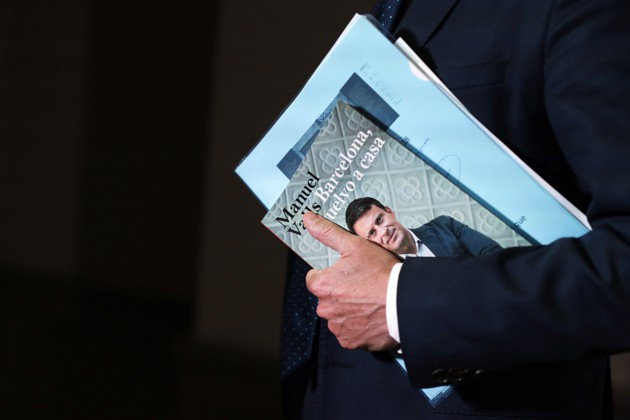
Valls campaigns in Barcelona in October with a copy of his recent book, Barcelona, I Return Home. (Pau Barrena / AFP / Getty)

Then came the decisive moment of Valls’s political life, the terrorist attacks of 2015. In January of that year, terrorists killed 12 people at the satirical magazine Charlie Hebdo and four more at a kosher supermarket; then in November, militants killed 130 others in coordinated attacks at the Bataclan concert hall, cafés, and the main Paris sports stadium. After the January assaults, Valls gave an impassioned speech in the National Assembly, in which he said that anti-Semitism had no place in France, that its “reawakening” was “the symptom of a crisis of democracy.” France was “at war against terrorism, jihadism and Islamic radicalism,” he said then, a message he reiterated later that year when he called the November 13 attacks “an act of war.” These statements won him admiration from much of France’s Jewish community, the largest in Europe, but further alienated him from its Muslim community, also the largest in Europe, as well as from the base of the Socialist Party.

That would mark the beginning of the end of Valls’s political career in France. He stepped down as prime minister at the end of 2016 to run in the Socialist presidential primaries, which he lost to the more left-leaning Benoît Hamon. That was just ahead of national elections that saw the implosion of the Socialists and the victory of Emmanuel Macron and his En Marche party. Valls quit the Socialists to join En Marche, narrowly winning a contested election to the National Assembly only for Macron to spurn his advances.

[Read: What the November 13 attacks taught Paris]

By then, Valls was one of the most disliked politicians in France. Socialist voters felt betrayed not only by his joining En Marche, but also by the policies he had championed while in power: market-friendly labor reforms that didn’t go over well with the party’s left-wing base, and his stance in what could loosely be called identity debates, such as his efforts to strip French jihadists of their citizenship, a proposal the Socialists ultimately withdrew for lack of support. Valls was essentially seen as a neo-conservative.

The season of terrorism also affected him not just politically, but personally. “It completely upended my life, which also explains my desire for change—for personal change in my private life,” he said. Last year, Valls and his wife, Anne Gravoin, separated, and he moved to Barcelona for a fresh start.

In 2017, as Valls’s political career in France was ending, Catalonia held a referendum on independence and decided to leave Spain, but Spanish authorities deemed the vote illegal. In proceedings that are live-streamed eight hours a day on Catalan television and radio, the referendum’s organizers are now standing trial on charges including disobedience, rebellion, and misuse of public funds.

At the height of the independence push, when Valls was still an elected official in France, he made impassioned speeches in favor of Spanish unity, saying that “unmaking Spain is unmaking Europe,” and in this moment, the germ of his candidacy first sprouted. Valls has repeatedly said, including to me, that he’s a republican in France, which replaced its monarch in the French Revolution, and a royalist in Spain, where he sees the royal family as defenders of Spanish democracy. Opposition to the Catalan independence movement is a pillar of his mayoral campaign. One of Valls’s opponents in the race is an independista running his campaign from jail, adding an element of romantic martyrdom to the political drama.

Protesters hold the Catalan flag outside La Sagrada Familia in October 2017. (Dan Kitwood / Getty)

I asked Valls if he saw himself as Catalan, Spanish, or French. “We all have multiple identities,” he told me. “I feel and have always felt very French.” Here he began to expound on the American and French Revolutions, after which patriotism and the nation became “positive ideas, progressive ideas.” Then, he went on.

“I feel Barcelonian because I think one always identifies with a city. I feel Catalan because Barcelona is Catalonia—it’s a language, it’s a culture, it’s a way of being Spanish.” But he didn’t exactly say he felt Spanish. “I have dual nationality. I have always loved Spain a lot. My father was very Catalan, very Catalanist, and raised us with a love of Spain.”

The Barcelona mayoral race might be the only political contest in Catalonia, though, that doesn’t actually revolve around the independence movement. It will likely be decided on municipal issues—how to regulate Airbnb and digital nomads who are flocking to Barcelona and driving up the price of rent in a city with a dearth of public housing, where the average annual salary is just under 30,000 euros, or $33,600. Locals complain of the blight of narcopisos, squats where people go to buy and consume drugs, an issue that has cropped up in recent years in apartments left vacant after corporations bought buildings and evicted tenants but not yet converted into more expensive rentals.

Valls is one of at least half a dozen candidates vying to depose the incumbent, Ada Colau, a popular mayor with a background in tenants’-rights activism who has been weakened by the city’s difficulties contending with quality-of-life issues, including the cost of rent and the narcopisos.

After Valls’s visit to La Sagrada Família the day I met him, he blasted Colau for her “tourismphobia.” He said vast numbers of people in Barcelona make a living on visitors, and criticized her for calling cruise-ship tourism a plague. When he took questions from the press, one journalist asked what Valls plans to do for the people who live in apartment buildings next to La Sagrada Familia that are slated for demolition to build a larger entrance to the basilica.

We were far from the ideals of Europe, but very much in the thick of issues facing every major European tourist city.

Here in Barcelona, Valls is seen as a curiosity, an ambitious former French Socialist—known in France for his staunch defense of laïcité, France’s sacred belief that religion should be excluded from public life, and a ban on “burkinis”—running on a law-and-order platform in a laid-back, progressive city.

Barcelonians don’t seem to resent Valls for being an opportunist or a carpetbagger. The city has a pretty open heart for welcoming newcomers from all over the world, to say nothing of Catalans such as Valls. But it isn’t so keen on the fact that he lived here for only a matter of months before announcing his intention to run in September. That he keeps making gaffes doesn’t help. Valls got some flak after a television interview in which he admitted that he didn’t know how much a metro ticket cost here.

His style hasn’t gone over well, either. “He campaigned with a bit of arrogance, since he had been a prime minister, and people don’t like that,” Lola García, the deputy editor of La Vanguardia, a conservative Barcelona daily newspaper, told me. “He’s very well educated, much more than local politicians, but at the same time, he doesn’t connect with people.” And Barcelona’s business community doesn’t seem terribly enthusiastic. Why? “Because he’s not from here, and he’s not going to win,” Marta Angerri, the head of Cercle d’Economia, a think tank and business association, told me.

The latest polls place him in the middle of the pack, and whoever wins will likely need to form a coalition, though campaigning won’t formally begin until 15 days before the May 26 election.

At the outset, Valls might have been a candidate with broad, cross-party appeal to voters opposed to the independence movement who still have a strong Catalan identity. But just before he formally announced, Valls was endorsed by Ciudadanos, a liberal, anti-Catalan-independence party that since their endorsement of Valls has drifted rightward. Its association with Valls has put off what might have been natural allies, such as the Catalan Socialist Party and the center-right People’s Party. And that was even before Ciudadanos made a power-sharing deal in Andalusia with not just the People’s Party, but also Vox, a far-right party, after regional elections there in December ended nearly 40 years of Socialist Party rule.

“He wanted to be the candidate of more people,” Antoni Fernández Teixidó, the head of Lliures, a tiny, new center-right business-friendly party that’s supporting Valls, told me of Valls’s candidacy. But that hasn’t happened. “The shadow of Ciudadanos is huge,” he added.

[Read: Spain’s fresh memories of dictatorship]

Then, in mid-February, the Socialist government of Prime Minister Pedro Sánchez collapsed—in part over the “Catalan question”—and new national elections will be held on April 28, a month before the Barcelona mayoral election. What happens if after those polls, Ciudadanos decides to ally with Vox in the national Parliament? Valls has been vehement in his critique of Vox, and told me that Ciudadanos would be misguided in making any alliances with the party. But he nevertheless attended a nationalist rally in Madrid in February at which Vox was also present. Valls later told me via a spokesman that he went to the rally “to defend the unity of Spain.” It would, he continued, “be absurd to relinquish patriotism and the colors of the flag to national populism.” He added that he was “a staunch supporter of patriotism, which is the love of ones own, against nationalism, which is the hatred of others.” He said the far-right considered him an enemy in both France and in Spain, and insisted he would “fight the far right with all my strength.”

Valls seemed aware that he’s in a bind. “Ciudadanos is supporting me; I’m not supporting them,” he told me, insisting that Ciudadanos is a “liberal, progressive, and European party.” That’s true. And yet at the same time, under its ambitious leader, Albert Rivera, it’s been more than flirting with Vox. The morning I met Valls, El País published a story about how Vox has put forward a candidate for a provincial election who has written a book denying the Holocaust. When I mentioned this to Valls, he hadn’t known and seemed taken aback.

It would be a great irony if a man known in France for his stance against anti-Semitism winds up two degrees of separation from a Holocaust denier in Spain. The more I spoke with him, the more I began to think that Valls is a man with two countries, three languages, and no political home.

Beyond the civic issues that will decide the mayoral race, Valls and his candidacy are a provocation, the start of a number of conversations about identity—personal, political, cultural, linguistic, European, national, regional, urban—and about the evolution, which is to say the decline, of the center-left Socialist tradition in which Valls came of age.

That political space has been occupied in France by Macron and his party. Valls told me that he might have wanted to break away from the Socialists, but that he didn’t have the nerve to do so in a season of terrorist attacks. Macron had better timing. And the center-left has been overtaken in Spain by new forces on both the right and the left. Spain is one of many populist political laboratories in Europe today. What sets it apart from some of the others—Italy, France, Poland—is the role of the housing market in an economic collapse that has redrawn the country’s political map, as well as the fact that the Catalan independence movement is seen as a kind of progressive force: utopian and perhaps naive, but a left-wing populism, unlike, say, the right-wing nativism of Italy’s League party or Poland’s governing Law and Justice Party.

By running in Barcelona, Valls wants to embody what being a European means, but he might instead represent the crisis of the European center-left. In Valls’s view, the left has been more comfortable in the opposition than in power, and has fractured across Europe over how to handle terrorism and the rise of Islamic radicalism. In France as in Britain, anti-Semitism has become a key issue dividing the left. Valls knows that his stance on the issue, and his comments following the 2015 attacks, were part of his undoing in the Socialist Party. Meanwhile, his electorate in Évry, outside Paris, feels like he’s abandoned it to move to greener pastures in Barcelona.

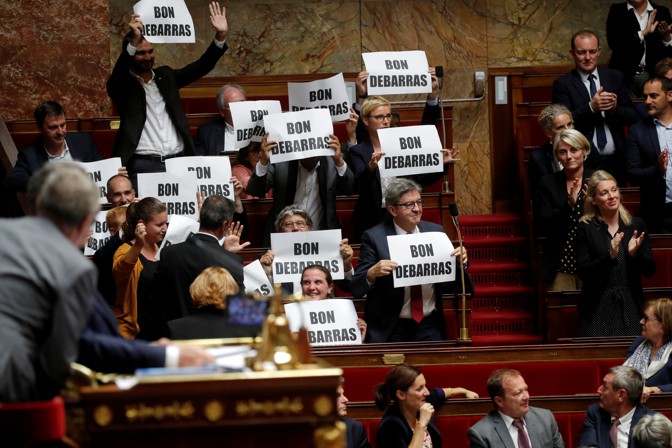
Members of France’s National Assembly hold signs that say “Good riddance” the day Valls gave his farewell speech, after already announcing his run for mayor of Barcelona. (Philippe Wojazer / Reuters)

Not long after meeting Valls, I went for a drink with Maruja Torres, a chronicler of Spain’s transition to democracy and one of the first women of her generation to become a war correspondent. At 76, she’s now a novelist and sometime columnist. “Ah, Valls, he is interesting,” Torres said over a vermouth. She is an unsparing student of power. Her curly hair was magenta and she had a fierce glint in her eyes when she smiled. “The Shakespearean question is interesting. Is he aware of his own failures?”

I told Torres that I think Valls is, or that he is at least aware that he’s missed the moment—in France, where Macron captured it, and in Barcelona, where he’s one voice in a crowded and confusing field—but that he is a born politician who doesn’t know how to be anything else, that he will keep fighting because he is hardwired to do so, whether or not he succeeds. Besides, the political crosscurrents shift quickly in Spain and in Europe these days, and he might well find a new tailwind, if not here, then maybe in Madrid or Brussels, depending on what happens in the Spanish national elections and the European parliamentary polls, which are the same day as the Barcelona mayoral election.

When I asked Valls what he hopes his political legacy will be, he said his was “a European fight.”

“It’s not my fate that’s at stake,” Valls said. “I’ve already done a lot, and if I don’t win, I don’t win.” He said he plans to stay in Barcelona no matter what happens in the race, for personal reasons. His new paramour is Susana Gallardo, who comes from a pharmaceutical fortune and whose ex-husband reportedly sold Pronovias, a wedding-dress company, for 550 million euros in 2017. Valls and Gallardo have become regulars in Spanish tabloids, and even in Paris Match, which Valls sued last summer after it published photos of the couple relaxing on a Spanish beach.

Then, for a second, he seemed to catch himself sounding a bit defeatist. “I’d like to win because it’s more personal, because it would be a way of showing what Europe is,” he said. “That’s something that’s never been done before.” Never before, and probably not yet.

Wednesday, 3 April 2019

The British Lawmakers Stuck in Limbo—And Brussels

With her time representing the United Kingdom in the European Parliament coming to a close, Jean Lambert was packing up her Brussels office.

Piles of books, folders, and boxes stacked around the room served as a testament to the nearly two decades she spent serving Londoners as one of their three Green Party representatives in Brussels and Strasbourg, France, where the European Parliament sits. With Britain leaving the European Union, British representation in EU institutions would no longer be required, and Lambert, along with 72 of her British colleagues, would soon be out of a job.

But Britain hasn’t left the EU yet. And with the job of Brexit not yet done, neither, consequently, is theirs. It is, in a word, awkward.

The future of British members of the European Parliament represents just one of the many unknowns that surround Brexit. With days to go before Britain faces another cliff-edge exit date—originally set for March 29, but now delayed until April 12—there is still no indication of how, when, or even if the country will leave the bloc. And as British lawmakers in Westminster continue to spar over what kind of departure the government should seek, British MEPs, like the rest of the country, are left to watch on the sidelines, unsure whether the next EU summit will be their last, or—should Britain seek a longer extension to its departure—they will end up fighting to keep their seats in European elections due in May.

[Read: In a bid to ‘take back control,’ Britain lost it]

When I spoke with Lambert at the end of March, Britain was already clearly heading for a short extension to its original exit date from the EU, with the potential for an even longer one. Still, as far as Lambert and her colleagues were concerned, their last day was imminent. Boxes were packed. Offices and apartments were cleared. Some parliamentary staff had already been made redundant.

“We’re assuming that we’re leaving,” Lambert told me by phone from Brussels. “But we’re also having to think about … if we don’t.” She described this state of limbo as “difficult” and “high stress.”

“We’ve got ongoing work, because of course the Parliament doesn’t stop just because the British are in total chaos.”

There is still the very real possibility that Britain, nearly three years after voting to leave the EU, would be compelled to take part in next month’s European Parliament elections. Whether the country ultimately does will depend on whether the British government asks the EU for a longer delay to its withdrawal date—until the end of June or later—so that it can find a new consensus for Prime Minister Theresa May’s Brexit deal, hold a general election, or even organize another referendum. On Tuesday, May announced that she would seek a further extension beyond April 12 to give Parliament more time to reach a consensus, and even offered to hold cross-party talks with opposition Labour Party leader Jeremy Corbyn to overcome the impasse. Though the prime minister said she wants the extension to be “as short as possible” so that the U.K. can avoid the EU elections, the length of the delay will ultimately be decided by EU leaders.

Such an extension isn’t even guaranteed (all 27 remaining EU member states would have to agree to it). But one thing is certain: For legal and political reasons, Brussels will not allow the U.K. to stay in the bloc beyond April 12 without ensuring that Britain takes part in the elections, both so that Britons are represented at the parliamentary level, and to allow European Union nationals to participate.

Regardless of whether that happens, Lambert said she won’t try for reelection. But that doesn’t mean her party isn’t preparing a list of candidates to replace her if the time comes. “We’re still running through the process,” she said of the Greens, which campaigned to remain in the EU during the 2016 referendum. “If the election is there, we are very happy to stand.”

They aren’t alone. Margot Parker, a U.K. Independence Party member of the European Parliament, told me that her euroskeptic party is also making preparations for a last-minute contest, albeit begrudgingly. “I went [to the European Parliament] to be a voice of those people who are euroskeptic,” said Parker, whose East Midlands region voted overwhelmingly to leave the EU during the 2016 referendum. “I would put my name down because if we have to go back [then] the job isn’t done, and I have to represent the people who actually really want somebody who will represent them.”

[Read: It’s a very awkward time to be a British lawmaker in Europe]

While some lawmakers are reluctantly accepting the possibility of EU elections, others have been actively gearing up for them. The Independent Group, composed of breakaway Conservative and Labour members of British Parliament who quit their former parties in part over their handling of Brexit, has applied to register as an official political party to field candidates in the European Parliament elections, should Britain take part. Chuka Umunna, the group’s spokesperson, said that if the bid is accepted, their candidates would stand under the new name Change UK—The Independent Group.

MEPs are nevertheless in a state of uncertainty, with one foot already out the door, and the other firmly stuck in the doorway. “A lot of us are fed up—like much of the country—that we still don’t have some clarity about what is actually happening and what is going to happen,” Emma McClarkin, a Conservative MEP representing the East Midlands, told me by phone from Strasbourg. “I’d hoped that in the days and weeks, if not months, before Brexit we would have been planning for the future, saying proper goodbyes, building those relationships, so that when we leave, it doesn’t all have to feel rushed and hurried at the end,” she said.

“It just feels a little bit like a hurried departure,” she added, “instead of it being an elegant exit.”

Free Prison Calls Could Finally Be Coming to Connecticut

Connecticut may soon be the first state in the nation to make calls from prison free for incarcerated people and their families, following on the heels of New York City, which became the first city to do so last year. Decades of research have shown that keeping in touch with loved ones while incarcerated greatly improves an individual’s chance for successful re-entry when they are released and that the financial toll of maintaining contact disproportionately falls on low-income family members.

A hearing for the bill — H.B. No. 6714 — was held in Hartford in late March, and advocates are cautiously optimistic it will be voted out of the state’s House Judiciary Committee next week. The bill was introduced by Rep. Josh Elliott, a progressive elected in 2016 to represent Connecticut’s 88th District, and drafted by Worth Rises, a national nonprofit focused on ending the influence of commercial interests in the criminal justice system.

According to a recent report by Prison Policy Initiative, Connecticut charges more for in-prison phone calls than any other state in the nation aside from Arkansas. A 15-minute call from a Connecticut prison costs $3.65, nearly five times the cost of calls from prisons in neighboring states like Rhode Island and New York (71 cents and 65 cents, respectively). Advocates say the high rates are due to Connecticut poorly negotiating its telecommunications contract with Securus Technologies, the national prison telecommunications corporation it has contracted with since 2012.

In addition to making phone calls free, the bill includes language stipulating that if Connecticut implements video conferencing for prisoners in the future — which it doesn’t currently offer, but other states have slowly begun to — then those communications should be free of charge too. The bill also maintains that Connecticut shall not limit in-person visitation if it makes phone calls and video conferences free. (The Prison Policy Initiative estimates that 74 percent of U.S. correctional facilities have reduced or eliminated in-person visitation since implementing video conferencing.)

A Securus spokesperson noted that their company offers not only a way for families to keep in touch but also “critical security features that prevent victim harassment, violent crime and other criminal activity.” With respect to the jurisdictions considering paying directly using taxpayer funds, the Securus spokesperson said, “we welcome discussions regarding financing models with all the agencies we serve, in order to determine the most effective way to pay for technology that keeps people both connected and safe.”

Karen Martucci, the director of external affairs for the Connecticut Department of Correction, said her agency “is supportive of efforts that increase communication between offenders and their loved ones, which will hopefully help to reduce the rate of recidivism.”

State data shows that Connecticut residents pay roughly $15 million annually for prison phone calls, with the state taking 68 percent as a kickback. A spokesperson for the state’s judicial branch testified at the hearing that losing prison phone call commission fees would result in cutting several important adult probation officer positions, illustrating how the state relies on revenue extracted from incarcerated people and their families.

One Republican legislator, Rep. Craig Fishbein from Wallingford, raised objections at the hearing and suggested that the bill would be too expensive and would seemingly allow for unlimited calls every day. He suggested making calls free on holidays like Christmas and Thanksgiving, instead.

Bianca Tylek, the executive director of Worth Rises, dismissed Fishbein’s proposal and told The Intercept that his comments reveal a fundamental misunderstanding of what advocates aim to achieve with the legislation.

“This bill was not introduced so people can talk on Christmas. It’s so family ties can be fostered, which we know leads to so many improved outcomes for children with incarcerated parents, for people on the inside to lower recidivism, and improving re-entry outcomes on the outside,” she said. “None of that is resolved with a few free days throughout the year.”

The exorbitant cost of prison phone calls exacts a heavy psychic price as well. Some prisoners are able to use their meager prison wages to cover the costs, which leaves them with no savings when they finish their sentence. Many, though, must rely on family members to pick up the tab. Every minute they’re on the phone, they’re aware of the literal cost their incarceration is putting on their loved ones, straining the types of relationships that are key to re-entry.

If the state of Connecticut assumed the costs of prison phone calls, Tylek said, it should revise its contract with Securus or another company to be a flat, fixed rate.

“It would be absolutely inappropriate and imprudent for the state to continue to pay for a contract that assumes the liability of costs on a per-minute basis,” she said. “Think about your state legislature. All elected officials have telephones in their offices, and some provider, maybe it’s Verizon or AT&T — that provider isn’t saying to the state legislator you’ll pay on a per-minute basis. In no place in the country are we doing that except in prisons.”

Tylek also dismissed the idea that this would mean people would have unfettered access to phones, noting prisons still need to establish systems so that the phones can be shared equitably. Tylek suggested that a solution may be limiting phone use to 90 minutes per day (or up to six 15-minute phone calls). “We’ve done surveys across the country and found that, on average, 90-120 minutes is what people are looking for, so we might actually look to codify something like that in the bill,” she said.

New York City passed a law in August 2018 to eliminate the charge for prison phone calls, making it the first city to do so; the change is set to go into effect in May. New York City will assume the costs of paying Securus for the phone services and will forego the $5 million it had annually collected in commission fees.

Aside from Connecticut and New York City, other states and cities are now also considering eliminating phone costs on prisoners and their families, including Massachusetts and San Francisco. In November, Shelby County, Tennessee, announced it would no longer charge juvenile detainees and their families for making phone calls; shortly thereafter, in North Carolina, the Mecklenburg County Sheriff’s Office also agreed to stop charging juveniles in custody at county jails for using phones.

The new legislative traction comes after years of activists raising alarm about the high costs of prison phone calls. In 2000, Martha Wright, a grandmother in Washington, D.C., filed a lawsuit against the private prison where her grandson was living, saying that the costs of calling him were unconscionably steep. The court ruled that Wright’s complaint was an issue for the Federal Communications Commission to handle; she then moved to petition them to intervene. In 2013, the agency finally acted, voting to cap rates for interstate phone calls in jails and prisons. Two years later, the FCC also capped the amount an incarcerated person could be charged for calling someone within their state.

The major prison telecommunication providers — including Securus Technologies, Global Tel Link, and CenturyLink — all challenged the FCC’s authority to regulate the rates, and in 2017, the U.S Court of Appeals for the D.C. Circuit ruled against the FCC. As The Intercept reported at the time, the court decision came amid political turnover at the federal agency, with the individual who voted against the FCC’s 2013 proposal, Ajit Pai, having been recently named commission chair by President Donald Trump. Pai praised the D.C Circuit for agreeing with him that the FCC overstepped its authority.

Last month, the National Consumer Law Center issued a new report detailing consumer abuses wrought by private companies that extract profits from the criminal legal system and highlighted the kickbacks that cash-strapped governments accept in exchange for things like offering exclusive contracts.

Report author Brian Highsmith, who testified in favor of Connecticut’s bill to make prison phone calls free, told The Intercept that it’s important for the public to understand that this is not just a criminal justice issue, but a fiscal policy and consumer protection issue too.

“Candidly, that changes the advocacy strategy,” he said. “One of the reasons we have arrived at this moment, in having created a system of mass incarceration and social control, is because it’s very easy for people to imagine that this stuff doesn’t affect you, and so many of these abusive practices have escaped widespread public awareness.”

While Highsmith thinks there can be a role for the federal government to play, he emphasized that many of these exploitative policies are set at the state and local level, and so will have to be tackled with laws like the ones proposed in Connecticut.

“This all really gets at the intersection of two of the worst trends,” he said. “One is offloading tasks to the private sector, which comes with reduced accountability and transparency, and the other is cost-shifting,” where governments rely on bails, fines, and fees imposed on people who interact with the criminal legal system to cover the costs of policing.

The post Free Prison Calls Could Finally Be Coming to Connecticut appeared first on The Intercept.

Tuesday, 2 April 2019

The Rare Businesses That Can’t Wait for Brexit

With days to go before Britain is due to leave the European Union, the terms of its exit are still unclear. Uncertainty and distrust abound. Without a negotiated withdrawal deal or an alternative plan, the country will suffer an abrupt and chaotic departure.

Unlike the vast majority of British business leaders, though, Lance Forman isn’t worried. In fact, he isn’t really worried about Brexit at all. The fourth-generation owner of Britain’s oldest salmon curer told me that his family’s company has survived fires, floods, and displacement. “What we learned from each of those catastrophes is that change provides great opportunity for renewal,” Forman said.

Brexit, he predicts, will do the same.

Not many people agree with him. Across the country, businesses have sounded the alarm over the fallout that a no-deal Brexit could cause, with Britain suddenly separate from the EU and subject to different rules, tariffs, and regulations. The Bank of England and the Confederation of British Industry, Britain’s biggest business lobby group, have voiced concerns about everything from supply-chain disruptions to job losses to weaker economic growth, worries that have been echoed by British lawmakers, who voted last month to reject a no-deal outcome in principle. And though Britain is no longer leaving the EU on March 29 as anticipated, the chance of the country crashing out of the bloc without a deal on April 12 remains, in the words of the European Commission, “a likely scenario.”

Still, some, such as Forman, support Britain’s withdrawal, regardless of how it happens. Their reasons for doing so tend to depend on their business: While some want to achieve regulatory autonomy from the bloc, others are hoping that a more “global Britain” could expand their trading prospects to markets beyond Europe. Yet this future is by no means decided. Not everyone who voted in favor of leaving the EU did so because they oppose regulation—in fact, some Leave voters want Britain to seek tougher regulations than those that already exist. Many simply want Britain to be able to decide its own rules for itself.

The company heads I spoke with who fall into the category of those excited for Brexit don’t deny that their views aren’t representative of most other business leaders. Still, they remain undeterred: The way they see it, Brexit will reap both winners and losers.

[Read: Running a London restaurant empire in the age of Brexit]

As far as Forman is concerned, his company stands to be one of the winners. The H. Forman & Son smokehouse sits on Fish Island, an East London neighborhood on the banks of the River Lea. The company’s salmon-pink-colored building stands out against the graffitied industrial landscape, itself a relic of the British capital’s manufacturing past. The area is a marked contrast to where the company’s products are sold—they can be found in, among other places, luxury U.K. department stores such as Selfridges and Harrods. Sitting in Forman’s office, which overlooks the factory floor where salmon is salted and smoked, he explained his optimism about Britain ending its 45-year membership in the EU. “Brexit is really, in terms of business, a one-off change in the rules,” he said. “The rules have been changing anyway all the time.”

Yasmeen Serhan / The Atlantic

Since taking over the family business from his father, Marcel, 25 years ago, Forman said that some of his company’s greatest challenges have come from keeping up with the bloc’s regulations, from the straightforward (such as insulating the factory to adhere with the bloc’s refrigeration standards) to the seemingly redundant (ordering new labels to specify that each packet of smoked salmon “contains fish”).

For big manufacturers, keeping up with these regulations might not be a major financial burden. But for small-scale producers such as H. Forman & Son, which employs approximately 80 people, the costs can add up. “Over the years, there have been so many changes in EU regulations on food, and it has cost us an absolute fortune,” Forman said.

These regulations aren’t limited to the smoked-salmon industry. Significant aspects of British law—from food safety and medicine to environmental protections and workers’ rights—are influenced by EU-wide standards. And though EU member states, including the United Kingdom, play an active role in setting these rules, the financial implications for businesses have underpinned frustrations with the bloc as a whole. In the run-up to the 2016 Brexit referendum, proponents of withdrawal argued that leaving the EU could save Britain upwards of £33 billion, or $43 billion, annually in EU regulatory spending. (As the think tank Open Europe points out, however, these regulations are estimated to provide the country a total benefit of £58.6 billion annually.)

These rules don’t apply solely to EU members—any company that wants to sell its products within the bloc’s common market must abide by them, too. A U.S.-based smoked-salmon company, for example, would need to follow the same product and safety standards as Forman’s to sell its goods in EU markets.

[Read: In a bid to “take back control,” Britain lost it]

For some of the business leaders opposed to EU regulatory standards, though, the issue isn’t just whom these rules apply to, but how they’re applied. Simon Boyd, the managing director of the Dorset-based steel manufacturer REIDsteel, argues that such rules disproportionately affect small-to-medium-size enterprises such as his.

“The same regulatory burden has to be suffered by a small business as it does by a company with 10,000 employees,” he told me by phone from his company’s headquarters in southwest England. REIDsteel, by comparison, employs just 130 people. Boyd noted that its size isn’t reflective of its reach: The company exports to 140 countries, including some in the EU. “We have to compete in a world market against America, China, Australia,” Boyd said. “These companies do not have to comply with the EU regulatory burden that we have … So Brexit, for us, is a hurrah moment. It’s where we can free ourselves from these chains and this burden that’s held our business back.”

The reality isn’t so simple. Britain is unlikely to roll back existing regulations once it leaves the EU, and it won’t necessarily deviate from the bloc’s future regulatory changes. “We’re almost certainly going to stay aligned with the EU so that we can continue exporting to them, because they are our largest export market,” Jonathan Portes, a professor of economics and public policy at King’s College London and a senior fellow at U.K. in a Changing Europe, told me.

For many sectors, including food, the British government has already confirmed as much. In a statement in February, Prime Minister Theresa May said that leaving the EU would not result in Britain lowering its standards for things such as workers’ rights, environmental protections, or health and safety. “Taking back control,” May told the House of Commons in February, “cannot mean giving up control of these standards.”

Julian Morgan, the managing director of KPM Marine, a marine-products manufacturer in Birmingham, told me that his reasons for supporting Brexit have nothing to do with regulation. “We work to a global standard, which is set by the International Maritime Organization,” he said. “European standards make no difference to us.”

And neither does access to European markets. Though KPM Marine is a local manufacturer, its products are exported to 38 countries globally—the majority of which Morgan said aren’t in the EU. For him, Brexit presents an opportunity for Britain to trade more with the rest of the world, just as his company already does. When I asked him about concerns surrounding a no-deal Brexit such as a fall in the value of the pound or congestion at British ports, he dismissed them. “If I send a consignment to Holland and the same consignment to Singapore, the only thing that changes on the paperwork is the address,” he said.

[Read: Brexit could cripple Britain’s ports]

Here, too, the reality is more complicated. If Britain leaves the EU without an agreement or a trade deal, it will automatically revert to trading on World Trade Organization terms, meaning that British goods bound for the EU would be subject to tariffs and customs checks. (Smoked salmon, for example, would face a 13 percent tariff.) Though Brexit advocates argue that a no-deal departure wouldn’t necessarily be the end of the world for Britain—and could even be “managed” with the right preparation—most analysts dispute this claim, noting that simply reverting to WTO rules (a situation rife with its own issues) wouldn’t mitigate other problems that a no-deal departure would pose, such as the grounding of planes.

“In theory, if we crashed out without anything at all, there simply wouldn’t be any flights between the U.K. and the EU,” Portes said. “Now both sides have said there will be temporary measures in place to ensure that it doesn’t happen, but that doesn’t mean the WTO provides the long-term solution for our relationship with the EU on aviation. It just doesn’t.”

When I asked Portes about the winners and losers of a no-deal Brexit, he conceded that some businesses would in fact be better off than others. But that doesn’t necessarily mean the country would be better off as a whole.

“The businesses that are best able to adapt will do the best—that’s true,” Portes said. “But if Brexit leads to greater restrictions on trade, immigration, and investment—and all the evidence suggests it will—then that will make us somewhat less prosperous overall. That doesn’t mean that every business will go bust and some business will do just fine, of course. But that doesn’t change the basic economics.”

Monday, 1 April 2019

Aqui estão os números que o governo escondeu e que mostram que não há epidemia de drogas no Brasil

“Eu não sei onde a Fiocruz faz suas pesquisas, mas eles insistem em dizer que não há uma epidemia de drogas no Brasil”, discursou o então ministro do Desenvolvimento Social e Agrário, Osmar Terra, durante audiência pública na Câmara dos Deputados. Era novembro de 2017, e o ministro, hoje titular da pasta da Cidadania, já havia declarado guerra à maior pesquisa sobre consumo de drogas da história do Brasil.

Concluído no final de 2016, o 3º Levantamento Nacional Domiciliar sobre o Uso de Drogas nunca foi divulgado pela Secretaria Nacional de Política de Drogas, a Senad, órgão do Ministério da Justiça responsável por encomendar a pesquisa. A hipótese mais provável, reforçada pela declaração de Osmar Terra, é que o governo federal censurou os números porque eles revelavam o oposto do que a gestão de Michel Temer queria mostrar – e que o governo Bolsonaro continua a sustentar.

O Intercept e a Casa da Democracia tiveram acesso com exclusividade à íntegra do documento. Realizado pela Fundação Oswaldo Cruz, a Fiocruz, instituição ligada ao Ministério da Saúde, o levantamento aponta, por exemplo, que 0,9% da população usou crack alguma vez na vida, 0,3% fez uso no último ano e apenas 0,1% nos últimos 30 dias. No mesmo período, maconha, a droga ilícita mais consumida, foi usada por 1,5%, e a cocaína, por 0,3% dos brasileiros. Pesquisadores ouvidos pela reportagem são unânimes em dizer que, embora preocupantes, os índices estão longe de representar o que o governo, sobretudo na figura de Osmar Terra, insiste em chamar de “epidemia”.

Para o levantamento, a Fiocruz usou a mesma metodologia da Pesquisa Nacional de Amostra Domiciliar, a Pnad, do IBGE, para ouvir 16.273 pessoas em 351 cidades. A amostra é o dobro do penúltimo levantamento nacional, realizado pelo Centro Brasileiro de Informações Sobre Drogas Psicotrópicas em 2005. O novo levantamento mostrou, pela primeira vez, os padrões de consumo dos municípios rurais e da faixa de fronteira do país. E investigou o uso de drogas lícitas – tabaco e cigarro – e ilícitas em dez tipos ou categorias: maconha, haxixe ou skank, cocaína em pó, crack e similares, solventes, ecstasy/MDMA, ayahuasca, LSD, ketamina e heroína, além de estimulantes e anabolizantes.

29-03-19-drogas-grafico-ilicitas-2-1553897347

Gráfico: João Brizzi/The Intercept Brasil

Contratada por meio de um edital de 2015, durante o governo Dilma Rousseff, e concluída no final de 2016, já na gestão Michel Temer, a pesquisa custou cerca de R$ 7 milhões aos cofres públicos. Desde então, seu conteúdo jamais foi revelado – nem mesmo em pedidos feitos via Lei de Acesso à Informação.

“A gente acredita que o embargo tem a ver com o fato de que a pesquisa não confirma a epidemia de crack propalada como bandeira política por certos setores conservadores da política, cujo expoente principal é Osmar Terra”, diz Cristiano Maronna, presidente da Plataforma Nacional de Política de Drogas, rede que articula organizações e pesquisadores da área. Maronna tentou duas vezes acessar o documento via Lei de Acesso à Informação, mas teve os pedidos negados. O deputado federal petista Paulo Teixeira também tentou acessar os dados no ano passado, sem sucesso.

Oficialmente, o governo diz que decidiu embargar o estudo por conta de sua metodologia. Questionado pela reportagem, o Ministério da Justiça e da Segurança Pública diz que a pesquisa “não atendeu aos requisitos do edital” porque não permite “a comparação dos resultados com o primeiro e o segundo levantamentos”. Por isso, a Senad não “detém propriedade intelectual sobre os dados, não os utiliza e não os divulga”, diz o governo, em um e-mail enviado pela assessoria de imprensa.

O governo vem pressionando a Fiocruz a engavetar o estudo e chegou a acionar o Ministério Público Federal, alegando que a fundação não cumpriu os requisitos do edital. Há a expectativa, de acordo com uma fonte que conhece o processo e que pediu para não ser identificada por medo de represálias, que a Senad tente anular o edital, alegando o seu não cumprimento, e peça o reembolso dos R$ 7 milhões. A Fiocruz informou apenas, por e-mail, que o edital tem uma “cláusula que condiciona a utilização do material produzido à anuência da Senad” e que o termo de cooperação se encerrou em 2018. “Neste momento, a Fundação aguarda a anuência da Senad”, disse sua assessoria, por e-mail.

LUND-Arte-3-1553891409

Joga pedra na pesquisa

O levantamento foi encomendado para ajudar o governo a criar políticas brasileiras em relação ao tema. A Fiocruz contratou quase 300 pesquisadores e técnicos, liderados pelo epidemiologista Francisco Inácio Bastos, pós-doutor em saúde pública e autor de mais de 290 artigos. Os resultados foram compilados em um relatório de 520 páginas – inédito até a publicação desta reportagem.

Consultei quatro especialistas em política de drogas para entender os achados do estudo. Chama a atenção, por exemplo, a porcentagem de uso de drogas, muito menor do que alardeia o governo. Usando como exemplo o caso de um hospital no Rio Grande do Sul, Osmar Terra disse que, em 2002, 80% das internações de urgência eram devidas ao uso de álcool; já em 2007, 80% eram causadas pelo crack. “Houve uma subida muito rápida da questão do crack”, ele sentenciou. Mas não é o que diz a pesquisa.“O estudo epidemiológico da Fiocruz é robusto e não mostra epidemia”, diz Luiz Fernando Tófoli, professor da Unicamp que há 20 anos trabalha com saúde mental e uso de drogas.

Mais do que o crack, o problema que salta aos olhos é o uso de álcool. Segundo a pesquisa, 66,4% já fizeram uso de álcool na vida, 43,1% no último ano e 30,1% nos últimos 30 dias – número que vem caindo. Há outros dados preocupantes, como a facilidade para encontrar bebidas alcoólicas e a baixa percepção dos seus riscos. Ao relacionar os tipos de violência consequentes do abuso do álcool, o estudo lista ocorrências variadas, como tentativa de estrangulamento e ameaça com arma de fogo. “Nossa política deveria ser estruturada a partir disso”, diz Maronna.

29-03-19-drogas-grafico-ilicitas-1-1553897344

Gráfico: João Brizzi/The Intercept Brasil

O governo afirma que não é possível comparar a pesquisa com a anterior, de 2005, que abrangeu as 108 maiores cidades do país. A atual pesquisa se estendeu a 351 municípios, mas manteve o recorte das 108 em várias tabelas comparativas ao longo do relatório. Neste estrato, é possível identificar, por exemplo, queda no consumo recente de tabaco — de 18,4%, em 2005, para 14,2%, em 2015 — e de álcool — de 38,3% para 33%.

Também é possível comparar os achados com outras duas pesquisas nacionais independentes, a Lenad 1 e 2, feitas pelo Instituto Nacional de Ciência e Tecnologia para Políticas Públicas do Álcool e outras Drogas, e com a pesquisa nacional sobre crack, feita em 2014 pela Fiocruz. Os números são coerentes: a Lenad de 2012 mostra que 6,8% dos brasileiros consumiram maconha uma vez na vida; no levantamento atual, são 7,7%. Os que usaram crack uma vez na vida eram 1,3% e hoje são 0,9%.

“Não vejo nada surpreendente. Exceto no caso do álcool e do solvente, que tiveram queda, os outros são números esperados e revelam que o consumo, em geral, se manteve estável”, diz Maurício Fiore, do Centro Brasileiro de Análise e Planejamento, o Cebrap, outro pesquisador que analisou a pesquisa a pedido da reportagem. Maronna também não vê revelações “assustadoras”. Segundo ele, “quase 10% ter usado droga ilícita uma vez na vida é um número razoável. Comparado a outros países, não revelam uma situação excepcional ou alarmante”, diz.

Os pesquisadores argumentam que, embora os achados da pesquisa possam ser questionados – e é comum que a comunidade científica faça isso – nada justifica o engavetamento. A Senad poderia ter tornado as informações públicas, mas com ressalvas. “Fica a impressão de que há algum interesse por trás. Se houve erro, a melhor maneira de identificar é debater. É assim que se faz ciência: publica-se e submete-se ao escrutínio dos especialistas”, diz Tófoli.

LUND-Arte-2-1553891699

Uma justificativa para os R$ 153 milhões

Com a troca de governo em janeiro, o embargo da pesquisa, que se arrasta desde 2016, ganhou novos contornos. No dia 19 de março, Osmar Terra e a ministra Damares Alves anunciaram a assinatura de contratos com 216 novas comunidades terapêuticas para tratamento de dependentes químicos, ao custo de R$ 153,7 milhões por ano para 10.883 vagas.

“Elas são decisivas para enfrentar a epidemia das drogas que destrói a nossa juventude, que causa a violência que o país vive e que está se propagando em uma escala gigantesca”, disse Terra na cerimônia. Damares Alves completou: “neste ato, o estado laico reconhece a importância das comunidades religiosas. É o retrato de um novo Brasil”.

Em 2013, Osmar Terra já falava em ‘epidemia’.

O Brasil possui quase 2 mil comunidades terapêuticas, em sua maioria ligadas a igrejas evangélicas e católicas, segundo um estudo do Instituto de Pesquisa Econômica e Aplicada. Nelas, em geral, o tratamento se baseia em isolamento, trabalho braçal e atividades religiosas. Muitas já foram denunciadas por maus tratos, cárcere privado e outros crimes – caso da Centradeq-Credeq, em Minas Gerais, que o Intercept visitou no final do ano passado. “Essas instituições são a trincheira de resistência à reforma psiquiátrica, violando direitos e ignorando a redução de danos, que, em combinação com a abstinência, apresenta bons resultados”, diz Maronna.

Osmar Terra é contra qualquer política de redução de danos. Ele acredita que a melhor abordagem é a abstinência e a internação compulsória – foi autor, inclusive, de um projeto de lei para obrigar os dependentes a serem internados. Defensor do modelo de clínicas religiosas, o ministro vê nas comunidades uma tábua de salvação para resolver, de uma vez por todas, “a epidemia de drogas no país”.

Seu esforço tem resultados. Aos poucos, o modelo de comunidade terapêutica tem se tornado preferência no governo, em detrimento dos Centros de Atendimento Psicossocial, os Caps, do SUS. Até 2017, o país custeava cerca de 2 mil vagas em comunidades. No ano seguinte, com Terra no comando, o número subiu para 6,6 mil. Em 2019, chegam a 10,8 mil leitos, um aumento de quase 50% em um ano.

A pergunta do milhão, ou melhor, dos R$ 153 milhões, suscitada por especialistas em políticas de drogas, é: por que, afinal, tal política pública foi implementada sem levar em conta o que dizem os números da pesquisa da Fiocruz, capaz de balizar decisões sobre quando, quanto, onde e de que forma investir para tratar dependentes? Mais uma vez, a resposta talvez seja: porque os números não dizem o que o governo queria ouvir.

Este texto foi produzido em parceria com o Instituto Casa da Democracia, organização dedicada ao estudo, à elaboração intelectual e à produção cultural em defesa da democracia e de sua promoção.

The post Aqui estão os números que o governo escondeu e que mostram que não há epidemia de drogas no Brasil appeared first on The Intercept.